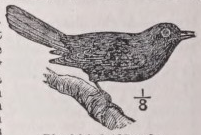
In England, a species of thrush (Turdus merula), a singing bird with a fin note; the merle. In America the name is given to several birds, as the Quiscalus versicolor, or crow blackbird; the Agelaeus phoeniceus, or red-winged blackbird; the cowbird; the rustygrackle, etc. See Redwing.
BLACKBIRD(fΓurdus menda), belongs to the Turdidoe or Thrushes, a family of Dentirostral Birds. The plumage of the male is of a uniform black colour, that of the female various shades of brown, while the bill of the male, especially during the breeding season, is of a bright gamboge yellow. The blackbird is of a shy and restless disposition, courting concealment, and rarely seen in flocks, or otherwise than singly or in pairs, and taking flight when startled with a sharp shrill cry. It builds its nest in March, or early in April, in thick bushes or in ivyclad trees, and usually rears two broods each season. The nest is a neat structure of coarse grass and moss, mixed with earth, and plastered internally with mud, and here the female lays from four to six eggs of a blue colour speckled with black. The blackbird feeds chiefly on fruits, worms, the larvae of insects, and snails, extracting the latter from their shells by dexterouslychipping them on stones; and though it is generally regarded as an enemy of the garden, it is probable that the amount of damage done by it to the fruit is amplycompensated for by its undoubted services as a vermin-killer. The notes of the blackbird are rich and full, but monotonous as compared with those of the song-thrush. Like many other singing birds it is, in the wild state, a mocking-bird, having been heard to imitate the song of the nightingale, the crowing of a cock, and even the cackling of a hen. In confinement it can be taught to whistle a variety of tunes, and even to imitate the human voice. It is found throughout Europe, Palestine, and the northern parts of Africa; and Darwin states that he observed it as far west as the Azores. Individuals reared in Britain, it is said, do not migrate; but annually great flocks arrive on the ...eastern shores of England from more northern countries, remaining for a few days only, and then proceeding southward.
9th ed. Encyclopædia Britannica, vol. 3, p. 799 [341 words — estimated reading time: 2 minutes]
No thesaurus entries found for "blackbird".
No Bible verses found for "blackbird".
This site uses cookies to remember your display preferences (search sources and editions, Bible version, auto-link, images, light/dark theme). No personal data whatsoever is collected. Privacy Policy