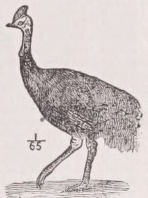
A large fowl of the genus Struthio, nearly as large as the ostrich, but its legs are thicker and stronger in proportion. The wings are so small as not to appear, being hid under the feathers. The head is armed with a helmet of horny substance, consisting of plates one over another. It runs with great rapidity, outstripping the swiftest racer. It is now arranged in a separate genus, Casuarius.
A large bird, of the genus Casuarius, found in the east Indies. It is smaller and stouter than the ostrich. Its head is armed with a kind of helmet of horny substance, consisting of plates overlapping each other, and it has a group of long sharp spines on each wing which are used as defensive organs. It is a shy bird, and runs with great rapidity. Other species inhabit New Guinea, Australia, etc.
CASSOWARY(Casuarius), a genus of Struthious Birds, only inferior in size to the ostrich, and, according to Professor Owen, approximating more closely than any other living birds to the extinct moas of New Zealand. Not many years ago only a single species of cassowary was known, but recent researches among the Australasian islands have led to the identification of at least other four species. They are all characterized by short rudimentary wings, consisting of four or five barbless shafts, a few inches long, and apparently useless for purposes of flight, of running, or of defence; and by loosely webbed feathers, short on the neck, but of great length on the rump and back, whence they descend over the body forming a thick hairlike covering. They possess stout limbs, with which they kick in front, and have the inner toe armed with a long powerful claw. The Galeated Cassowary {Casuarvus galeatus) stands 5 feet high, and has a horny, helmet-like protuberance on the crown of its head; the front of the neck is naked and provided with two brightly-coloured wattles; the tail is not apparent. It is a native of the Island of Ceram, where it is said to live in pairs, feeding on fruits and herbs, and occasionally on small animals. The Mooruk, or Bennett’s Cassowary (Casuarius Bennettii), is a shorter and more robust bird, approaching in the thickness of its legs to the moas. It differs further from the preceding species in having its head crowned with a horny plate insteιd of a helmet. It has hitherto only been found in New Britain, where the natives are said to regard it with some degree of veneration. When captured by them shortly after being hatched, and reared by the hand, it soon becomes tame and familiar; all the specimens which have reached Europe alive have been thus ...domesticated by the natives. The adult bird in the wild state is exceedingly shy and difficult of approach, and, owing to its great fleetness aud strength, is rarely if ever caught. It eats voraciously, and, like the ostrich, will swallow whatever comes in its way. It has the curious habit, says Bennett (Gatherings of a Naturalist in Australasia), “of squatting down on its tarsi like a dog.”
9th ed. Encyclopædia Britannica, vol. 5, p. 185 [378 words — estimated reading time: 3 minutes]
No thesaurus entries found for "cassowary".
No Bible verses found for "cassowary".
This site uses cookies to remember your display preferences (search sources and editions, Bible version, auto-link, images, light/dark theme). No personal data whatsoever is collected. Privacy Policy