
A species of birds of the genus Fringilla, which are said to delight in chaff, and are admired for their song.
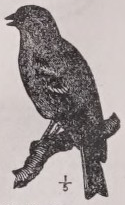
CHAFFINCH(Fringilla coelebs), a Conirostral Bird, belonging to the family Fringillidae or Finches, and distinguished, in the male sex, by the deep greyish blue of its crown feathers, the sulphur yellow of its rump, the white of the wing coverts, so disposed as to form two conspicuous bars, and the reddish brown passing into vinous red of the throat and breast. The female is less conspicuous in its colouring than the male, and the young males resemble the females until after the first autumn moult, when they gradually assume the plumage of their sex. The chaffinch breeds early in the season, and its song may often be heard in February. Its nest, which is a model of neatness and symmetry, it builds on trees and bushes, preferring such as are overgrown with moss and lichens. It is chiefly composed of moss and wool, lined internally with grass, wool, feathers, and whatever soft material the locality affords. The outside consists of moss and lichens, and according to Selby, “is always accordant with the particular colour of its situation.” When built in the neighbourhood of towns the nest is somewhat slovenly and untidy, being often composed of bits of dirty straw, pieces of paper and blackened moss; in one instance, near Glasgow, the author of the Birds of the West of Scotland found several postage-stamps thus employed. It lays four or five eggs of a pale purplish buff, streaked and spotted with purplish red. In spring the chaffinch is destructive to early flowers, and to young radishes and turnips just as they appear above the surface; in summer, however, it feeds principally on insects and their larvae, while in autumn and winter its food consists of grain and other seeds. On the Continent of Europe the chaffinch is a favourite songbird, especially in Germany, where a ...cow has been known to be given in exchange for one of these birds, and where great attention is paid to its training. Its notes are clear and powerful, and, according to Bechstein, “seem almost to approach to words.” The chaffinch is found throughout Europe and Western Asia, and has been observed as far west as the Azores. It is resident all the year in the warmer parts of this area, but migrates southward from Northern Europe on the approach of winter. It was at one time supposed that the females only migrated, and Linnaeus named the species Coelebs, or “bachelor,” in allusion to this alleged desertion of the males by their mates, which, however, does not appear to take place.