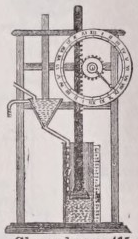
CLEPSYDRA (from κλ∈πταv, to steal, and ΰδωρ, water), the chronometer of the Greeks and Romans, which measured time by the flow of water. In its simplest form it was a short-necked globe of known capacity, pierced at the bottom with several small holes, through which the water placed in it escaped or stole away. The instrument was employed to set a limit to the speeches in courts of justice, hence the phrases aquaem dare, to give the advocates speaking time, and aquam perdere, to waste time; it was also very generally used instead of the sun-dial. Its defects were—first, that the flow of water varied with the temperature and pressure of the air, and secondly, that the rate of flow became less as the vessel emptied itself. The latter was remedied by keeping the level of the water in the clepsydra uniform, the volume of that discharged being noted. In the clepsydra or hydraulic clock of Ctesibius of Alexandria, made about 135 b.c., the movement of waterwheels caused the gradual rise of a little figure, which pointed out the hours on an index attached to the machine. The rate of the flow of water through an orifice being proportional to the square of the vertical distance of its upper surface from the orifice, a clepsydra of simple construction can be formed by making in the bottom of a glass cylinder an opening through which its contents can escape in twelve hours, and graduating the vessel into 144 ( = 12?) equal parts. A mark made at division 121( = 11 2 ) from the bottom indicates the quantity of water remaining at the end of the first hour, and in like manner the squares of 10, 9, 8, and the lower numbers give the divisions to which the level of the water descends at the end of the second, third, fourth, and succeeding hours.
9th ed. Encyclopædia Britannica, vol. 5, p. 826
[313 words — estimated reading time: 2 minutes]