
A small sea vessel. [Not in use.]
Word of the Day: Catachrestical
Crayer
Encyclopedia Britannica
CRAYER, Gaspard de (1582-1669), was born at Antwerp, and learnt the art of painting from Raphael Coxcie. He matriculated in the guild of St Luke at Brussels in 1607, resided in the capital of Brabant till after 1660, and finally settled at Ghent. Amongst the numerous pictures which he painted in the last of these cities, one in the town museum represents the Martyrdom of St Blaise, and bears the inscription A * 1668 aet. 86. Crayer, one of the most productive yet one of the most conscientious artists of the later Flemish school, was second to Rubens in vigour and below Vandyck in refinement; but he very nearly equalled both in most of the essentials of painting; and it is probably true, as stated by modern critics, that his fame was unfairly overshadowed by that of two great contemporaries with whom he was on terms of intimacy. He was well known and always well treated by Albert and Isabella, governors of the Netherlands. The Cardinal-Infant Ferdinand made him a court-painter. His pictures abound in the churches and museums of Brussels and Ghent; and there is scarcely a country chapel in Flanders or Brabant that cannot boast of one or more of his canvases. But he was equally respected beyond his native countrvι and some important pictures of his composition are to be found as far south as Aix in Provence, and as far east as Amberg in the Upper Palatinate. His skill as a decorative artist is shown in the panels executed for a triumphal arch at the entry of Cardinal Ferdinand into the Flemish capital, some of which are publicly exhibited in the museum of Ghent. Crayer died at Ghent. His best works arc the Miraculous Draught of Fishes in the Gallery of Brussels, the Judgment of Solomon in the Gallery of Ghent, and Madonnas with Saints in the Louvre, the Munich Pinakothek, ...and the Belvedere at Vienna. His portrait by Vandyck was engraved by P. Pontius.
9th ed. Encyclopædia Britannica, vol. 6, p. 555
[331 words — estimated reading time: 2 minutes]
[331 words — estimated reading time: 2 minutes]
1. Any crustacean of the family Astacidae, resembling the lobster, but smaller, and found in fresh waters. Crawfishes are esteemed very delicate food both in Europe and America. The North American species are numerous and mostly belong to the genus Cambarus. The blind crawfish of the Mammoth Cave is Cambarus pellucidus. The common European species is Astacus fluviatilis.
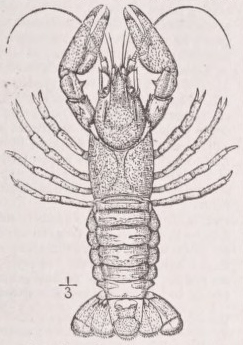
2. See Crawfish.
1. A general name for all colored stones, earths, or other minerals and substances, used in designing or painting in pastel or paste, whether they have been beaten and reduced to paste, or are used in their primitive consistence. Red crayons are made of blood-stone or red chalk; black ones, of charcoal or black lead.
2. A kind of pencil, or roll of paste, to draw lines with.
3. A drawing or design done with a pencil or crayon
1. An implement for drawing, made of clay and plumbago, or of some preparation of chalk, usually sold in small prisms or cylinders.
2. A crayon drawing.
3. A pencil of carbon used in producing electric light.
To sketch, as with a crayon; to sketch or plan.
Crayon
Encyclopedia Britannica
CRAYON, a coloured material for drawing, employed generally in the form of pencils, but sometimes also as a powder, and consisting of native earthy and stony friable substances, or of artificially prepared mixtures of a base uf pipe or China clay with Prussian blue, orpiment vermilion, umber, and other pigments. Calcined gypsum, talc, and compounds of magnesium, bismuth, and lead are occasionally used as bases. The required shades of tints are obtained by adding varying amounts of colouring matter to equal quantities of the base. The ingredients of crayons or pastils are made into a paste with gum, turpentine, or alcoholic solution of shellac, and pιdverized as finely as possible in a mill, which subjects them repeatedly to the action of a revolving cast-iron grinder. The paste is introduced into a copper cylinder, closed at one end by a plate pierced with holes of the diameter of the. crayons to be made. Through these it is forced by means of a piston, and the vermicular pieces obtained are then cut into the required lengths, and dried in a furnace at a gentle heat. Black crayons may be manufactured from a mixture of one part of lamp-black with about two-thirds of its bulk of clay; red crayons from powdered and elutriated haematite worked up into a paste with gum arabic and a little soap. White crayons are commonly formed by sawing chalk of good quality into convenient shapes. Mixtures of soap, wax, and lampblack are employed for lithographic crayons or chalks. The late well-known zoological lithographer, George Ford, employed chalks made after the following receipt :— [table]...
The wax is gradually incorporated with the melted soap by heating, and as the resultant mass begins to burn, the soda is added; afterwards the black is by degrees stirred in. The melted tallow may be added at any stage in the operation.
Crayons are valuable to the artist in enabling him to make groupings of colours and to secure landscape and other effects with ease and rapidity. The outline as well as the rest of the picture is drawn in crayon. The colours are softened off and blended by the finger, with the assistance of a stump of leather or paper; and shading is produced by cross-hatching and stippling. The paper employed is of loose but not soft or spongy texture, and is of various tints, warm grey or yellowish being generally preferred. For portraits pumice-paper and red or brown crayons are considered most suitable. The colours are fixed by the process known as transudation. The drawing is supported face downwards by its edges or corners, and a solution of isinglass is applied to the back with a brush in quantity sufficient to penetrate to the coloured surface of the paper, which may then be turned upwards to dry. The fixing solution is prepared as follows;—three-quarters of an ounce of isinglass is infused for a day in 2⅜ ounce of pure vinegar; a pint of hot water is added, and the solution of isinρ∙bss is filtered and mixed with an equal volume of spirits of wine, The art of painting in crayons or pastils is supposed to have originated in Germany in the 17th century. By Johann Alexander Thiele (1685-1752) it was carried to great perfection, and in France it was early practised with much success. Amongst celebrated crayon-painters may be mentioned Carriera Rosalba (1675-1757), W. Hoare (1707-1792), F. Cotes (1726-1770), J. Russell (1744-1806), and the late Mr Bright.
9th ed. Encyclopædia Britannica, vol. 6, p. 555
[591 words — estimated reading time: 4 minutes]
[591 words — estimated reading time: 4 minutes]
The act or art of drawing with crayons.
No thesaurus entries found for "cray".
No Bible verses found for "cray".