
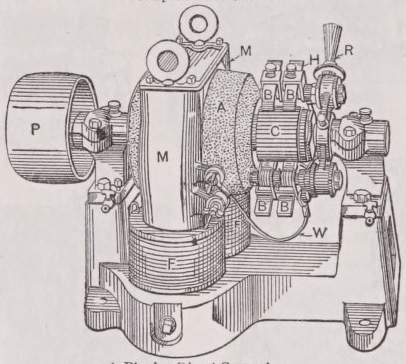
A dynamo-electric machine.
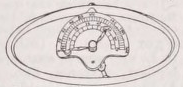
DYNAMOMETER (δwα∕us, strength, and μerροv, a measure), an instrument for measuring force exerted by men, animals, and machines. One of the simplest forms, namely, that devised by the mechanician Graham, and improved by Desaguliers, was essentially a steel-yard in which the position of the weight on the longer arm indicated the force exerted on the shorter inorder to produce equilibrium. The dynamometer invented by Leroy of the French Academy consisted of a metallic tube 10 to 12 inches long, in which was a spiral spring with an attached graduated rod terminating above in a globe. Pressure being applied to the globe, the rod sank into the tube, and thus marked the force employed in compressing the spring. M. Regnier’s dynamometer (see Journ, de VHcοle Polytechnique, tom. ii.) consists of an elliptical steel spring having fixed to one of its arms a semicircular graduated brass plate with central index, and to the other a small lever, which, acting on the index, shows the amount of force exerted in effecting a greater or less approximation of the arms to each other. In a similar instrument contrived by M. Poncelet, the springs are hinged together at the extremities, and separated from each other in proportion to the tension brought to bear upon them. A dynamometer for therapeutical purposes, invented by Dr Hamilton of Long Island College Hospital, consists of au india-rubber bulb filled with coloured water, into which dips a tube closed at the upper end. Pressure being applied to the bulb, some of the water is forced up into the tube, the graduations upon which show the amount of pressure upon the air within it which is exerted by the water. By the dynamometer of Colonel Morin a curve is drawn, the area of which represents the product of the force exerted into ...the space through which it acts, or, in other words, the quantity of work performed in a given time. Details with respect to Morin’s, Watt’s, and other dynamometers will be found in vol. i. of Laboulaye’s Dictionnaire des Arts et Manufactures.