
1. A genus of climbing plants. The yellow (false) jasmine (Gelsemium sempervirens) is a native of the Southern United States. It has showy and deliciously fragrant flowers.
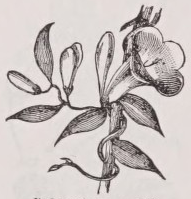
GELSEMIUM, a drug, consisting of the root of Gelsemium (or as sometimes less correctly called Gelseminum) sempervirens, a climbing shrub of the natural order Loganiaceoe, having a milky juice, opposite, lanceolate shining leaves, and axillary clusters of from one to five large, funnel-shaped, very fragrant yellow flowers, whose perfume has been compared to that of the wallflower. The fruit is composed of two separable jointed follicles, containing numerous flat-winged seeds. The stem often runs underground for a considerable distance, and indiscriminately with the root it is used in medicine. The plant is a native of the United States, growing on rich clay soil by the side of streams near the coast, from Virginia to the south of Florida. In the United States it is commonly known as the wild, yellow, or Carolina jessamine, although in no way related to the true jessamines, which belong to the Oleaceoe. It was first described in 1640 by John Parkinson, who grew it in his garden from seed sent by Tradescant from Virginia; at the present time it is but rarely seen, even in botanical gardens, in Great Britain....
The root, on analysis by Kollock in 1855, was found to contain an alkaloid (now called Gelsemine or Gelsemia), a dry acrid resin, ∣ per cent, of a volatile oil heavier than water, fatty resin, fixed oil, yellow colouring matter, gallic acid, starch, albumen, gum, pectic acid, extractive matter, lignin, and 3 ’ 17 per cent, of mineral matter, consisting chiefly of salts of potassium, calcium, magnesium, iron, and silica. The leaves and flowers were found to contain the same ingredients in less quantity. Eberle, who examined the root in 1869, states that the central woody portion of the root does not contain any alkaloid, and that therefore the bark is the physiologically active portion. In addition to the above, Wormley, in 1870, discovered in the root a crystalline substance named by him gelseminic acid, whose solution in alkalies exhibits a powerful blue fluorescence. It has, however, since been shown by Sonnenschein to be identical with aesculin, a crystalline glucoside found in the bark of the horse chesnut, Aesculus Hippocastanum. The active properties of gelsemium root have been proved by Wormley and Bartholow to depend upon the alkaloid gelsemine (C 11 H 19 NO 2 ), which in the pure state is a colourless, odourless solid, not yet obtained in a crystalline form, readily soluble in ether and chloroform, less so in alcohol, and very sparingly in water, except in the presence of hydrochloric acid, and having an intensely persistent bitter taste, perceptible in a solution containing only τ ^⅛ σ th part of it by weight.
The readiest and best test for gelsemine, detecting the smallest traces, appears to be the cherry-red colour developed when ceroso-ceric oxide is added to its solution in concentrated sulphuric acid. The dose of the alkaloid is from, ∙ δ ⅛th to ∕ π th of a grain; larger quantities are poisonous, ⅜th of a grain having proved fatal in an hour and a half to a strong cat.
The pharmaceutical preparation known as gelsemin consists chiefly of the resin, combined with uncertain proportions of the other constituents of the root, and is prepared by precipitation with water from the strong tincture.
The medicinal properties of the root were discovered by accident, the infusion having been administered instead of that of some other root, with the result of curing the fever for which it was taken. It was then experimented upon by the American eclectic practitioners. In 1852 Professor AV. Proctor called the attention of the medical profession to its valuable properties; and in 1864 it was placed on approval in the secondary list, and in 1873, so rapidly had it risen in favour, in the primary list of remedies of acknowledged value in the United States pharmacopoeia. It has latterly attracted considerable attention in England as a remedy for certain forms of facial neuralgia, especially those arising from decayed teeth, or involving branches of the fifth nerve. In the United States it is more particularly valued for controlling nervous irritability in fevers of a malarial type, in which it is said to excel every other known agent. The physiological action of the drug lias been carefully examined by Bartholow, Ott, and Ringer and Murrell, from whose investigations it appears that it has a paralysing action on the motor centres, affecting successively the third, fifth, and sixth nerves, its fatal action being due to its causing paralysis of the respiratory muscles, and thus producing death by asphyxia. Tn large doses it produces alarming symptoms, which occasionally terminate fatally. These appear to vary slightly in different cases, but the more prominent are pain in the forehead and in the eyeballs, giddiness, ptosis, a feeling of lightness in the tongue slurred pronunciation, laboured respiration, wide dilatation of the pupils, and impossibility of keeping an erect posture. The mind in most cases remains clear until shortly before death. The earliest and most prominent symptom of a fatal or dangerous dose is the drooping of the eyelids, which indicates the immediate administration of stimulants, for when the paralysis of the tongue which ensue3 extends to the epiglottis, deglutition becomes impossible, and the epiglottis is apt, unless the sufferer be placed in a forward position to flap back and close the windpipe. The antidotes which have been found the most successful are carbonate of ammonia, brandy, aromatic spirits of ammonia, and morphia. It has been found that death may be averted by keeping up artificial respiration until the poison is eliminated by the kidneys.
See Eclectic Dispensatory, p. 186; Pharm. Joum., 3d ser., vol. vi.; by Binger and Murrell, &c. in Lancet, 1873, 1875-78; Hales, New Remedies, p. 390; Bartholow, Materia Medica, p. 380; American Journ. Pharm., 1855, 1870; Proc. Amer. Pharm. Assoc., 1873, p. 652; Practitioner, 1870, p. 202; Grover Coe, Positive Medical Agents, p. 114; Hughes, Pharmacodynamy, vol. i. p. 372; Sonnenschein, Berichte der deutsch, chem. Ges., xi. 1182; Bentley and Trimen, Med. Plants, pt. xix. No. 181.