
A species of Antelope, in Southern Africa, whose form partakes of that of the horse, the ox, and the deer.
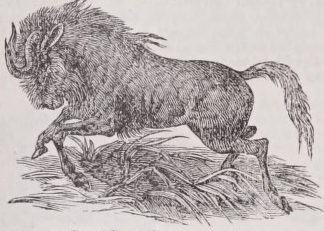
GNU(Caloblepas), a genus of ruminant mammals constituting the equine group of the antelope family, and containing two species—the gnu or kokoon (f·atoblepas gnu) and the brindled gnu (fjatoblepas gorgon). Owing to their singular appearance, which has been aptly compared to that of a creature compounded of a bison’s head, a horse’s body, and an antelope’s legs, their proper zoological position has been a matter of dispute—some placing them among the oxen, while others regard them as a connecting link between bovine animals and the true antelopes. The gnu measures about 4⅛ feet in height at the shoulders, and 9 feet in extreme length. Its nose is broad and flattened, and bears on its upper surface a crest of reversed hair, while there is an abundant growth of bushy black hair beneath the chin and between the forelegs. The horns, which are present in both sexes, are very broad at their base, forming a solid helmet on the forehead, from which they bend downwards and outwards, thereafter curving rapidly upwards to the tip. A mane of light-coloured hair, tipped with brown, and presenting a neatly clipped appearance, extends along the neck, while the horse-like tail, which is more or less of a creamy colour, reaches to the ground. The nostrils are large, and are furnished with a muscular valve by which they can be closed. The gnu is a native of the arid plains of South Africa, where it congregates in considerable herds, its restlessness of disposition leading it to migrate frequently from place to place. The fantastic appearance of these creatures is fully equalled by the grotesqueness of their actions. Advancing, as they generally do, in single file, they may be seen wheeling and prancing in all directions, tossing their heads, switching their long tails, and ...then starting off, especially if alarmed by the appearance of a lion, at tremendous speed, raising columns of dust along their track, and leaving their pursuers hopelessly in the rear. Should they be surprised in their gambols by the sight of a caravan, their exceeding inquisitiveness impels them to approach the intruding object, which they do in a compact square, looking all the while the very picture of defiance. “During bright moonlight,” says Captain Harris, “curiosity often prompted a clump of gnus to approach within a few yards of our bivouac, where they would stand for hours in the same position, staring wildly, lashing their dark flanks, and uttering a subdued note resembling the harsh croaking of a frog.” The noise made by the old bulls, as they roam singly during the rutting season, is much more formidable, being usually compared to the roar of the lion; and many sportsmen who have hunted the gnu bear testimony to the remarkable likeness between the solitary males with their long manes, when seen at a considerable distance, and the “king of beasts.” They are by no means the formidable creatures their ferocious aspect might lead one to suppose. However defiant the herd appears as it approaches a caravan, the report of a gun puts the whole troop of gnus to flight, and they are never known to attack man unless driven thereto in self-defence. The female has seldom more than a single young one at a birth, the calf at first being of a whitish colour. When captured young, the gnu may, according to Captain Harris, be reared by the hand on cows’ milk; and although of uncertain temper, it can be got to herd with the cattle on the farm. The flesh of the calf is considered a delicacy, but that of the adult is insipid, being almost destitute of fat. Its long silky tail is in great request for chowries, and its hide is cut into strips and used for ropes and twine.
The brindled gnu is a more northerly form, never being found south of the Orange river. It is readily distinguished from the other species by the black colour of its tail and mane, the obscure vertical streaks on its body, its more elevated withers, and its extremely long aquiline nose. While equally grotesque in appearance and manner, it is much less spirited and active than the gnu. Its flesh is highly prized by the natives, who also convert its hide into mantles, rendered attractive to South-African taste by being dressed without removing the long hair of the mane and beard.