
A fish of several species of the genus Trigla. The head is loricated with rough lines, or bony plates, and there are seven rays in the membranes of the gills.
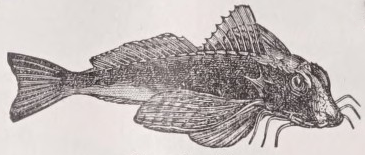
GURNARD(Tripla). The gurnards form a group of the family of “mailed cheeks” (Triglidoe), and are easily recognized by three detached finger-like appendages in front of the pectoral fins, and by their large, angular, bony head, the sides of which are protected by strong, hard, and rough bones. The pectoral appendages are provided with strong nerves, and serve not only as organs of locomotion when the fish moves on the bottom, but also as organs of touch, by which it detects small animals on which it feeds. Gurnards are coast-fishes, generally distributed over lhe tropical and temperate areas; of the forty species known seven occur on the coast of Great Britain, viz., the red gurnard ( 7 τ . jt√nt), the streaked gurnard (T. lineata), the sapphirine gurnard (T. himιndo), the grey gurnard (T. gurnardus), Bloch’s gurnard (T. cuculus), the piper (T. lyra), and the long-finned gurnard (T. obscura or T. lucerna). Although never found very far from the coast, gurnards descend to depths of several hundred fathoms; and as they are bottom-fish they are caught chiefly by means of the trawl. Not rarely, however, they may be seen floating on the surface of the water, with their broad, finely-coloured pectoral fins spread out like fans. In very young fishes, which abound in certain localities on the coast in the months of August and September, the pectorals are comparatively much longer than in the adult, extending to the end of the body; they are beautfully coloured and kept expanded, the little fishes looking like butterflies. When caught and taken out of the water, gurnards emit a grunting noise. Their flesh is very white, firm, and wholesome.