
A plant of the genus Hyacinthus, with campaniform or bell-shaped flowers.
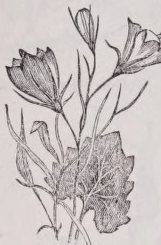
HAREBELL, or, as the name is often written, Hairbell, known also as the Blue-bell of Scotland, and Witches’ Thimbles, a well-known perennial wild flower, Campanula rotundtfolia, L., a member of the natural order Campanu- laceoe. The harebell has a very slender slightly creeping rootstock, and a wiry, erect stem. The radical leaves, to which the specific name refers, have long stalks, and are roundish or cordate, crenate or serrate; the lower stem leaves are ovate or lanceolate, and the upper ones linear, subsessile, acute and entire, rarely pubescent. The flowers are slightly drooping, arranged in a panicle, or in small specimens single, having the calyxtube glabrous, with subulate and erect segments, the corolla campanulate, with slightly recurved segments, and the capsule nodding, and opening by pores at the base of the calyx-tube. There are two varieties :—(a) genuina, with slender stem leaves, and (δ) montana, in which the lower stem-leaves are elliptical-oblanceolate. The plant is found on heaths and pastures throughout Great Britain and North America, and flowers in late summer and autumn. The harebell has ever been a great favourite with poets, and on account of its delicate blue colour has been considered as an emblem of purity.