
hous'leek. [ See Leek .] A plant of the genus Sempervivum, which is found on the tops of houses. The lesser houseleek is of the genus Sedum.
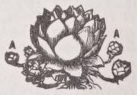
HOUSELEEK, Sempervivum, a genus of ornamental evergreen plants belonging to the natural order Crassu- laceae. About 30 species are known in gardens, some of which are hardy perennial herbs, and grow well in dry or rocky situations; the others are evergreen shrubs or undershrubs, fit only for cultivation in the greenhouse or conservatory. The genus Sempervivum is distinguished from the nearly allied Sedum by having about 12 petals, and by the glands at the base of the ovary being laciniated if present. The common houseleek, S. tectorum, L. (Germ. Hauswurzel ; Fr. Joubarbe), is often met with in Britain on roofs of outhouses and wall tops, but is not a native. Originally it was indigenous in the Alps, but it is now widely dispersed in Europe, and has been introduced into America. The leaves are thick, fleshy, and succulent, and are arranged in the form of a rosette lying close to the soil The plant propagates itself by offsets on all sides, so that it forms after a time a dense cushion or aggregation of rosettes. The flowering stem, which is of rather rare occurrence, is about a foot high, reddish, cylindrical, and succulent, and terminates in a level-topped cyme, reflexed at the circumference, of reddish flowers, which bloom from June to September. The houseleek has been known variously as the Houselick, Homewort, Great Houseleek, Sedum majus, and Crassula major altera, Sedum acre, L., being styled the Least Houseleek. In Germany it is sometimes called Donnerkraut, from being supposed to protect the house on which it grows from thunder. The leaves are said to contain malic acid in considerable quantity, and are reckoned by herbalists to possess cooling and astringent properties. The leaves, freshly bruised, are applied to haemorrhoids, boils, wens, and corns, and the ...expressed juice is used as a remedy for inflammation of the eyes and freckles, and especially for thrush (aphthae) in children, also for stings and burns, erysipelas and herpes. Internally bouseleek is used as a cooling remedy in dysentery and fluxes. The young leaves have also been eaten as salad, ∏ke Portulacca. S. glutinosum, Ait., and S. balsamiferum, Webb, natives respectively of Madeira and the Canary Islands, contain a very viscous substance in large quantity, and are used for the preparation of bird-lime; fishermen in Madeira, after dipping their nets in an alkaline solution, rub them with this substance, rendering them as tough as leather. S. montanum, L., indigenous in Central Europe, according to Gmelin, causes violent purging; 5 ’. arboreum, L., το ρίγα άα'ξωον of Dioscorides, is employed in Cyprus, the East, and northern Africa as an external remedy for malignant ulcers, inflammations, and burns, and internally for mucous discharges.
See Britten and Holland, Dictionary of Plant Names, pp. 265-271; Fristedt, Joannis Franckenii Botanologia, p. 60; Rosenthal, Plantarum Diaphoricarum, p. 576.