
A genus of quadrupeds, the Makis, natives of Africa and the East Indies.
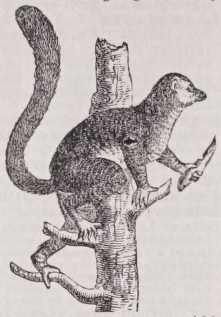
LEMUR, a term applied by Linnaeus to a group of mammals, and suggested by the nocturnal habits and strange ghost-like appearance of some of its members. As they had previously no vernacular appellation in English, it has been generally adopted, and is now completely anglicized, making “lemurs” in the plural. The French call them Makis, the Germans Halbaffen, in allusion to their forming, in appearance at least, a transition from monkeys to ordinary quadrupeds. For the same reason they are called Prosimiae by some systematic writers. When the name was bestowed by Linnaeus, only five species were known, of which one, L. volans, Linn., Galeoprithecus volans of modern writers, is now removed by common consent from the group. Notwithstanding the discovery of many new and curious forms, the lemurs remain a very natural and circumscribed division of the animal kingdom, though no longer considered a single genus, but divided up into many genera and even families....
The Lemurs, or Lemuroid animals as they ought more properly to be called, were formerly associated with the monkeys in the Linnaean order Primates, and afterwards in the Quadrumana of Cuvier, forming in that order the third main division, called by Geoffroy St Hilaire Strepsirhνna, on account of the twisted form of the external nostrils, a division equivalent in value to the Catαrhiηa or Old World and the Platyrhina or New World monkeys. As more complete knowledge of their organization has been gradually attained, the interval which separates them structurally from the monkeys has become continually more evident, and they are now considered either as a distinct suborder of the Primates, or even as forming an order apart, without any very near affinities with the animals with which they have hitherto been so closely associated.
The existing species are not numerous, and do not diverge widely in their organization or habits, being all of small or moderate size, all adapted to an arboreal life, climbing with ease, and, as they find their living, which consists of fruits, leaves, birds’ eggs, small birds, reptiles, and insects, among the branches of the trees, they rarely have occasion to descend to the ground. None are aquatic, and none burrow in the earth. Many of the species, but by no means all, are nocturnal in their habits, spending the day in sleeping in holes, or rolled up in a ball, perched on a horizontal branch, or in the fork of a tree, and seeking their food by night. Their geographical distribution is very peculiar; by far the larger proportion of species, including all those to which the term “lemur” is now especially restricted, are exclusively inhabitants of Madagascar, where they are so abundant and widely distributed that it is said by M. Grandidier, who has contributed more than any other traveller to enrich our knowledge of the structure and manners of these animals, that there is not a little wood in the whole island in which some of them cannot be found. From Madagascar as a centre a few species less typical in character extend through the African continent westward as far as Senegambia, and others are found in the Oriental region as far east as the Philippine Islands and Celebes.
The following are the essential anatomical characters common to the whole group :—
Teeth heterodont, or divided by their form into incisors, canines, and molars, and diphyodont, or consisting of a first and second set. Molars multicuspidate. Skull with complete bony margin to the orbits, which communicate freely (except in Tarsias') with the temporal fossae. Lacrymal foramen outside the margin of the orbit. Clavicles well developed. Radius and ulna distinot. Scaphoid, lunar, and central bones of the carpus almost always separate. Five digits on the manus and pes, though the index of the manus may be rudimentary. Pollex (or thumb) and hallux (or great toe) always well developed—the latter especially large, opposable to the other digits, and with a flat nail. The index or second digit of the pes always terminating in a long pointed claw. The fingers and toes generally not tapering towards their extremities, but (except in Chiromys) dilated, flattened, and rounded at the tips. Cerebral hemispheres not completely overlapping the cerebellum, and but little convoluted. Stomach simple. Caecum always present, generally large. The middle or transverse portion of the colon almost always folded or convoluted on itself. Uterus bicornuate. Placenta non-deciduate, diffused or bell-shaped—the whole of the chorion, except the cephalic pole, being covered with villosities. Allantois of great size.
In subdividing the group for the purpose of a more detailed description of the different animals of which it is composed, it must first be noted that there are two very aberrant forms, each represented by a single species—(1) the little Tarsius of the Indian archipelago, and (2) the singular Chiromys or aye-aye, which, though an inhabitant of the headquarters of the order, Madagascar, and living in the same forests and under the same external conditions as the most typical lemurs, exhibits a most remarkable specialization in the structure of its limbs and teeth, the latter being modified so as to resemble, at least superficially, those of the rodents, an order in which it was once placed. The differences between these two forms and the remaining lemurs is so great that the whole order naturally divides itself into three families, the first of which may be again divided into four subfamilies, which with the genera they contain may be thus arranged :— [table]
Family Lemuridae.
Upper incisors two on each side, small and separated by an interval in the middle line. Upper canines large, conical, compressed, and pointed. Premolars two or three, molars three on each side above and below, with numerous, more or less pointed, cusps. In the front of the lower jaw are on each side two or three closely approximated, long, slender teeth lying almost horizontally and projecting forwards. These are generally considered to represent the incisors and canines, but there is some doubt about their homologies, and they may be all considered as incisors, the canine being absent. The first lower premolar larger than those behind it, and shaped like a canine. The orbit and temporal fossa widely continuous beneath the bar of bone (formed by the frontal and malar) constituting the posterior boundary of the former cavity. The fibula well developed and distinct from the tibia. All the digits of both feet (except the second of the hind foot) with flat nails, and corresponding form of ungual phalanges.
I. Subfamily Indrisinae. —The dentition of the adult consists of thirty teeth, usually expressed by the formula tf, c⅛, p⅛, >n⅜; but. as indicated above, they may be √⅛, c⅜, ρ⅛, m⅜. In the milk dentition there are twenty-two teeth, the true molars of course not being represented, but there are two additional teeth in the fore part of the lower jaw which have no successors in the permanent series. Hind limbs greatly developed, but the tarsus normal. Hallux of large size, and very opposable. The other toes united at their base by a fold of skin, which extends as far as the end of the first phalanx. Mammae two, pectoral. Caecum very large, and colon extremely long and spirally coiled.
The animals of this group are, as their organization indicates, essentially arboreal, and feed exclusively on fruit, leaves, buds, and flowers. When they descend to the ground, which is but seldom, they sit upright on their hind legs, and move from one clump of trees to another by a series of short jumps, holding their arms above them in the air. They are restricted geographically to the island of Madagascar. Among them are the largest members of the order. A very detailed and beautifully illustrated account of their characters, external and internal, and distribution and habits, is given in the Histoire Naturelle de Madagascar, by A. Grandidier and Alphonse Milne-Edwards (1875). The species are not numerous and are distributed into three genera.
1. Indris, Geoff.—Upper incisors subeqnal in size. Upper canine larger than the first premolar, muzzle moderately long, ears exserted. Carpus without an os centrale. Tail rudimentary. Vertebrae: C7, D12, L9, S4, C9.
The only well-established species is the indris (Z. brericaudatus, Geoff., fig. 1), discovered by Sonnerat in 1780. It is the largest of the lemurs, the length of the head and body being about 2 feet, and the tail 2 inches. It is very variable in oolour, for although usually nearly black, marked with whitish spots principally in the lumbar region and fore arm, individuals have been found quite white. It inhabits exclusively the forests of a part of the east coast of Madagascar, living in small troops of four or five in number, and resembling in most of its habits the animals of the next genus.
2. Propithecus, Bennett.—Second upper incisor much smaller than the first. Upper canine larger than the first premolar. Muzzle rather short. Ears short, concealed by the fur. An os centrale in the carpus. Tail long. Vertebrae: C7, Dl 2, L8, S3, C28.
The species are all subject to great variations in colour, which has led to much difficulty in discriminating them, and to much confusion of synonymy. Grandidier and Milne-Edwards recognize three as certainly distinct:— P. diadema, P. verreauxii, and P. coronatus (fig. 2). Some of these are to be found in almost every part of the island of Madagascar, living in the woods in small bands of six or eight together, and feeding exclusively on buds, flowers, and berries. Their powerful hind limbs enable them to leap from tree to tree, often to a distance of ten yards, without any apparent effort, seem ing to fly through the air. When obliged to descend to the ground to pass from one clump of trees to another, they do not run on all fours, but stand erect, and throwing their arms above their heads, progress by a series of short jumps, producing an effect which is described by travellers who have seen them thus in their native haunts as exceedingly ludicrous. They are not nocturnal, but most active in the morning and evening, remaining seated or coiled up among the branches during the heat of the day. They are naturally of a quiet and gentle disposition, and do not show much intelligence. They are also less vociferous than the tnιe lemurs, only when alarmed or angered making a noise which has been compared to the clucking of a fowl. Like the rest of the subfamily they never have more than one young one at a time.
3. Avahis, Jourdan.—Second upper incisor larger than the first. Upper canine scarcely larger than the first premolar. Muzzle very short. Ears very small and hidden in the fur, which is very soft and woollv. Carpus without os centrale. Tail long. Vertebrae: C7, Dll, L9, S3, C23.
One species, A. laniger (Gmelin), the woolly lemur, or avahis, considerably smaller than any of the last group. It differs from them in its habits, being quite nocturnal, and not associating in small troops, but being always met with either alone or in pairs. It is very slow in its movements, and rarely descends to the ground, but when it does it walks upright like the other Indrisinae. It is found throughout the forests which clothe the mountains on the east coast of Madagascar, and also in a limited district on the north-west coast, the specimens from which locality are of smallersize and rather different in colour.
II. Subfamily Lernurinae.—The dentition in the adult consists of thirty-six teeth, which as usually enumerated are ⅛, c∣, p⅜, wιf. In the forepart of the lower jaw are on each side three elongated, compressed, procumbent teeth, of which the outer, usually considered the homologue of the canine, is larger than the others. All have long tails. Hind limbs not of the same disproportionate size as in the last group; and the caecum much less developed. Tarsus but slightly elongated, the os calcis being always less than one-fourth the length of the tibia. Toes of the hind feet free to the base. Habitat, Madagascar and some of the adjacent Comoro islands.
This group contains the typical lemurs, or those to which the term is now chiefly restricted. Two rather aberrant members make it necessary to divide it into three genera.
1. Lemur, Linn.—Upper incisors separated by an interval in the middle, but not in contact with each other or the canine, in front of which they are both placed. Muzzle elongated. Ears conspicuous and tufted. Mammae two, pectoral. Vertebrae: C7, D12, L7 (or D13, L6), S3, C27.
Animals much about the size of a common cat, with fox-like faces, soft thick fur, and long tails well clothed with hair. Not having the same disproportionate size of the limbs as the last group, they are much more quadrupedal in their actions, walking on the ground or running along the branches of trees on all four feet, but also jump ing with marvellous agility. They are gregarious, living in small troops, are diurnal in their habits, but most active towards evening, when they make the woods resound with their loud cries, and feed, not only on fruits and buds, but also on eggs, young birds, and insects. When at rest or sleeping, they generally coil their long, bushy tails around their bodies, apparently for the sake of the warmth it affords. They have usually either one or two young ones at a birth, λvhich are at first nearly naked, and are carried about, hanging close to and almost concealed by the hair of the mother’s belly. After a while they change their position and mount upon the mother’s back, where they are carried about until they are able to climb and leap by themselves. Though no member of the Indrisinae has as yet lived long enough in captivity to be brought alive to Europe, the lemurs are commonly seen in menageries, and often breed in England. They present a great tendency to variation in their colouring, in consequence of which many nominal species have been made. The most distinct, and at the same time most beautiful, is the ring-tailed lemur (Z. caitcι, Linn., fig. 4), of a delicate grey colour, and with a long tail marked with alternating rings of black and white. This is said by Mr G. A. Shaw (Proc. Zooh Soc., 1879, p. 132)
to be an exception to all the other lemurs in not being arboreal, but living chiefly among rocks and bushes. Pollen, however, says that it inhabits the forests of the south-west parts of Madagascar, living, like its congeners, in considerable troups, and not differing from them in its habits. He adds that it is extremely gentle, and active and graceful in its movements, and utters at intervals a little plaintive cry like that of a domestic cat. All the others have the tail of uniform colour. The largest species is L. varius, Geoff., the ruffed lemur, sometimes black and white, and sometimes reddish-brown, the variation apparently not depending on sex or age, but on the individual. In L. macaco the male is black and the female red. L. mongoz, L. collaris, and L. albifrons are other well-known species.
2. Hapalemur, Is. Geoff.—Upper incisors very small, subequal, separated widely in the middle line. Those of each side in contact with each other and with the canine, the posterior one being placed on the inside, and not in front of the latter. Muzzle very short and truncated. Mammae four. There is apparently but one species, H. griseus, smaller than any of the true lemurs, of a dark grey colour, with round face and short ears. It is quite nocturnal, and lives chiefly among bamboos, subsisting on the young shoots. A second species has been named H. simus, but it is doubtful if it is not only a variety.
3. Lcpilemur, Is. Geoff.; Lcpidolcmur and Myxocebus, Peters. —Upper incisors absent or only two in number and very small. Muzzle more elongated than in the last. No distinct os centrale in the carpus. L. mustelinus is the best known species. It has, at all events when adult, no upper incisors. It is rare, and like Hapalemur nocturnal in its habits. A second closely allied species, but with better developed premaxillae, containing a pair of small styliform incisors, has been described by Peters under the name of Myxocebus caniceps {Monatsb. Berlin. Akad., 1874, p. 690).
III. Subfamily Galaginae.—Dentition as in Lemurinae, from which they are distinguished by the elongation of the tarsus, caused by a peculiar modification of the os calcis and the naviculare, the distal portion of the former and the whole of the latter having the form of nearly cylindrical rods placed side by side, while the other bones retain nearly their normal form and proportion.
1. Chirogaleus, Geoff.—Third upper premolar very much smaller than the first molar, and with only one external cusp. The animals included under this name appear to form a transition between the true lemurs and the galagos. The genus was originally established by Geoffroy St Hilaire in 1812 for the reception of three animals only known at that time by drawings made in Madagascar by the traveller Commerson. Subsequent discoveries have brought to light several species that may be refeιτed to it, including one or two which are sometimes considered as forming a genus apart under the name of Microccbus. They are all small, some being less than a rat in size, long-tailed, and nocturnal in their habits. One of the largest, C. furcifer, is of a reddish-grey colour, and is distinguished by a dark median stripe on its back which divides on the top of the head into two branches, one of which passes forwards above each eye. The most interesting peculiarity of these animals, a knowledge of which we owe to Μ. Grandidier, is that certain species (∂. samati, G. gliroidcs, C. milii, &c. ) during the dry season coil themselves up in holes of trees, and pass into a state of torpidity, like that of the hibernating animals in the winter of northern climates. Before this takes place, an immense deposit of fat accumulates upon certain parts of the body, especially upon the basal portion of the tail, which has then dimensions corresponding to that of the well known fat-tailed sheep of the Cape, but which by the time they emerge from their torpor has acquired its normal proportions. The smallest species, to which many names have been given (C ’. pusillus, rufus, smithii, &c.), lives among the small branches on the tops of the highest trees, feeding on fruit and insects, and making nests which resemble those of birds.
2. Galago, Geoff. = Otolicnus, liliger.—Third upper premolar with two large external cusps, and nearly equalling the first molar in size. Os calcis about one-third the length of the tibia, and the naviculare much longer than the cuboid. Vertebrae: C7, D13, L6, S3, C22-26. Tail long, and generally bushy. Ears large, rounded, naked, and capable of being folded at the will of the animal. Mammae four, two pectoral and two inguinal.
The galagos differ from all the lemuroids previously mentioned, inasmuch as they are all inhabitants, not of Madagascar, but of the African continent, being widely distributed in the wooded districts from Senegambia in the west to Abyssinia in the east, and as far south as Natal. They pass the day in sleep, but are very active at night, feeding on fruit, insects, and small birds. When they descend to the ground they sit upright, and move about by jumping with their hind legs, like jerboas and kangaroos. They are pretty little animals, varying in size from that of a small cat to less than a rat, with large eyes and ears, soft woolly fur, and long tails. There are several species, of which G. crassicaτιdatus, from Mozambique, is the largest. A similar species, or perhaps variety, from Angola is G. montiert. G. garnetti, allcni, maholi, demidoffi, and senegalensis are other recognized species. The last-mentioned was the first known to science, having been brought from Senegal by Adanson, and described in 1796 by Geoffroy, who adopted the name Galago, by which it was said to be called by the natives.
IV. Subfamily Lorisinae.—Dental formula as in Lemurinae. Index finger veιy short, sometimes rudimentary and nailless. Fore and hind limbs nearly equal iu length. Tarsus not specially elongated. Pollex and hallux diverging widely from the other digits, the hallux especially being habitually directed backwards. Tail short or quite rudimentary. Mammae two, pectoral.
A small group of very peculiar animals, of essentially nocturnal habits, and remarkable for the slowness of their movements. They are completely arboreal, their limbs being formed only for climbing and clinging to branches, not for jumping or running. They have rounded heads, very large eyes, short ears, and thick, short, soft fur. They feed, not only on vegetable substances, but, like many of the Lemuridae, also on insects, eggs, and birds, which they steal upon while roosting at night. N one of...