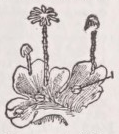
On section of the colesule a number of minute flask-shaped bodies are found, attached to the apex of the stem, which have been named archigonia or pistillidia. After fertilization one of these enlarges, active cell formation proceeding from the central cell at the base, within which appears the germ-cell, which in time becomes the capsule, the ultimate contents producing spores arranged in fours, and elongated cells bearing within spiral filaments (elaters). Until the maturity of the spores, the sporangium remains at the base of the colesule, but at length the outer coat (calyptra) ruptures near the summit, and by the rapid evolution of the cells of the fruit-stalk (seta) the capsule is borne upwards. At this stage, which is of brief duration, the fronds look as if dotted with black-headed pins on white stalks. Released from pressure, the hygrometric action of the elater soon ruptures the wall of the capsule, which divides, in the majority of species, into four valves, and the spores are scattered around.
The antheridia are sometimes found imbedded in crypts within the substance of the thallus (S,iccif), or in special receptacles either sessile or raised above the surface of the same {Marchantia). In the foliose Hepaticae they are usually seated in the axils of modified leaves (perigonial), sometimes appearing beneath the fertile involucra (monoecious), or on special branches of the same plant (paroecious), or they occur on separate plants (dioecious). The antheridia are much smaller than the capsules, spherical or ovoid in form, and seated on a short footstalk. They are invested with a single coat of tabular cells. Before maturity they are greenish, but when ripe their colour turns to yellow. On pressure they rupture irregularly, and allow the escape of crowds of lenticular cells, which revolve actively under the microscope until the ciliated phytozoa within them are released.
The phytozoa of mosses were first figured by Unger (1834), who described them as consisting of a thick body, and a thin thread-like prolongation, which goes in advance when the body is in motion, and is spiral in form. Thuret has since shown that the so-called “tail” bears two long oscillating cilia. Hofmeister first observed the formation of the free germinal vesicle within the basal cell of the pistillidium as the direct result of fertilization.
II. Asexual Germs.— Beyond the true fructification, in the majority of Hepaticae, certain bodies are met with, which are known as gemmae, but which differ from each other in complexity and significance.
(1) In some Harchantiae basket-like or crescentic receptacles are found, containing lenticular bodies, which, under favourable conditions, will produce new fronds.
(2) On the borders of the leaves, especially near the apex of the shoots, prolification from the ordinary cellular tissue is met with in most Hepaticae, in the form of detached cells or tufts of such cells. These are generally described as gemmae, but resemble more closely the gonidia of lichens, and probably aid in the diffusion of dioecious species, which from the absence of ⅛ or $ plants would otherwise become extinct.
(3) Another process has been ascribed to gemmation, but has been more happily named by Dr A. Braun rejuvenescence {Verjungung'). In decayed or apparently withered fronds, certain cells, after a period of rest, assume new activity and multiply so as to give rise to new individuals {Anthoceros, Riccia, <fcc.).
Distinction between Hepaticae and Musci. — There is scarcely a character in the definition of Hepaticae which might not refer to some genus of mosses, although the definition as a whole may be sufficiently distinctive, and practically there is no difficulty in distinguishing one from the other.
In Musci the urn-case or capsule generally opens by means of a lid, and the mouth is surrounded by a peristome divided into four, eight, or more teeth. A columella is nearly always present, and the spores ripen in a sac between the former and the walls of the capsule. From the early elongation of the fruit rudiment, the calyptra is ruptured at an earlier stage, the upper part investing the urn-case like a cap, during the development of the spores; the lower remnant remains at th⅛ base of the seta (which, as well as the capsule, is composed of more ligneous texture than in Hepaticae) as the vaginula. The spore gives rise to a confervoid prothallus often extensively branched, and from this the leaf-buds arise. The leaves are imbricated on all sides of the stem, and the phyllotaxis is usually ⅜, ⅜, or j. The leaves are frequently strengthened by a midrib, and the rootlets are divided by numerous septa.
Habitat. —The Hepaticae are cosmopolitan in range, and form a relatively important average of the alpine vegetation, being abundant in moist equable and insular places, e.g., Ireland, Scotland, New Zealand. They are also met with in more tropical zones, such as South America, India, Java, and the West Indies.
Classification.
I. Marchantiaceae. — Fronds thalloid, prostrate, furcate; epidermis pierced with curious stomata; inner section areolate, occupied by green gonidial cells, lower surface simply cellular, emitting long rootlets, papillose within.
(a) Marchantieae. — Capsules aggregate on a stalked receptacle: e.g., Marchantia, Asterella, Fegatella, Dumortiera, Lunu-laria, &c.
(δ) Targionicae. — Antheridia immersed; involucre like a split pea; capsule nearly sessile, below the apex.
(c) Riccieae. — Antheridia and pistillidia immersed, the latter emitting the spores by the decay of the walls; spores without elaters: e.g., Riccia, Ricciella, &c.
II. Jungermanniaceae. — Capsule solitary terminal on the primary shoots or on short lateral ones, splitting into four valves.
* Foliosae. ( a) Leaves succubous: e.g., Jungermannia, Scapania, Lopho-colea, &c.
( b) Leaves incubous: e.g., Lijennia, Frullania, Schisma, Lepi∙ dozia, kc. * * Frondosae : e.g., Pellia, Blasia, Petalophyllum, kc.
III. Anthoceroteae. — Capsule horn or pod-like, opening by one or two valves, columella central, spores intermingled with deformed elaters: e.g., Anthoceros, Monoclaea. Uses.—At the present time the Hepaticae are of little practical use to man. „ In the dark ages of medicine, when the doctrine of “signatures” was in fashion, the strongly-marked epidermic cells were supposed to resemble the structure of the liver, and the species were esteemed “a sovran remedy” in liver complaints. The Hepatica fontana {Marchantia polymorpha) of Casper Bauhine, “which grows near springs, wells, and watery places, very lowe, almost like a moss, and puts out flowers about June, not unlike stars, ” is wonderfully commended by Schroder, in those disorders of the liver which arise from too much heat {English Dispensary, 1733). A few species possess a pungent, bitter taste {Porella) resembling that of Sedum acre. Many also evolve a musky odour, observable in the woods and fields after rain, and incorrectly referred to the smell of moist earth.
Beyond the beauty of tint and outline, which light up many a dreary ravine, they supply abundant material for the microscope, enabling us by the translucency of tissue, and their easy preservation, so long as moisture is supplied, to study cell and leaf-structure, and the wonders of reproduction, as no other class will do.
Lastly, many fern-growers have of late included the Hepaticae and Musci in their lists of favourites, the variety adding immeasurably to the interest of their collections. Most of the species are readily cultivated in a cold frame or fernery, the atmosphere of which must be kept moist and equable. In the renowned ferneries of Mr Backhouse of York, A. Stansfield of Todmorden, and the Glasnevin Gardens, Dublin, species have long been cultivated, many foreign to the climate, and introduced with foreign plants. (B. C. )