
Word of the Day: Catachrestical
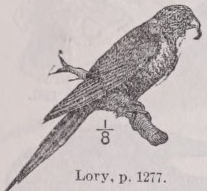
Any one of many species of small parrots of the family Trichoglossidae, generally having the tongue papillose at the tip, and the mandibles straighter and less toothed than in common parrots. They are found in the East Indies, Australia, New Guinea, and the adjacent islands. They feed mostly on soft fruits and on the honey of flowers.
Lory
Encyclopedia Britannica
LORY, a word of Malayan origin signifying Parrot, in general use with but slight variation of form in many European languages, is the name of certain birds of the order Psittaci, mostly from the Moluccas and New Guinea, which are remarkable for their bright scarlet or crimson colouring, though also, and perhaps subsequently, applied to some others in which the plumage is chiefly green. The “Lories” have been referred to a considerable number of genera, of which Eclectus, Lorins (the Domicella of some authors), Eos, and Chalcopsittacus may be here particularized, while under the equally vague name of “Lorikeets” may be comprehended the genera Charmosyna, Loriculus, and Coriρhilus. By most systematists some of these forms have been placed far apart, even in different families of Psittaci, but Garrod has shown {Proc. Zool. Society, 1874, pp. 586-598, and 1876, p. 692) the many common characters they possess, which thus goes some way to justify the relationship implied by their popular designation. The latest and perhaps the most complete account of these birds is to be found in the first part of Count T. Salvadori’s Ornitologia deli a Papuasia e delle Molucche, published at Turin in 1880, though he does not entirely accept Garrod’s arrangement. Of the genus Eclectus the Italian naturalist admits five species, namely, E. pectoralis and E. roratus, (which are respectively the ροlychlοrus and grandis of most authors), E. cardinalis (otherwise intermedius), E. westermani, and E. Cornelia— the last two from an unknown habitat, though doubtless within the limits of his labour, while the first seems to range from Waigiou and Mysol through New Guinea, including the Kei and Aru groups, to the Solomon Islands, and the second is peculiar to the Moluccas and the ...third to Bouru, Amboyna, and Ceram. Still more recently Dr A. B. Meyer has described {Proc. Zool. Society, 1881, p. 917) what he considers to be another species, E. riedeli, from Cera or Seirah, one of the Tenimber group, of which Timor Laut is the chief, to the sou th-w est of New Guinea. Much interest has been excited of late by the discovery in 1873, by the traveller and naturalist last named, that the birds of this genus possessing a red plumage were the females of those wearing green feathers. So unexpected a discovery, which was announced by Dr Meyer on the 4th of March 1874, to the Zoological and Botanical Society of Vienna, naturally provoked not a little controversy, for the difference of coloration is so marked that it had even been proposed to separate the Green from the Red Lories generically; but now the truth of his assertion is generally admitted, and the story is very fully told by him in a note contributed to Gould’s Birds of New Guinea (part viii., 1st October 1878), though several interesting matters therewith connected are still undetermined. Among these is the question of the colour of the first plumage of the young, a point not without important signification to the student of phylogeny.
Though the name Lory has long been used for the species of Eclectus, and some other genera related thereto, some writers would restrict its application to the birds of the genera Lorius, Eos, Chalcopsittacus, and their near allies, which are often placed in a subfamily, Loriinae, belonging to the so-called Family of Trichoglossidae, or “Brush-tongued” Parrots. Garrod in the course of his investigations on the anatomy of Psittaci was led not to attach much importance to the structure indicated by the epithet “brush-tongued,” stating {Proc. Zool. Society, 1874, p. 597) that it “is only an excessive development of the papillae which are always found on the lingual surface.” The birds of this group are very characteristic of the New-Guinea Subregion, in which occur, according to Count Salvador!, ten species of Lorius, eight of Eos, and four of Chalcopsittacus ; but none seem here to require any further notice, though among them, and particularly in the genus Eos, are included some of the most richly-coloured birds to be found in the whole world; nor does it appear that more need be said of the so-called Lorikeets. (a. n.)
9th ed. Encyclopædia Britannica, vol. 15, p. 7
[698 words — estimated reading time: 4 minutes]
[698 words — estimated reading time: 4 minutes]
No thesaurus entries found for "lory".
No Bible verses found for "lory".