
A tree and a genus of trees, called Mespilus; also, the fruit of the tree. The German or common medlar is cultivated in gardens for its fruit.
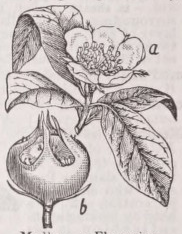
MEDLAR, Mespilus Germanica, I.., of the tribe Pomex of the order Bosacex, regarded by Bentham and Hooker as a subgenus of Pyrus (Gen. Pl., i. 626; see also DC., Prod, ii. 633; Trans. Lin. Soc., xiii. 99), is a native of European woods, &c., from Holland southwards, and of western Asia (Loudon, Arb., ii. 877). It occurs in hedges, <fcc,, in middle and south England, as a small much-branched spinous tree, but is not indigenous to Great Britain (Hooker’s Stud. Fl. of Br. Isles, 132; Baxter’s Brit. Gen. of Pl., 493, and Mag. Nat. Hist., vol. ix. 86). The medlar was well known to the ancients. Pickering (Citron. Hist, of Pl., 201) identifies it with a tree mentioned in a Siao-ya ode (She-King, ii. 1, 2), 827 b.c. It is the ρχσπίλη of Theophrastus and Mespilus of Pliny. Loudon (l.c.) gives three varieties, diffusa, stricta, and sylvestris, — the last being spiny, but losing its spines under cultivation, —as well as four varieties of fruit. He also mentions several instances of large specimens throughout England. The well-known fruit is globular, but depressed above, with leafy persistent sepals, and contains stones of a hemispherical shape. It is not fit to eat until it begins to decay. (For culture of the medlar see Horticulture.) The Japanese medlar is Eriobotrya japonica, I. , a genus of the same tribe of llosacex.