
A species of fish.
Word of the Day: Catachrestical
An American marine fish of the Herring familt (Brevoortia tyrannus), chiefly valuable for its oil and as a component of fertilizers; -- called also mossbunker, bony fish, chebog, pogy, hardhead, whitefish, etc.
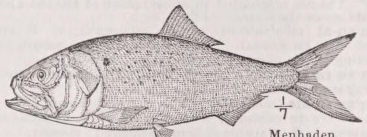
Menhaden
Encyclopedia Britannica
MENHADEN, economically one of the most important fishes of the United States, known by a great number of local names, “menhaden” and “mossbunker” being those most generally in use. In systematic works it appears under the names of Clupea menhaden and Brevoor-tia tyrannus. It is allied to the European species of shad and pilchard, and, like the latter, approaches the coast in its wanderings in immense shoals, which are found throughout the year in some part of the littoral waters between Maine and Florida, the northern shoals retiring into deeper water or to more southern latitudes with the approach of cold weather. The average size of the menhaden is about 12 inches. Although it was long known as a palatable tablefish, and largely used, when salted, for export to the West Indies, and as bait for cod and mackerel, the menhaden fishery has been developed to its present importance only within the last twenty years. A large fleet of steamers and sailing vessels is engaged in it; and a great number of large factories have sprung into existence to extract the oil, which is used for tanning and currying, and for adulterating other more expensive oils, and to manufacture the refuse into a very valuable guano. In the year 1877 2,426,589 gallons of oil and 55,444 tons of guano were produced.
An extensive business is also carried on m converting menhaden of a suitable size into “American sardines.”
A very complete account of this fishery is given by G. Brown Goode in “The Natural and Economic History of the American Menhaden,” United States Commission of Fish and Fisheries, part v., Washington, 1879.
9th ed. Encyclopædia Britannica, vol. 16, p. 10
[276 words — estimated reading time: 2 minutes]
[276 words — estimated reading time: 2 minutes]
No thesaurus entries found for "menhaden".
No Bible verses found for "menhaden".