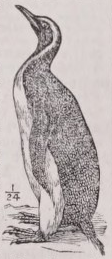
1. A genus of fowls of the order of Palmipeds. The penguin is an aquatic fowl with very short legs, with four toes, three of which are webbed; the body is clothed with short feathers, set as compactly as the scales of a fish; the wings are small like fins, and covered with short scale-like feathers, so that they are useless in flight. Penguins seldom go on shore, except in the season of breeding, when they burrow like rabbits. On land they stand erect; they are tame and may be driven like a flock of sheep. In water they swim with rapidity, being assisted by their wings. These fowls are found only in the southern latitudes.
1. Any bird of the order Impennes, or Ptilopteri. They are covered with short, thick feathers, almost scalelike on the wings, which are without true quills. They are unable to fly, but use their wings to aid in diving, in which they are very expert. See King penguin, under Jackass.
2. The egg-shaped fleshy fruit of a West Indian plant (Bromelia Pinguin) of the Pineapple family; also, the plant itself, which has rigid, pointed, and spiny-toothed leaves, and is used for hedges.
PENGUIN, the name (of very uncertain origin) of a flightless sea-bird, turn out to be Sir Francis Drake” and his men. In support of the third hypothesis Mr. Reeks wrote (Zoologist, ser. 2, p. 1804) that the people in Newfoundland who used to meet with this bird always pronounced its name “Pin wing.” Prof. Skeat’s inquiry (loc. citA), whether the name may not after all be South-American, is to be answered in the negative, since, so far as evidence goes, it was given to the North-American bird before the South-Americau was known in Europe. ] but, so far as is known, first given to one inhabiting the seas of Newfoundland, as in Hore’s “Voyage to Cape Breton,” 1536 (Hackluyt, Researches, iii. pp. 168-170), which subsequently became known as the Great Auk or Gare-fowl (vol. x. p. 78); and, though the French equivalent Pingouin · preserves its old application, at the present day, the word Penguin is by English ornithologists always used in a general sense for certain Birds inhabiting the Southern Ocean, called by the French Manchots, the Spheniscidae of ornithologists, which in some respects form perhaps the most singular group of the whole Class, or at least we may say of the CarinateSubclass. For a long while their position was very much misunderstood, some of the best of recent or even living systematists having placed them in close company with the Alcidae or Auks, to which they bear only a relationship of analogy, as indeed had been perceived by a few ornithologists, who recognized in the Penguins a very distinct Order, Pηιpennes. The view of the latter is hardly likely to be disputed in future, now that the anatomical researches of MM. Paul Gervais and Alix (Journ. de Zoologie, 1877, pp. 424-470), M. Filhol {Bull. Soc. Philomathique, ser. 7, vi. pp. ...226-248), and above all of Prof. Watson (Zoology, Voy. Challenger, part xviii.) have put the independent position of the Splieniscidae in the clearest light. The most conspicuous outward character presented by the Penguins is the total want of quills in their wings, which are as incapable of flexure as the flippers of a Cetacean, though they move freely at the shoulder-joint, and some at least of the species occasionally make use of them for progressing on land. In the water they are most efficient paddles, and are usually, if not always, worked alternately with a rotatory action. The plumage which clothes the whole body, leaving no bare spaces, generally consists of small scale-like feathers, many of them consisting only of a simple shaft without the development of barbs; but several of the species have the head decorated with long cirrhous tufts, and in some the tail-quills, which are very numerous, are also long. In standing these birds preserve an upright position, generally resting on the “tarsus” alone, but in walking or running on land this is kept nearly vertical, and their weight is supported by the toes alone.
The most northerly limit of the Penguins’ range in the Atlantic is Tristan d’Acunha, and in the Indian Ocean Amsterdam Island, but they also occur off the Cape of Good Hope and along the south coast of Australia, as well as on the south and east of New Zealand, while in the Pacific one species at least extends along the west coast of South America and to the Galapagos; but north of the equator none are found. In the breeding season they resort to the most desolate lands in higher southern latitudes, and indeed have been met with as far to the southward as navigators have penetrated. Possibly the Falkland Islands may be regarded as the locality richest in species, though, whatever may have been the case once, their abundance there as individuals does not now nearly approach what it is in many other places, owing doubtless to the ravages of man, whose advent is always accompanied by massacre and devastation on an enormous scale—the habit of the helpless birds, when breeding, to congregate by hundreds and thousands in what are called “Penguin-rookeries” contributing to the ease with which their slaughter can be effected. Incapable of escape by flight, they are yet able to make enough resistance or retaliation (for they bite powerfully when they get the chance) to <xcite the wrath of their murderers, and this only brings upon them greater destruction, so that the interest of nearly all the numerous accounts of these “rookeries” is spoilt by the disgusting details of the brutalhavocperpetrated upon them.
The Spheniscùlae have been divided into at least eight genera, but three, or at most four, seem to be all that are needed, and three can be well distinguished, as pointed out by Dr Coues in the Philadelphia Proceedings for 1872 (pp. 170-212), by anatomical as well as by external characters. They are (1) Aptenodytes, easily recognized by its long and thin bill, slightly decurved, from which Pygoscelis, as Prof. Watson has shewn, is hardly distinguishable; (2) Eudyptes, in which the bill is much shorter and somewhat broad; and (3) Spheniscus, in which the shortish bill is compressed and the maxilla ends in a conspicuous hook. Aptenodytes contains the largest species, among them those known as the “Emperor” and ‘ ‘ King” Penguins, A. patagonica and A. longirostris. Three others belong also to this genus, if Pygoscelis be not recognized, but they seem not to require any particular remark. Eudyptes, containing the crested Penguins, known to sailors as “Rock-hoppers” or “Macaronis,” would appeal* to have five species, and Spheniscus four, among which S. nιendiculus, which occurs in the Galapagos, and therefore has the most northerly range of the whole group, alone needs notice here. The generic and specific distribution of the Penguins is the subject of an excellent essay by Prof. Alphonse Milne-Edwards in the Annales des Sciences Naturelles for 1880 (vol. ix. art. 9, pp. 23-81), of which there is a German translation in the Mittheilungen of the Ornithological Union of Vienna for 1883 (pp. 179-186, 210-222, 238-241). (a. n.)
9th ed. Encyclopædia Britannica, vol. 18, p. 491 [1,023 words — estimated reading time: 6 minutes]
This site uses cookies to remember your display preferences (search sources and editions, Bible version, auto-link, images, light/dark theme). No personal data whatsoever is collected. Privacy Policy