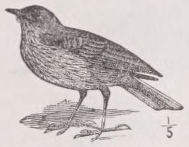
Any one of numerous species of small singing birds belonging to Anthus and allied genera, of the family Motacillidae. They strongly resemble the true larks in habits, colors, and the great length of the hind claw. They are, therefore, often called titlarks, and pipit larks.
PIPIT, French Pipit, cognate with the Latin Pipio (see Pigeon, supra p. 84), the name applied by ornithologists to a group of birds having a great resemblance both in habits and appearance to the Larks (vol. xiv. p. 317), with which they were formerly confounded by systematises as they are at the present day in popular speech, but differing from them in several important characters, and, having been first separated to form the genus Anthus, which has since been much broken up, are now generally associated with the Wagtails (⅛.v.) in the Family Mota- cillidae. Pipits, of which over fifty species have been described, occur in almost all parts of the world, but in North America are represented by only two species— Neocorys spraguii, the Prairie-Lark of the north-western plains, and Anthus ludovicianus, the American Titlark, which last is very nearly allied to the so-called Water-Pipit of Europe, A. spipoletta. To most English readers the best known species of Pipit is the Titlark or Meadow-Pipit, A. pratensis, a bird too common to need description, and abundant on pastures, moors, and uncultivated districts generally; but in some localities the Tree-Pipit, A. trivialis, or A. arboreus of some authors, takes its place, and where it does so it usually attracts attention by its loud song, which is not unlike that of a Canary-bird, but delivered (as appears to be the habit of all the Pipits) on the wing and during a short circuitous flight. Another species, the Rock-Lark, A. obscurus, scarcely ever leaves the sea-coast and is found almost all round the British Islands. The South-African genus Macronyx, remarkable for the extreme length of its hind claw, is generally placed among the Pipits, but differs from all the rest in its brighter coloration, which has a curious ...resemblance to the American genus Sturnella (see Icterus, vol. xii. p. 697), though the bird is certainly not allied thereto. (a. n.)
9th ed. Encyclopædia Britannica, vol. 19, p. 112 [327 words — estimated reading time: 2 minutes]
No thesaurus entries found for "pipit".
No Bible verses found for "pipit".
This site uses cookies to remember your display preferences (search sources and editions, Bible version, auto-link, images, light/dark theme). No personal data whatsoever is collected. Privacy Policy