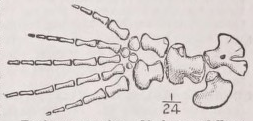
1. Any species of very large snakes of the genus Python, and allied genera, of the family Pythonidae. They are nearly allied to the boas. Called also rock snake.
PYTHON, a genus of gigantic snakes inhabiting the tropical parts of Africa and Asia, and known in some parts of the British possessions by the name of “rock-snakes.” On account of their general appearance, beautifully-marked skin, large size, and similarity of habits they are frequently confounded with the true boas of the New World and misnamed “boa-constrictors.” They differ from them, however, by having a double row of scutes under the tail, pits in the shields round the margins of the upper and lower jaws, and teeth in the intermaxillary bone....
Africa is inhabited by three species {Python sebae, P. regius, and P. natalensis), and Asia by two {Python vιolurus and P. reticulatus), the former of these two species being found on the continent of India and in Ceylon, the latter in the large islands of the Archipelago and in the Malayan Peninsula. In Australasia and New Guinea similar snakes occur, but they are of much smaller size and differ in essential structural characters from the rock-snakes. These latter are among the largest of living reptiles; although their dimensions and strength have been much exaggerated, specimens of 18 and 20 feet have been brought to Europe, and reliable statements of the occurrence of individuals which measured 30 feet are on record. Snakes of this size will easily overpower and kill one of the small species of deer or antelopes which abound in their native haunts, a sheep, or a good-sized dog; but the width of their mouth would not permit them to swallow an animal larger than a half-grown sheep. The way in which they seize and kill their prey does not differ from that observed in numerous other non-venomous snakes: after having seized their victim, they smother it by constriction, throwing several coils of the body over and round it. In swallowing they always commence with the head; and, as they prey exclusively on mammals and birds, the hairs and feathers offer a considerable impediment to the passage through the narrow but distensible throat. The process of deglutition is therefore slow, although facilitated by the great quantity of saliva discharged over the body of the victim. During the time of digestion the snake is very lazy, and unwilling to move and to defend itself when attacked. At other times these animals are fierce enough, although always harmless to man if left unmolested. In captivity they seem to become used to those who attend upon them, but their apparent tameness is due rather to the depressing influence of a colder climate than to a change of their naturally excitable temper. Rock-snakes are mostly arboreal, and prefer localities in the vicinity of water to which animals resort for the purpose of drinking. They move, climb, and swim with equal facility. It has now been well established by observations on specimens in a state of nature as well as in captivity that the female rock-snake incubates her eggs for about two months, at the end of which period the young are hatched, and probably remain under the protection of the mother for a few weeks longer. The snake collects the eggs into a conical heap, round which she coils herself, entirely covering them so that her head rests in the centre on the top of the cone. In this position the animal remains without food throughout the whole period of incubation, and an increase of the temperature between the coils of the snake has been observed in every case.
9th ed. Encyclopædia Britannica, vol. 20, p. 144 [587 words — estimated reading time: 4 minutes]
Phr. a prophet is without honor in his own country, "you don't need a weatherman to know which way the wind blows"
No Bible verses found for "python".
This site uses cookies to remember your display preferences (search sources and editions, Bible version, auto-link, images, light/dark theme). No personal data whatsoever is collected. Privacy Policy