
A North American nocturnal carnivore (Procyon lotor) allied to the bears, but much smaller, and having a long, full tail, banded with black and gray. Its body is gray, varied with black and white. Called also coon, and mapach.
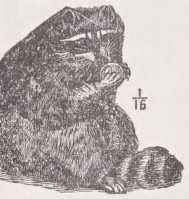
RACCOON. This name, familiar to all readers of works on American natural history, is borne by a small carnivore belonging to that section of the order which contains the bears, weasels, badgers, &c. (see Mammalia, vol. xv. p. 440). The raccoon resembles in many respects a diminutive bear, both in its general build and in the proportions of its skull and teeth, which last are broad, blunt, and rounded, and more suited for a semi-vegetarian than for an exclusively animal diet. Its other more important zoological characters, with an account of its systematic position, have been already noted in the article just referred to. The common North-American raccoon (Procyon lotor) is a clumsy thickly-built animal about the size of a badger, with a coat of long coarse greyish brown hairs, short ears, and a bushy black and white ringed tail. Its range extends over the whole of the United States, and stretches on the west northwards to Alaska and southwards well into Central America, where it attains its maximum size. The following notes on the habits of the raccoon are extracted from Dr C. Hart Merriam’s charming work on the mammals of the Adirondacks (N. E. New York)....
“Raccoons are omnivorous beasts and feed upon mice, small birds, birds’ eggs, turtles and their eggs, frogs, fish, crayfish, molluscs, insects, nuts, fruits, maize, and sometimes poultry. Excepting alone the bats and flying-squirrels, they are the most strictly nocturnal of all our mammals, and yet I have several times seen them abroad on cloudy days. They haunt the banks of ponds and streams, and find much of their food in these places, such as crayfish, mussels, and fish, although they are unable to dive and pursue the latter under water, like the otter and mink. They are good swimmers and do not hesitate to cross livers that lie in their path. . . . The raccoon hibernates during the severest part of the winter, retiring to its nest rather early, and appearing again in February or March, according to the earliness or lateness of the season. It makes its home high up in the hollow of some large tree, preferring a dead limb to the trunk itself. It does little in the way of constructing a nest, and from four to six young are commonly born at a time, generally early in April in this region. The young remain with the mother about a year.”
The South-American species, Procyon cancrivorus , the crab-eating raccoon, is very similar to P. lotor , but differs by its much shorter fur, larger size, proportionally more powerful teeth, and other minor characters. It extends over the whole of South America, as far south as the Rio Negro, and is very common in all suitable localities. Its habits are similar to those of the North-American species.