
A large and valuable sparoid food fish (Archosargus, / Diplodus, probatocephalus) found on the Atlantic coast of the United States. It often weighs from ten to twelve pounds.
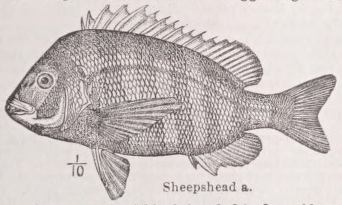
SHEEPSHEAD is the name of one of the largest species of the genus Sargus, marine fishes known on the coasts of southern Europe as “sargo” or “saragu.” These fishes possess two kinds of teeth :—one, broad and flat, like incisors, occupying in a single series the front of the jaws; the other, semiglobular and molar-like, arranged in several series on the sides of the jaws. For the systematic position of the genus, see vol. xii. p. 689. The sheepshead, Sargus οvis, occurs in abundance on the Atlantic coasts of the United States, from Cape Cod to Florida, and is one of the most valued food-fishes of North America. It is said to attain to a length of 30 inches and a weight of 15
pounds. Its food consists of shellfish, which it detaches with its incisors from the base to which they are fixed, crushing them with its powerful molars. It may be distinguished from some other allied species occurring in the same seas by the presence of seven or eight dark crossbands traversing the body, by a recumbent spine in front of the dorsal fin, by twelve spines and as many rays of the dorsal and ten rays of the anal fin, and by forty-six scales along the lateral line. The term “sheepshead” is also given in some parts of North America to a very different fish, a freshwater Sciaenoid, Corvina oscula, which is much less esteemed for the table.