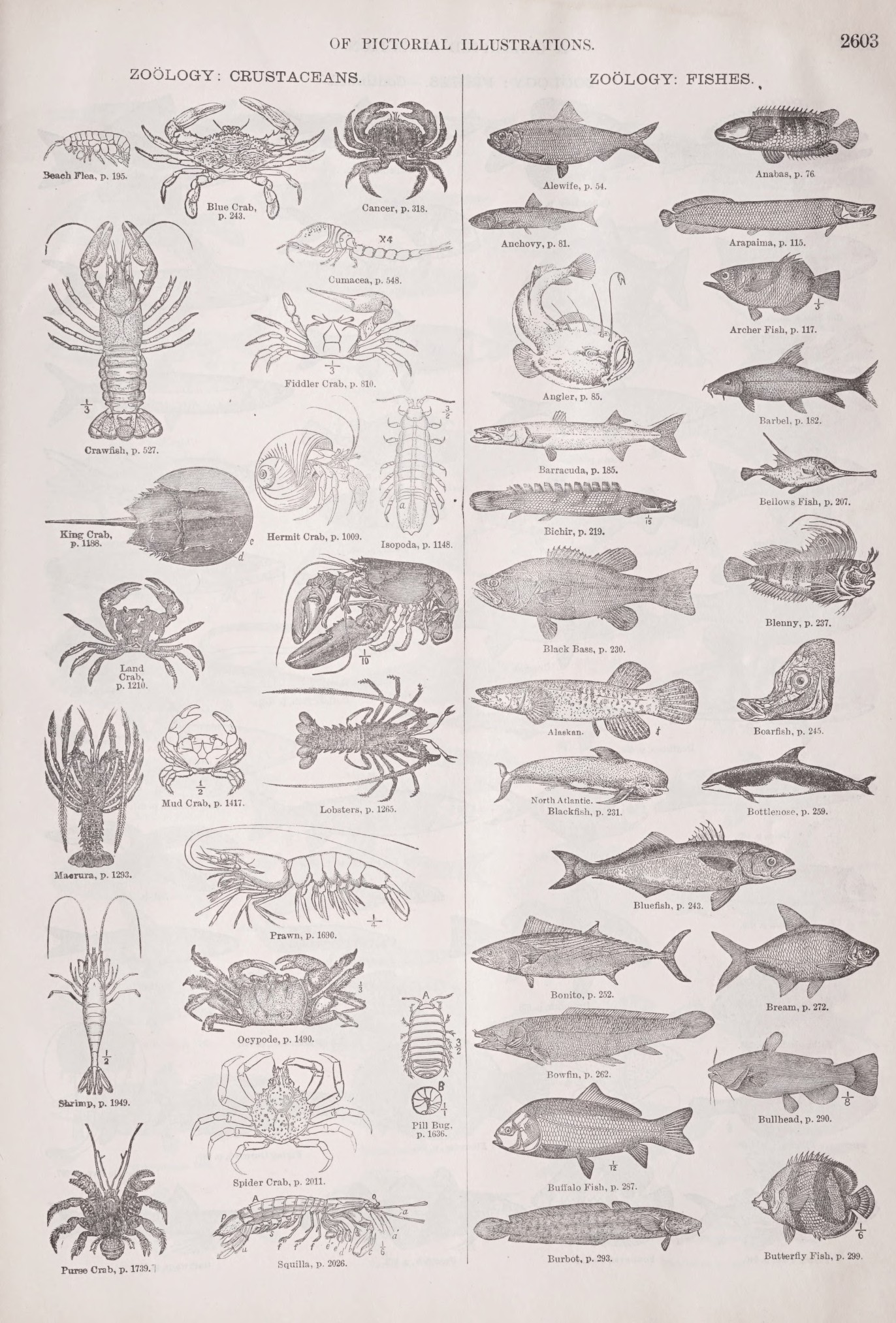
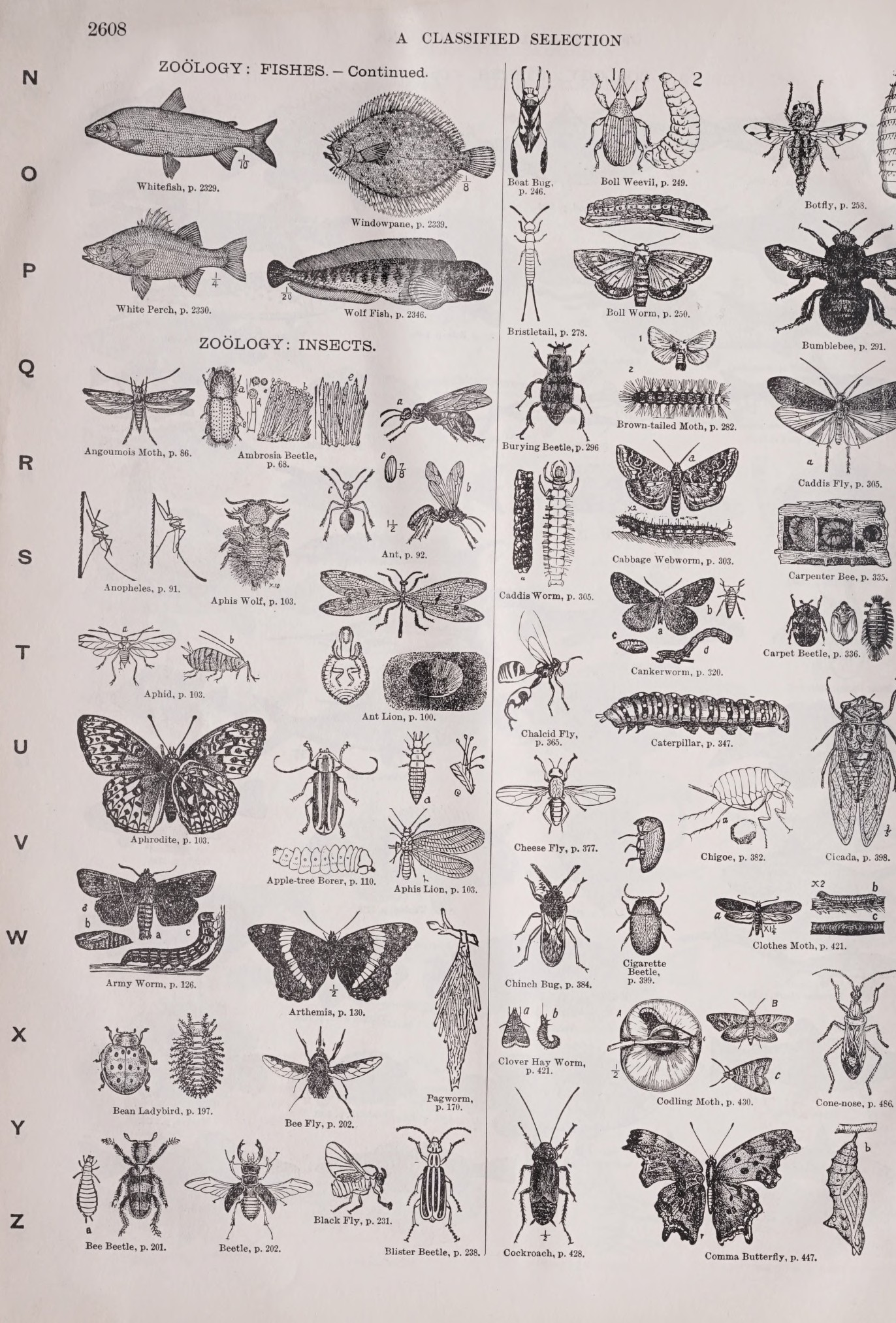
A treatise on animals, or the science of animals; that branch of natural history which respects the forms, classification, history and habits of animals, particularly of brutes or irrational animals.
Word of the Day: Catachrestical
1. That part of biology which relates to the animal kingdom, including the structure, embryology, evolution, classification, habits, and distribution of all animals, both living and extinct.
2. A treatise on this science.
Zoology
Encyclopedia Britannica
ZOOLOGY
THF branch of science to which the name zoology is strictly applicable may be defined as that portion of biology which relates to animals, as distinguished from that portion which is concerned with plants.
The science of biology itself has been placed by Mr Herbert Spencer in the group of concrete sciences, the other groups recognized by that writer being the “abstractconcrete” and the “abstract.” The abstract sciences are logic and mathematics, and treat of the blank forms in which phenomena occur in relation to time, space, and number. The abstract-concrete sciences are mechanics, physics, and chemistry. The title assigned to them is justified by the fact that, whilst their subject-matter is found in a consideration of varied concrete phenomena, they do not aim at the explanation of complex concrete phenomena as such, but at the determination of certain “abstract” quantitative relations and sequences known as the “laws” of mechanics, physics, and chemistry, which never are manifested in a pure form, but always are inferred by observation and experiment upon complex phenomena in which the abstract laws are disguised by their simultaneous interaction. The group of concrete sciences includes astronomy, geology, biology, and sociology. These sciences have for their aim to “explain” the concrete complex phenomena of (a ) the sidereal system, (ό) the earth as a whole, (c) the living matter on the earth’s surface, (d ) human society, by reference to the properties of matter set forth in the generalizations or laws of the abstract-concrete sciences, i.e., of mechanics, physics, and chemistry....
The classification thus sketched exhibits, whatever its practical demerits, the most important fact with regard to biology, namely, that it is the aim or business of those occupied with that branch of science to assign living things, in all their variety of form and activity, to the one set of forces recognized by the physicist and chemist. Just as the astronomer accounts for the heavenly bodies and their movements by the laws of motion and the property of attraction, as the geologist explains the present state of the earth’s crust by the long-continued action of the same forces which at this moment are studied and treated in the form of “laws” by physicists and chemists, so the biologist seeks to explain in all its details the long process of the evolution of the innumerable forms of life now existing, or which have existed in the past, as a necessary outcome, an automatic product, of these same forces.
Science may be defined as the knowledge of causes; and, so long as biology was not a conscious attempt to ascertain the causes of living things, it could not be rightly grouped with other branches of science. For a very long period the two parallel divisions of biology,—botany and zoology,— were actually limited to the accumulation of observations, which were noted, tabulated, and contemplated by the students of these subjects with wonder and delight, but only to a limited extent and in restricted classes of facts with any hope or intention of connecting the phenomena observed with the great nexus of physical sequence or causation. A vague desire to assign the forms and the activities of living things in all their variety to general causes has always been present to thoughtful observers from the earliest times of which we have record, but the earlier attempts in this direction were fantastic in the extreme; and it is the mere truth that, at the time when the phenomena of inorganic nature had been recognized as the outcome of uniform and constant properties capable of analysis and measurement, living things were still left hopelessly out of the domain of explanation, the earlier theories having been rejected and nothing as yet suggested in their place.
The history of zoology as a science is therefore the history of the great biological doctrine of the evolution of living things by the natural selection of varieties in the struggle for existence,—since that doctrine is the one medium whereby all the phenomena of life, whether of form or function, are rendered capable of explanation by the laws of physics and chemistry, and so made the subject-matter of a true science or study of causes. A history of zoology must take account of the growth of those various kinds of information with regard to animal life which have been arrived at in past ages through the labours of a long series of ardent lovers of nature, who in each succeeding period have more and more carefully and accurately tested, proved, arranged, and tabulated their knowledge, until at last the accumulated lore of centuries—almost without the consciousness of its latest heirs and cultivators—took the form of the doctrine of descent and the filiation of the animal series.
History.
There is something almost pathetic in the childish wonder and delight with which mankind in its earlier phases of civilization gathered up and treasured stories of strange animals from distant lands or deep seas, such as are recorded in the Physiologus, in Albertus Magnus, and even at the present day in the popular treatises of Japan and China. That omnivorous universally credulous stage, which may be called the “legendary,” was succeeded by the age of collectors and travellers, when many of the strange stories believed in were actually demonstrated as true by the living or preserved trophies brought to Europe by adventurous navigators. The possibility of verification established verification as a habit; and the collecting of things, instead of the accumulating of reports, developed a new faculty of minute observation. The early collectors of natural curiosities were the founders of zoological science, and to this day the naturalist-traveller and his correlative, the museum curator and systematist, play a most important part in the progress of zoology. Indeed, the historical and present importance of this aspect or branch of zoological science is so great that the name “zoology” has until recently been associated entirely with it, to the exclusion of the study of minute anatomical structure and function which have been distinguished as anatomy and physiology. It is a curious result of the steps of the historical progress of the two divisions of biological science that, whilst the word “botany” has always been understood, and is at the present day understood, as embracing the study, not only of the external forms of plants, their systematic nomenclature and classification, and their geographical distribution, but also the study of their minute structure, their organs of nutrition and reproduction, and the mode of action of the mechanism furnished by those organs, the word “zoology” has been limited to such a knowledge of animals as the travelling sportsman could acquire in making his collections of skins of beasts and birds, of dried insects and molluscs’ shells, and such a knowledge ‘as the museum curator could acquire by the examination and classification of these portable objects. Anatomy and the study of animal mechanism, animal physics, and animal chemistry, all of which form part of a true zoology, have been excluded from the usual definition of the word by the mere accident that the zoologist of the last three centuries has had his museum but has not had his garden of living specimens as the botanist has had; and, whilst the zoologist has thus for a long time been deprived of the means of anatomical and physiological study—only supplied within the past century by the method of preserving animal bodies in alcohol—the demands of medicine for a knowledge of the structure of the human animal have in the meantime brought into existence a separate and special study of human anatomy and physiology.
From these special studies of human structure the knowledge of the anatomy of animals has proceeded, the same investigator who had made himself acquainted with the structure of the human body desiring to compare with the standard given by human anatomy the structures of other animals. Thus comparative anatomy came into existence as a branch of inquiry apart from zoology, and it is only now, in the latter part of the 19th century, that the limitation of the word “zoology” to a knowledge of animals which expressly excludes the consideration of their internal structure has been rejected by the general consent of those concerned in the progress of science; it is now generally recognized that it is mere tautology to speak of zoology and comparative anatomy, and that our museum naturalists must give attention as well to the inside as to the outside of animals.
The anatomy and physiology of plants have never been excluded from the attention of botanists, because in contrast to the earlier zoologists they always were in possession of the whole living plant, raised from seed if need be in a hot-house, instead of having only a dried skin, skeleton, or shell. Consequently the study of vegetable anatomy and physiology has grown up naturally and in a healthy way in strict relation to the rest of botanical knowledge, whilst animal anatomy and physiology have been external to zoology in origin, the product of the medical profession and, as a consequence, subjected to a misleading anthropocentric method.
Whilst we may consider the day as gone by in which zoology could be regarded as connoting solely a special museum knowledge of animals (as twenty-five years ago was still the case), it is interesting to observe by the way the curious usurpation of the word “physiology,” which, from having a wide connotation, indicated by its etymology, —the physiologus of the Middle Ages being nothing more nor less than the naturalist or student of nature,—has in these later days acquired a limitation which it is difficult to justify or explain. Physiology to-day means the study of the physical and chemical properties of the animal or vegetable body, and is even distinguished from the study of structure and strictly confined to the study of function. It would hardly be in place here to discuss at length the steps by which physiology became thus limited, any more than to trace those by which the words “physician” and “physicist” (which both mean one who occupies himself with nature) came to signify respectively a medical practitioner and a student of the laws of mechanics, heat, light, and electricity (but not of chemistry), whilst the word “naturalist” is very usually limited to a lover and student of living things, to the exclusion of the so-called physicist, the chemist, and the astronomer. It is probable that physiology acquired its present significance, viz., the study of the properties and functions of the tissues and organs of living things, by a process of external attraction and spoliation which gradually removed from the original physiologus all his belongings and assigned them to newly named and independently constituted sciences, leaving at last, as a residuum to which the word might still be applied, that medical aspect of life which is concerned with the workings of the living organism regarded as a piece of physico-chemical apparatus.
Whatever may be the history of the word “physiology,” we find zoology, which really started in the 16th century with the awakening of the new spirit of observation and exploration, for a long time running a separate course uninfluenced by the progress of the medical studies of anatomy and physiology. The history of every branch of science involves a recognition of the history, not only of other branches of science, but of the progress of human society in every other relation. The century which destroyed the authority of the church, witnessed the discovery of the New World, and in England produced the writings of Francis Bacon is rightly regarded as the starting-point of the modern knowledge of natural causes or science. The true history of zoology as a science lies within the three last centuries; and, whilst the theories and fables which were current in earlier times in regard to animal life and the various kinds of animals form an important subject of study from the point of view of the history of the development of the human mind, they really have no bearing upon the history of scientific zoology. The great awakening of western Europe in the 16th century led to an active search for knowledge by means of observation and experiment, which found its natural home in the universities. Owing to the connexion of medicine with these seats of learning, it was natural that the study of the structure and functions of the human body and of the animals nearest to man should take root there; the spirit of inquiry which now for the first time became general showed itself in the anatomical schools of the Italian universities of the 16th century, and spread fifty years later to Oxford.
In the 17th century the lovers of the new philosophy, the investigators of nature by means of observation and experiment, banded themselves into academies or societies for mutual support and intercourse. It is difficult to exaggerate the importance of the influence which has been exercised by these associations upon the progress of all branches of science and of zoology especially. The essential importance of academies is to be found, as Laplace, the great French astronomer, has said, “in the philosophic spirit which develops itself in them and spreads itself from them as centres over an entire nation and all relations. The isolated man of science can give himself up to dogmatism without restraint; he hears contradictions only from afar. But in a learned society the enunciation of dogmatic views leads rapidly to their destruction, and the desire of each member to convince the others necessarily leads to the agreement to admit nothing excepting what is the result of observation or of mathematical calculation.”
The first founded of surviving European academies, the Academia Naturae Curiosorum (1651), especially confined itself to the description and illustration of the structure of plants and animals; eleven years later (1662) the Royal Society of London was incorporated by royal charter, having existed without a name or fixed organization for seventeen years previously (from 1645). A little later the Academy of Sciences of Paris was established by Louis XIV. The influence of these great academies of the 17th century on the progress of zoology was precisely to effect that bringing together of the museum-men and the physicians or anatomists which was needed for further development. Whilst the race of collectors and systematizes culminated in the latter part of the 18th century relation to real knowledge, but was part of a peculiar and in itself highly interesting mysticism. A fantastic and elaborate doctrine of symbolism existed which comprised all nature; witchcraft, alchemy, and medicine were its practical expressions. Animals as well as plants were regarded as “simples” and used in medicine, and a knowledge of them was valued from this point of view. Plants were collected and cultivated for medicinal use; hence the physic gardens and the botanist’s advantage.
in Linnaeus, a new type of student made its appearance in such men as John Hunter and other anatomists, who, not satisfied with the superficial observations of the popular “zoologists,” set themselves to work to examine anatomically the whole animal kingdom, and to classify its members by aid of the results of such profound study. From them we pass to the comparative anatomists of the 19th century and the introduction of the microscope as a serious instrument of accurate observation.
The influence of the scientific academies and the spirit in which they worked in the 17th century cannot be better illustrated than by an examination of the early records of the Royal Society of London. The spirit which animated the founders and leaders of that society is clearly indicated in its motto “Nullius in verba.” Marvellous narrations were not permitted at the meetings of the society, but solely demonstrative experiments or the exhibition of actual specimens. Definite rules were laid down by the society for its guidance, designed to ensure the collection of solid facts and the testing of statements embodying novel or remarkable observations. Under the influence of the touchstone of strict inquiry set on foot by the Royal Society, the marvels of witchcraft, sympathetic powders, and other relics of mediaeval superstition disappeared like a mist before the sun, whilst accurate observations and demonstrations of a host of new wonders accumulated, amongst which were numerous contributions to the anatomy of animals, and none perhaps more noteworthy than the observations, made by the aid of microscopes constructed by himself, of Leeuwenhoek, the Dutch naturalist (1683), some of whose instruments were presented by him to the society.
It was not until the 19th century that the microscope, thus early applied by Leeuwenhoek, Malpighi, Hook, and Swammerdam to the study of animal structure, was perfected as an instrument, and accomplished for zoology its final and most important service. The earlier half of the 19th century is remarkable for the rise, growth, and full development of a new current of thought in relation to living things, expressed in the various doctrines of development which were promulgated, whether in relation to the origin of individual animals and plants or in relation to their origin from predecessors in past ages. The perfecting of the microscope led to a full comprehension of the great doctrine of cell-structure and the establishment of the facts—(1) that all organisms are either single corpuscles (so-called cells) of living material (microscopic animalcules, &c.) or are built up of an immense number of such units; (2) that all organisms begin their individual existence as a single unit or corpuscle of living substance, which multiplies by binary fission, the products growing in size and multiplying similarly by binary fission; and (3) that the life of a multicellular organism is the sum of the activities of the corpuscular units of which it consists, and that the processes of life must be studied in and their explanation obtained from an understanding of the chemical and physical changes which go on in each individual corpuscle or unit of living material or protoplasm (cell-theory of Schwann).
On the other hand, the astronomical theories of development of the solar system from a gaseous condition to its present form, put forward by Kant and by Laplace, had impressed men’s minds with the conception of a general movement of spontaneous progress or development in all nature; and, though such ideas were not new but are to be found in some of the ancient Greek philosophers, yet now for the first time they could be considered with a sufficient knowledge and certainty as to the facts, due to the careful observation of the two preceding centuries. The science of geology came into existence, and the whole panorama of successive stages of the earth’s history, each with its distinct population of strange animals and plants, unlike those of the present day and simpler in proportion as they recede into the past, was revealed by Cuvier, Agassiz, and others. The history of the crust of the earth was explained by Lyell as due to a process of slow development, in order to effect which he called in no cataclysmic agencies, no mysterious forces differing from those operating at the present day. Thus he carried on the narrative of orderly development from the point at which it was left by Kant and Laplace,—explaining by reference to the ascertained laws of physics and chemistry the configuration of the earth, its mountains and seas, its igneous and its stratified rocks, just as the astronomers had explained by those same laws the evolution of the sun and planets from diffused gaseous matter of high temperature.
The suggestion that living things must also be included in this great development was obvious. They had been so included by poet-philosophers in past ages; they were so included by many a simple-minded student of nature who, watching the growth of the tree from the seed, formed a true but unverified inference in favour of a general process of growth and development of all things from simpler beginnings. The delay in the establishment of the doctrine of organic evolution was due, not to the ignorant and unobservant, but to the leaders of zoological and botanical science. Knowing as they did the almost endless complexity of organic structures, realizing as they did that man himself with all the mystery of his life and consciousness must be included in any explanation of the origin of living things, they preferred to regard living things as something apart from the rest of nature, specially cared for, specially created by a Divine Being, rather than to indulge in hypotheses which seemed to be beyond all possibility of proof, and were rather of the nature of poets’ dreams than in accordance with the principles of that new philosophy of rigid adherence to fact and demonstration which had hitherto served as the mainsprings of scientific progress. Thus it was that the so-called “Natur-philosophen” of the last decade of the 18th century, and their successors in the first quarter of the 19th, found few adherents among the working zoologists and botanists. Lamarck, Treviranus, Erasmus Darwin, Goethe, and Saint-Hilaire...
9th ed. Encyclopædia Britannica, vol. 24, p. 799 — signed E. R. L.
[21,042 words — estimated reading time: 2.1 hours]
[21,042 words — estimated reading time: 2.1 hours]
Organization Roget’s Thesaurus §357
N. organized world, organized nature, living nature, animated nature, living beings, organic remains, fossils, protoplasm, cytoplasm, protein, albumen, structure, organization, organism, biology, natural history, organic chemistry, anatomy, physiology, zoology, botany, microbiology, virology, bacteriology, mycology, naturalist, archegenesis, antherozoid, bioplasm, biotaxy, chromosome, dysmeromorph, ecology, oecology, erythroblast, gametangium, gamete, germinal matter, invagination, isogamy, oogamy, karyaster, macrogamete, microgamete, metabolism, anabolism, catabolism, metaplasm, ontogeny, ovary, ovum, oxidation, phylogeny, polymorphism, protozoa, spermary, spermatozoon, trophoplasm, vacuole, vertebration, zoogloea, zygote, darwinism, neo-darwinism, lamarkism, neolamarkism, weismannism, morphology, taxonomy
Adj. organic, organized, karyoplasmic, unsegmentic, vacuolar, zoogloeic, zoogloeoid
Zoology Roget’s Thesaurus §368
N. zoology, zoonomy, zoography, zootomy, anatomy, comparative anatomy, animal physiology, comparative physiology, morphology, mammalogy, anthropology, ornithology, ichthyology, herpetology, ophiology, malacology, helminthology, entomology, oryctology, paleontology, mastology, vermeology, ichthy &c. ichthyotomy, taxidermy, zoologist &c
Adj. zoological
No Bible verses found for "zoology".