
A Mediterranean fish, called also sarachus.
Word of the Day: Catachrestical
1. Hanging at the cathead, ready to let go, as an anchor.
Cold.
See Acolythist.
An organic base, in the form of a white powder, obtained from Aconitum lycoctonum.
1. AC'OLYTE ,
2. In the ancient church, one of the subordinate officers, who lighted the lamps, prepared the elements of the sacraments, attended the bishops, etc. An officer of the like character is still employed in the Romish Church.
1. One who has received the highest of the four minor orders in the Catholic church, being ordained to carry the wine and water and the lights at the Mass.
2. One who attends; an assistant.
Acolyte
Encyclopedia Britannica
ACOLYTE (from ακόλουθος, an attendant), one of a minor order of clergy in the ancient church, ranking next to the sub-deacon. We learn from the canons of the fourth Council of Carthage that the archdeacon, at their ordination, put into their hands a candlestick with a taper and an empty pitcher, to imply that they were appointed to light the candles of the church and to furnish wine for the eucharist. Their dress was the cassock and surplice. The name and office still exist in the church.
9th ed. Encyclopædia Britannica, vol. 1, p. 98
[87 words — estimated reading time: 1 minute]
[87 words — estimated reading time: 1 minute]
An acolyte.
Aconcagua
Encyclopedia Britannica
ACONCAGUA, a province of Chile, South America, is about 100 miles long by 40 miles wide, and lies between 31° 30' and 33° 20' S. lat., and 70° and 71° 30' W. long., between the provinces of Valparaiso and Santiago on the N. and Coquimbo on the S. A large part of the province is mountainous, but it contains several rich and fertile valleys, which yield wheat, maize, sugar-cane, fruits, and garden produce in abundance. In the agricultural districts there are raised from 50 to 60 fanegas of wheat for every quadra, equal to about 35 bushels per English acre. The province has also mineral resources, but not to such extent as Coquimbo or Atacama. Its chief town is San Felipe. The mountain Aconcagua, one of the loftiest peaks of the Andes, rises to the height of 23,910 feet above the sea on the frontier between this province and Mendoza, a department of the Argentine Republic. A river of the same name rises on the south side of the mountain, and after a course of 230 miles falls into the Pacific 12 miles N. of Valparaiso. Popidation (1870), 134,178.
9th ed. Encyclopædia Britannica, vol. 1, p. 98
[192 words — estimated reading time: 2 minutes]
[192 words — estimated reading time: 2 minutes]
Alt. of Acondylous
Being without joints; jointless.
Aconite
Encyclopedia Britannica
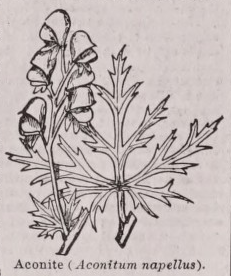
ACONITE, Aconitum, a genus of plants commonly known as Aconite, Monkshood, Friar’s Cap, or Helmet flower, and embracing about 18 species, chiefly natives of the mountainous parts of the northern hemisphere. They are distinguished by having one of the five blue or yellow coloured sepals in the form of a helmet; hence the English name. Two of the petals placed under the hood of the calyx are supported on long stalks, and have a hollow spur at their apex. The genus belongs to the natural order Ranunculacese, or the Buttercup family. Aconitum Napellus, common monkshood, is a doubtful native of Britain. It is an energetic irritant and narcotic poison. It causes death by a depressing effect on the nervous system, by producing palsy of the muscles concerned in breathing, and by fainting. A tincture prepared by the action of spirit on the roots is used medicinally to allay pain, especially in cases of tic. Its roots have occasionally been mistaken for horse-radish. The Aconite has a short underground stem, from which dark-coloured tapering roots descend. The crown or upper portion of the root gives rise to new plants. When put to the lip, the juice of the Aconite root produces a feeling of numbness and tingling. The horseradish root, which belongs to the natural order Cruci-ferae, is much longer than that of the Aconite, and it is not tapering; its colour is yellowish, and the top of the root has the remains of the leaves on it. It has a pungent taste. Many species of Aconite are cultivated in gardens, some having blue and others yellow flowers. Aconitum Lycoctonum, Wolfsbane, is a yellow-flowered species common on the Alps of Switzerland. One species, Aconitum heterophyllum, found in the East Indies, and called Butees, has tonic properties in its roots. The roots of Aconitum ...ferox supply the famous Indian (Nipal) poison called Bikh, Bish, or Nabee. This species is considered by Hooker and Thomson as a variety of Aconitum Napellus. Aconitum palmatum yields another of the celebrated Bikh poisons. Aconitum luridum, of the Himalayas, also furnishes a poison.
9th ed. Encyclopædia Britannica, vol. 1, p. 98
[351 words — estimated reading time: 3 minutes]
[351 words — estimated reading time: 3 minutes]
No thesaurus entries found for "ACO".
No Bible verses found for "ACO".