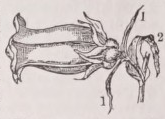
1. In botany, a floral leaf, one of the seven fulcrums or props of plants. It differs from other leaves in shape and color, and is generally situated on the peduncle, so near the corol, as easily to be mistaken for the calyx.
2. In the Asiatic Researches, 4.354, this word is anglicized, and written bract.
BRACTON, Henry de, a learned ecclesiastic, who was chief justiciary in the reign of Henry III. He is supposed to have been born at Bretton-Clovelly in Devonshire. He studied at Oxford, where he took the degree of doctor of laws, and is believed to have delivered lectures in that university. He was appointed a justice itinerant for the counties of Nottingham and Derby in 1245, and his name appears as a justiciary or judge of the Aula Regis on the Fine Rolls in 1249 and in each of the next seventeen years, written indifferently Bratton and Bretton, which circumstance has led Selden and others to attribute to him the authorship of the earliest treatise on the law of England in the French tongue, known as Bretone or Bretoun. In 1254 the king assigned to him by letters patent, in which he was designated “dilectus clericus noster,” the use of a house in London belonging to William late earl of Derby during the minority of the heir, and in 1263 he was collated to the archdeaconry of Barnstaple. This office, however, he resigned in the following year; and in 1265 he was appointed chief justiciary, and held that office until the end of 1267, when all notice of him ceases. He w ’ rote a most comprehensive and systematic work on the laws of England in five volumes, entitled De Legibus et Consuetudinibus Anglioe, which is modelled after the Institutes of Justinian, and is supposed, from internal evidence, to have been completed about the time when he was appointed chief justiciary, as it contains references to changes in the law made shortly before that time, but takes no notice of the statute of Marlborough passed in 52 Henry III. A Latin abridgment of Bracton’s work was written by Gilbert de Thornton, who was appointed Chief-Justice of the King’s Bench in the 17th year ...of the reign of Edward I., of which Selden possessed a copy, but no copy of it is at present known to exist. There are numerous MSS. extant of Bracton’s work, but only two editions of it have been printed, the first in folio in 1569, the second in quarto in 1640. The text of these editions is identical, as well as the paging.
9th ed. Encyclopædia Britannica, vol. 4, p. 196 [380 words — estimated reading time: 3 minutes]
No thesaurus entries found for "Bract".
No Bible verses found for "Bract".
This site uses cookies to remember your display preferences (search sources and editions, Bible version, auto-link, images, light/dark theme). No personal data whatsoever is collected. Privacy Policy