
1. Alt. of Caple
Word of the Day: Catachrestical
Capel
Encyclopedia Britannica
CAPEL, Arthur, Lord(c. 1600-1649), was the son of Sir Henry Capel. His birth year is not accurately known; but it was about 1600. In 1640 he was chosen to represent the county of Hertford, and sat as a member of the Long Parliament, which was convened that year. He was elevated to the peerage by Charles I.; and on the breaking out of the revolutionary war he raised and maintained a troop in the royal interest, till the final triumph of the Parliamentarians compelled him to make peace with them. During the war he acted, together with Edward Hyde and Lord Colchester, as general in the west, and was concerned in important engagements at Bristol, Exeter, and Taunton. Having with noble devotion reassembled his troop in order to effect the rescue of Charles, he was forced by famine and sedition to surrender at Colchester to General Fairfax, and was condemned by the Commons to be banished; but on the authority of some of the Parliamentary leaders he was immediately committed to the Tower. He contrived to effect his escape from prison, but was apprehended at Lambeth, and again committed to stand his trial at Westminster for treason. He was condemned to death, and was executed on the 9th of March 1649, exhibiting on the scaffold the greatest calmness and dignity. He was the author of Daily Observations or Meditations, a posthumous publication, which was afterwards reprinted under a diferent title, with an account of his life.
9th ed. Encyclopædia Britannica, vol. 5, p. 53
[248 words — estimated reading time: 2 minutes]
[248 words — estimated reading time: 2 minutes]
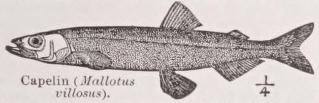
A small fish, about six inches in length, sholes of which appear off the coasts of Greenland, Iceland and New-foundland. They constitute a large part of the food of the Greenlanders.
A small marine fish (Mallotus villosus) of the family Salmonidae, very abundant on the coasts of Greenland, Iceland, Newfoundland, and Alaska. It is used as a bait for the cod.
Capell
Encyclopedia Britannica
CAPELL, Edward (1713-1781), a well-known critic and annotator of Shakespeare, was born at Troston in Suffolk in 1713. Through the influence of the duke of Grafton he was early appointed to the office of deputyinspector of plays, with a salary of £200 per annum. Shocked at the inaccuracies which had crept into Sir Thomas Hanmer’s edition of Shakespeare, he projected an entirely new edition, to be carefully collated with the original copies. After spending three years in collecting and comparing a vast number of scarce folio and quarto editions, he published his own edition in 10 vols. 8vo, with an introduction, written in a style of extraordinary quaintness, which was afterwards appended to the prolegomena of Johnson’s and Steevens’s editions. The work was published at the expense of the principal booksellers of London, who gave him £300 for his labour. Three other volumes of Notes and Various Readings of Shakespeare, which he had announced in his introduction, under the title of The School of Shakespeare, were published under the editorial superintendence of Mr Collins, in 1783, two years after Capell’s death. They contain the results of his unremitting labour for thirty years in collating the ancient MSS., and though utterly wanting in literary taste, throw considerable light on the history of the times of Shakespeare, as well as on the sources from which he derived his plots. Besides the works already specified, he published a volume of ancient poems called Prolusions, and an edition of Antony and Cleopatra adapted for the stage.
9th ed. Encyclopædia Britannica, vol. 5, p. 53
[258 words — estimated reading time: 2 minutes]
[258 words — estimated reading time: 2 minutes]
A bright fixed star in the left shoulder of the constellation Auriga.
A brilliant star in the constellation Auriga.
Capella
Encyclopedia Britannica
CAPELLA, MartianusMineus Felix, author of a curious encyclopaedic work on the liberal arts, was born in the north of Africa, and flourished probably towards the beginning of the 5th century a.d., or at least during the 4th century. There is, however, no direct evidence as to the exact epoch at which he lived, and the few references to the author contained in the work itself are not sufficiently definite to admit of any certain conclusion being drawn. He appears to have been a solicitor by profession and in easy circumstances. His work, entitled. Satyra de Nuptiis Philologiae et Mercurii, is an elaborate allegory in nine books, written in a mixture of prose and verse. The style is heavy aud involved, loaded with metaphor and bizarre expressions, and verbose to excess. The first two books contain the allegory proper,—the marriage of Mercury to a nymph named Philologia. It is wrought out in great detail, but the original conception is not a happy one, and the execution is tasteless. The remaining seven books contain expositions of the seven liberal arts, which then comprehended all human knowledge. Book iii. treats of grammar, iv. of dialectics, v. of rhetoric, vi. of geometry, vii. of arithmetic, viii. of astronomy, ix. of music. These abstract discussions are linked on to the original allegory by the device of personifying each science as a courtieι of Mercury and Philologia. The work was a complete encyclopaedia of the liberal culture of the time, and it was in high repute during the Middle Ages. There is much interesting matter in it, and much erudition is displayed by the author, but the whole is executed in a clumsy, pedantic, and tasteless fashion....
A passage in book viii. has always attracted the attention of commentators, for it contains a very clear statement of the heliocentric system of astronomy. Many have supposed that Copernicus, who quotes Capella, may have received from this work some hints towards his own new system.
The editio princeps of Capella is that by Bodianus, 1449; the best of the older editions is that by Grotius, 1599; modern editions are those of Kopp, 1836, and Eyssenhardt, 1866. Eyssenhardt, uι various contributions to the Rheinisches Museum, has done much for the text and explanation of Capella.
9th ed. Encyclopædia Britannica, vol. 5, p. 53
[378 words — estimated reading time: 3 minutes]
[378 words — estimated reading time: 3 minutes]
The musical director in royal or ducal chapel; a choir-master.
No thesaurus entries found for "Capel".
No Bible verses found for "Capel".