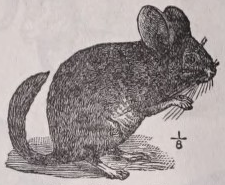
1. A small rodent (Chinchilla lanigera), of the size of a large squirrel, remarkable for its fine fur, which is very soft and of a pearly gray color. It is a native of Peru and Chili.
CHINCHILLA, a city of Spain, in the province of Murcia, picturesquely situated on an abrupt hill ten miles south-east of Albacete, in the immediate neighbourhood of the junction of the railway lines from Cartagena and Valencia to the capital. It is surrounded by walls rebuilt in 1837, and defended by a citadel; and in the principal church there are reservoirs capable of furnishing the city with water for several months. Earthenware and crucibles, coarse linen, and woollen cloths are manufactured. Population, 3500....
CHINCHILLA(Chinchilla lanigera), a small Mammal belonging to the order Rodentia, inhabits the eastern slopes of the Andes in Chili, Bolivia, and Peru, where it has a vertical range of from 8000 to 12,000 feet. It is very similar in size to the common squirrel,being about 10 inches long exclusive of the tail, and in the form of its head it resembles a rabbit. It is covered with a dense soft fur three-fourths of an inch long on the back, and upwards of an inch in length on the sides, of a slate-grey colour, darkly mottled on the upper surface, and of a dusky white beneath; its ears are long and broad and thinly covered with hair. It lives in burrows, and these subterranean dwellings undermine some parts of the Chilian Andes to such an extent as to cause considerable inconvenience and even danger to travellers on horseback. Chinchillas live in communities, forming their burrows among loose rocks, and coming out to feed only in the early morning and towards sunset. They feed chiefly on roots and grasses, in search of which they often travel a considerable distance from their homes; and when eating they sit on their haunches, holding their food in their fore paws. The Indians in hunting them employ a weasel (Galictis vittata), which is trained to enter the crevices of the rocks, where the chinchillas often lie concealed during the day in order to avoid the sunshine, and drive them out, when they are readily killed. The fur of this rodent was prized by the ancient Peruvians, who made coverlets and other articles with the skin, and at the present day they are exported in large numbers to Europe—134,000 skins having been imported into London during 1874— where they are made into muffs, tippets, and trimmings for ladies’ dresses. That they have not under such circumstances become rare, if not altogether extinct, is doubtless owing to their extraordinary fecundity, the female usually producing five or six young twice a year. They are exceedingly docile in disposition and cleanly in their habits, and are thus well fitted for domestication, and in this state, owing to the value of their furs, might no doubt be profitably reared.
9th ed. Encyclopædia Britannica, vol. 5, p. 673 [83 words — estimated reading time: 1 minute]
No thesaurus entries found for "Chinchilla".
No Bible verses found for "Chinchilla".
This site uses cookies to remember your display preferences (search sources and editions, Bible version, auto-link, images, light/dark theme). No personal data whatsoever is collected. Privacy Policy