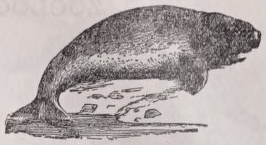
DUGONGfHalicore), a genus of herbivorous Cetacea, forming, along which the Sea-Cows {Manatus), and the now extinct Rhytinα, the sub-order Sirenia. In this genus the head is small, and is abruptly truncated in front, the snout being remarkably obtuse and furnished with bristles. The intermaxillary bones are enormously developed, and from these proceed two large incisor teeth or tusks, which are well developed in the male, but which in the female are arrested in their growth, and remain concealed beneath the surface. There are never more than five molar teeth on each side of either jaw, or twenty in all, and these are flat on the grinding surface. The flippers are unprovided with nails, and the tail is broad, and differs from that of the manatee in being crescent-shaped instead of rounded. The bones are very hard and firm, and take a polish equal to that of ivory. The dugongs frequent the shallow waters of the tropical seas, extending from the east coast of Africa north of the mouth of the Zambesi river, along the shores of the Indian, Malayan, and Australian seas, where they may be seen basking on the surface of the water, or browsing on submarine pastures of Algae and Fuci, for which tho thick obtuse lips and truncated snout preeminently fit them. They are gregarious, feeding in large numbers in localities where they are not often disturbed. The female produces a single young one at a birth, and is remarkable for the great affection it shows for its offspring, so that when the young dugong is caught there is no difficulty in capturing the mother with it. There are two species—the Indian Dugong (Halicore indicus) and the Australian Dugong (Halicore australis). The former is very abundant along the shores of the Indian Ocean, and is captured in large numbers by the ...Malayans, who esteem its flesh as a great delicacy; while the lean portions, especially of young specimens, are regarded by Europeans even as excellent eating. It is generally taken by spearing, the main object of the hunter being to raise the tail out of the water, when the animal becomes perfectly powerless. It seldom attains a length of more than 8 or 10 feet. The Australian Dugong is a larger species, attaining sometimes a length of 15 feet. It occurs along the Australian coast from Moreton Bay to Cape York, and is highly valued by the natives, who hunt for it with spears, and gorge themselves with its flesh, when they are fortunate enough to secure a carcase. In recent years the oil obtained from the blubber of this species has been largely used in Australia as a substitute for cod-liver oil. It does not contain iodine, but is said to possess all the therapeutic qualities of cod-liver oil without its nauseous taste. A full grown dugong yields from 10 to 12 gallons of oil, and this, according to Bennet, “forms in cold weather a thick masβ, and requires to be melted before a fire previously to being used.” According to the same authority, the flesh of the Australian dugong is easy of digestion, the muscular fibre when fresh resembling beef, and when salted having the flavour of excellent bacon. In the earliest Australian dugong fishery, natives were employed to harpoon these cetaceans; they soon, however, became too wary to allow themselves to be approached near enough for this purpose, and the harpoon was abandoned for the net. The latter is spread at night, and in its meshes dugongs are caught in considerable numbers. The skin is nearly half an inch thick, and can be made into gelatine or glue.
[610 words — estimated reading time: 4 minutes]