
A fowl of the genus Anas, inhabiting the north of Europe.
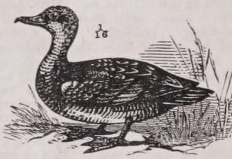
GADWALL, a word of obscure origin, the common English name of the Duck, called by Linnaeus Anas strepera, but considered by many modern ornithologists to require removal from the genus Anas to that of Chaυlelasmus or Ctenorhynchus, of either of which it is not only the typical but the sole species. Its geographical distribution is almost identical with that of the common Wild Duck or Mallard (see Duck, vol. vii. p. 505), since it is found over the greater part of the Northern Hemisphere; but, save in Iudia, where it is said to be perhaps the most plentiful species of Duck during the cold weather, it is hardly anywhere so numerous, and both in the eastern parts of the United States and in the British Islands it is rather rare than otherwise. Its habits also, so far as they have been observed, greatly resemble those of the Wild Duck; but its appearance on the water is very different, its small head, flat back, elongated form, and elevated stern rendering it recognizable by the fowler even at such a distance as hinders him from seeing its very distinct plumage. In coloration the two sexes agree much more than is the case with any of the European Freshwater Ducks {Anatinae) — one only, the Anas marmorata, excepted; but on closer inspection the drake exhibits a delicate ash-coloured breast, and upper wing-coverts of a deep chestnut, which are wholly wanting in his soberly clad partner. She, however, has, in common with him, some of the secondary quills of a pure white, presenting a patch of that colour which forms one of the most readily-perceived distinctive characters of the species. The Gadwall is a bird of some interest, since it is one of the few that have been induced, by the protection afforded them in certain localities, to resume the indigenous position they once ...filled, but had, through the draining and reclaiming of marshy lands, long since abandoned. In regard to the present species, this fact is due to the efforts of the late Mr Andrew Fountaine, on whose property, in
West Norfolk and its immediate neighbourhood, the Gadwall has now, for nearly thirty years, annually bred in constantly increasing numbers, so that it may again be accounted, in the fullest sense of the word, an inhabitant of England; and, as it has been always esteemed one of the best of wild fowl for the table, the satisfactory result of its encouragement by this gentleman is not to be despised. (a. n.)