
Word of the Day: Catachrestical
Garganey
Encyclopedia Britannica
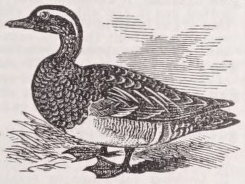
GARGANEY (North-Italian, Garganello), or Summer-Teal, the Anas querquedula and A. circia of Linnaeus (who made, as did Willughby and Ray, two species out of one), and the type of Stephens’s genus Querquedιda. This bird is one of the smallest of the Anatidoe, and has gained its common English name from being almost exclusively a summer-visitant to this country, where nowadays it only regularly resorts to breed in some of the East-Norfolk waters called Broads, though possibly at one time found at the same season throughout the great Fen-district. About the same size as the common Teal (A. crecca), the male is readily distinguished therefrom by its peculiarly-coloured head, the sides of which are nutmeg-brown, closely freckled with short whitish streaks, while a conspicuous white curved line descends backwards from the eyes. The upper wingcoverts are bluish-grey, the scapulars black with a white shaft-stripe, and the wing-spot (specwàm) greyish-green bordered above and below by white. The female closely resembles the hen Teal, but possesses nearly the same wingspot as her mate. In Ireland or Scotland the Garganey is very rare, and though it is recorded from Iceland, more satisfactory evidence of its occurrence there is needed. It has not a high northern range, and its appearance in Norway and Sweden is casual. Though it breeds in many parts of Europe, in none can it be said to be common; but it ranges far to the eastward in Asia—even to Formosa, according to Swinhoe—and yearly visits India in winter. Those that breed in Norfolk arrive somewhat late in spring and make their nests in the vast reed-beds which border the Broads—a situation rarely or never chosen by the Teal. The labyrinth or bony enlargement of the trachea in the male Garganey differs in form from ...that described in any other Drake, being more oval and placed nearly in the median line of the windpipe, instead of on one side, as is usually the case.
9th ed. Encyclopædia Britannica, vol. 10, p. 80
[340 words — estimated reading time: 2 minutes]
[340 words — estimated reading time: 2 minutes]
No thesaurus entries found for "Garganey".
No Bible verses found for "Garganey".