
HAL , in some names, signifies hall.
Word of the Day: Catachrestical
Hal
Encyclopedia Britannica
HAL, a town of Belgium, province of South Brabant, is situated on the Senne and the Charleroi canal, 9 miles S.S.W. of Brussels. It has a beautiful Gothic church of the 14th century, very much resorted to by pilgrims on account of a famous miracle-working image of the Virgin. The church has been enriched by a large number of votive gifts, and contains a beautifully carved high altar of white marble. The principal industries are tanning, soap-boiling, the manufacture of paper, and salt-refining. The population in 1869 was 6406.
9th ed. Encyclopædia Britannica, vol. 11, p. 379
[94 words — estimated reading time: 1 minute]
[94 words — estimated reading time: 1 minute]
Hala
Encyclopedia Britannica
HALA, or Halla (formerly known as Murtizâbâd), a town in Hyderabad district, Sind, India, situated on the Aliganj canal and immediately connected with the Trunk Road at two points, 25° 48' 30'' N. lat., 68° 27' 30" E. long. It was long famous for its glazed pottery and tiles, made from a fine clay obtained from the Indus, mixed with flints. The stisis, or trouser-cloths, for which the town is also celebrated, are manufactured to the value of .£750 yearly. Hâla was built about 1800 in consequence of old Hâla, 2 miles distant, being threatened with encroachment by the Indus. Among the antiquities round which the new town has grown up are the tomb and mosque of a pir or saint, who died in the 16th century, and in whose honour a fair, largely attended by Mahometans from all parts of the province, is held twice a year. The local trade, chiefly of grain, piece goods, ghi, cotton, and sugar, is valued approximately at £3900; the transit trade (in the same articles) at about £700. Population (1872), 4096, including 2646 Mahometans and 1234 Hindus.
9th ed. Encyclopædia Britannica, vol. 11, p. 379
[189 words — estimated reading time: 2 minutes]
[189 words — estimated reading time: 2 minutes]
Halas
Encyclopedia Britannica
HALAS, a corporate town of Hungary, in the megye or county of Pest-Pilis-Solt-Kis-Kun, is situated about 76 miles S.S.E. from Budapest, in 46° 24' N. lat. and 19° 3Γ E. long. The most noteworthy buildings are the Calvinist and Roman Catholic churches, and the Jewish synagogue. IIalas contains also a Protestant gymnasium, various literary institutions, and a local tribunal. The inhabitants of the town and neighbourhood are mostly engaged in cattle-breeding and agricultural pursuits. Not far from Halas is a lake of the same name, containing an island which was once fortified, and served as a place of refuge to the inhabitants from the incursions of the Turks. Prior to 1876 Halas belonged to the old district of Little Cumania. In the spring of 1879 the town was much injured by floods. The population in 1870 amounted to 13,127, of whom the greater number were Magyars.
9th ed. Encyclopædia Britannica, vol. 11, p. 380
[154 words — estimated reading time: 1 minute]
[154 words — estimated reading time: 1 minute]
An appearance as of a halo of light, surrounding the edges of dark objects in a photographic picture.
A military weapon, consisting of a pole or shaft of wood, with a head armed with a steel point, with a cross piece of steel, flat and pointed at both ends, or with a cutting edge at one end, and a bent point at the other. It is carried by sergeants of foot and dragoons.
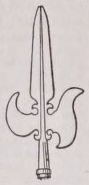
An ancient long-handled weapon, of which the head had a point and several long, sharp edges, curved or straight, and sometimes additional points. The heads were sometimes of very elaborate form.
One who is armed with a halberd.
One who is armed with a halberd.
Halberstadt
Encyclopedia Britannica
HALBERSTADT, the chief town of a circle in the government district of Magdeburg, Prussian province of Saxony, is situated in a beautiful and fertile country on the Holzemme, a tributary of the Eode, and at the junction point of four railways, 29 miles S.W. of Magdeburg. It has an antique appearance, and in a large number of the buildings the mediaeval wood-architecture is still preserved. About a mile and a half distant from Halberstadt are the Spiegel'sche Berge, from which there is obtained a fine view of the surrounding country. The town possesses a cathedral in the Pointed style, dating from the 13th and 14th centuries, and restored between 1850 and 1871, containing a rich Gothic screen of the date of 1510, other interesting antiquities, beautiful glass windows, and several valuable paintings. Of the remaining churches the only one of special interest is the Liebfrauenkirche, a basilica in the later Romanesque style, dating from the 12th and 13th centuries, and restored in 1848, containing noteworthy wall paintings and figures in relief. Among the other old buildings may be mentioned the town-house, dating from the 14th century and restored in the 17th century; the town hall orypt, dating from the 15th century; and the Petershof, formerly the residence of the bishop, but now used as a custom house. The principal educational establishments are the gymnasium—the new buildings for which were opened in 1875—with a library of 30,000 volumes; the real-school of the first order; the normal school, connected with which there is a deaf and dumb institute; and the provincial trade school. Near the cathedral is a building called the temple of friendship which contains a collection of the portraits of the friends of the poet Gleim, who was a resident in the town, and whose ...house was the resort of a large circle of poets and scholars. In the same neighbourhood a beautiful monument in the Early Pointed style has been elected to the memory of those who fell in the late Franco-German war. The principal manufactures of the town are linen and woollen cloth, leather, paper, gloves, wadding, cigars, soap, oil, sugar, chemical products, brandy, and liqueurs. The population in 1875 was 27,757.
Halberstadt owes its origin to the foundation in the 9th century of the bishopric of which it became the seat. It received town rights from Bishop Arnulf in 998. It was burnt down in 1113 by the emperor Henry V., and in 1179 by Henry the Lion. At the peace of Westphalia in 1648 the bishopric was united as a principality to Brandenburg. At the Tilsit peace in 1807 it was joined to Westphalia, but in 1813 it again came into the possession of Prussia.
See Lucanus, Der Dom zu Halberstadt, 1837, Wegweiser durch Halberstadt, 2d edition 1866, and Die Liebfrauenkirche zu Halberstadt, 1872; Scheffer, Inschriften und Legenden Halberstädtischer Bauten, 1864; Schmidt, Urkundenbuch der Stadt Halberstadt, Halle, 1878.
9th ed. Encyclopædia Britannica, vol. 11, p. 380
[493 words — estimated reading time: 3 minutes]
[493 words — estimated reading time: 3 minutes]
Halbert
Encyclopedia Britannica
HALBERT, Halbard (French, Haleharde), a weapon consisting of an axe-blade balanced by a pick and having an elongated pike-head at the end of the staff, which was usually about 5 or 6 feet in length. Various derivations have been suggested for the term, but M. Demmin seems to have hit the right one in the German Halbbαrthe. “half battle-axe.” The earliest halberts represented in the miniatures of the 14th century, or preserved in the collections of Switzerland and Germany, have the axe-blade often prolonged beyond the end of the staff, and thus resemble the English bill of the 15th century. Fauchet, in his Origines des Dignitez, printed in 1600, states that Louis XI. of France ordered certain new weapons of war called hallebardes to be made at Angers and other places in 1475. The Swiss had a mixed armament of pikes and halbards at the battle of Morat in 1476. We find the same mixture of billmen and halbardiers in the English army at the same period. In the 15th and 16th centuries the halbards became larger, and the blades were formed in many varieties of shape, often engraved, inlaid, or pierced in open work, and exquisitely finished as works of ark This weapon was in use in England from the reign of Henry VII. to the reign of George III., when it was still carried by sergeants in the guards and other infantry regiments. It is still retained as the symbol of authority borne before the magistrates on public occasions in some of the burghs of Scotland. The Lochaber axe may be called a species of halbert furnished with a hook on the end of the staff at the back of the blade.
9th ed. Encyclopædia Britannica, vol. 11, p. 380
[289 words — estimated reading time: 2 minutes]
[289 words — estimated reading time: 2 minutes]
Calm; quiet; peaceful; undisturbed; happy. halcyon days were seven days before and as many after the winter solstice, when the weather was calm. Hence by halcyon days are now understood days of peace and tranquility.
1. hal'shon. [Latin halcyon; Gr. a king-fisher.]
1. Pertaining to, or resembling, the halcyon, which was anciently said to lay her eggs in nests on or near the sea during the calm weather about the winter solstice.
2. Hence: Calm; quiet; peaceful; undisturbed; happy.
A kingfisher. By modern ornithologists restricted to a genus including a limited number of species having omnivorous habits, as the sacred kingfisher (Halcyon sancta) of Australia.
Halcyon; calm.
Halcyon; calm.
See Alcyonoid.
Haldane
Encyclopedia Britannica
HALDANE, James Alexander (1768-1851), whose disinterested labours in the cause of religion have secured for his name an honourable place in the ecclesiastical history of Scotland, was the younger son of Captain James Haldane of Gleneagles, Perthshire, and was born at Dundee on July 14, 1768. Educated first at Dundee and afterwards at the High School and university of Edinburgh, he shortly after the completion of his sixteenth year entered the service for which he had been from his childhood destined, by joining the “Duke of Montrose” East Indiaman as a midshipman. After four voyages to India he in the summer of 1793 was nominated to the command of the “Melville Castle”; but having, during a Jong and unexpected detention of his ship, begun a careful study of the Bible, he came under deep religious impressions and, somewhat abruptly resolving to quit the naval profession, returned to Scotland before his ship had sailed. About the year 1796 he became acquainted with the celebrated evangelical divine, Simeon of Cambridge, in whose society he made through Scotland more than one tour, in the course of which he endeavoured by tract-distribution and other means to awaken others to somewhat of that interest in religious subjects which he himself so strongly felt. In May 1797 he preached, at Gilmerton near Edinburgh, his first sermon with a success which was considered to be very encouraging; and during the next few years he made repeated missionary journeys, preaching wherever he could obtain hearers, and generally in the open air. Not originally disloyal to the Church of Scotland, he w as gradually driven by the hostility of the Assembly and the exigencies of his position into a separatistic attitude; in 1799 he was ordained on the principles of Independency as pastor ...of a large congregation in Edinburgh, to which he continued gratuitously to minister for more than fifty years; and in 1808 he made public avowal of his conversion to Baptist views. As advancing years compelled him to withdraw from the more exhausting labours of itineracy and open-air preaching, he sought more and more to influence the discussion of current religious and theological questions by means of the press, and by numerous pamphlets took part in the controversies connected with the names of Edward Irving, Erskine of Linlathen, Campbell of Row, and others. His latest works were a treatise on the Doctrine of the Atonement (1845) and an Exposition of the Epistle to the Galatians (1848). He died on the 8th of February 1851.
HALDANE, Robert (1764-1842), elder brother of the preceding, and intimately associated with him in many of his labours, was born in London on February 28, 1764. After attending classes in the Dundee grammar school and in the High School and university of Edinburgh he in 1780 joined H.M.S. “Monarch,” of which his uncle Lord Duncan was at that time in command, and in the following year was transferred to the “Foudroyant,” on board of which, during the night engagement with the “Pegase,” he distinguished himself so much that Captain Jervis (afterwards Lord St Vincent) wrote to Admiral Duncan predicting a brilliant future for his nephew. Haldane was afterwards present at the relief of Gibraltar, but at the peace of 1783 he finally left the navy, and soon afterwards settled on his estate of Airthrey, near Stirling. The earlier phases of the French Revolution as they occurred attracted his attention and at first excited his deepest sympathy, a sympathy which induced him, at the cost of making many enemies, to avow his 8trong disapproval of the war with France. As his bright and oversanguine visions of a new order of things to be ushered in by political change disappeared, he, unlike Wordsworth’s “Solitary,” began to direct his thoughts to religious subjects, and underwent a spiritual change which, while neither sudden nor violent, was decisive and complete. Resolving to devote himself and his means wholly to the advancement of Christianity, his first proposal for that end, made in 1796, was to organize a vast mission to Bengal, of which he was to provide the entire expense; with this view the greater part of his estate was sold, but after every arrangement had been well nigh completed, the East India Company refused to sanction the scheme, which therefore had to be reluctantly abandoned. In December 1797 he joined his brother and some others in the formation of the “Society for the Propagation of the Gospel at Home”; and in building chapels or “tabernacles” for its congregations, in supporting its missionaries, and in maintaining institutions for the education of young men to carry on its work, he in the course of the twelve years which followed is stated on good authority to have expended upwards of £70,000. In 1816 he visited the Continent, and first at Geneva and afterwards in Montauban (1817) occupied himself in lecturing with surprising success to theological students, among whom were Malan, Monod, and Merle D’Aubigné. Returning to Scotland in 1819, he lived partly on his estate of Auchengray and partly in Edinburgh, and like his brother took an active part, chiefly through the press, in many of the religious controversies of the time. He died on the 12th of December 1842.
In 1816 he published a work on the Evidences and Authority of Divine Revelation, and in 1819 the substance of his theological prelections in a Commentaire stir l’Épître aux Romains. Among his later writings, besides numerous pamphlets on what was known as “the Apocrypha controversy” and on the Sabbatarian question, are a treatise On the Inspiration of Scripture (1828), which has passed through seven editions, and a later Exposition of the Epistle to the Romans (1835), which has been frequently reprinted, and has been translated into French and German. See Memoirs of R. and J. A. Haldane, by Alexander Haldane (1852).
9th ed. Encyclopædia Britannica, vol. 11, p. 380
[420 words — estimated reading time: 3 minutes]
[420 words — estimated reading time: 3 minutes]
Sound; entire; healthy; robust; not impaired; as a hale body.
Sound; entire; healthy; robust; not impaired; as, a hale body.
Hale
Encyclopedia Britannica
HALE, Sir Matthew (1609-1676), lord chief-justice of England, was born on November 1, 1609, at Alderley in Gloucestershire, where his father, a retired barrister, had a small estate. His paternal grandfather was a rich clothier of Wotton-under-Edge; on his mother’s side he was connected with the noble family of the Poyntzes of Acton. Both his parents having died before he was five years old, the future chief-justice was placed by his guardian under the care of Mr Staunton, vicar of Wotton-under-Edge, through whose influence he became strongly imbued with puritanical principles. There he remained till he attained his sixteenth year, when he entered Magdalen Hall, Oxford, under the tuition of the puritanical but learned Obadiah Sedgwick. At Oxford Hale devoted himself for several terms to the study of Aristotle and Calvin with a view to holy orders, and manifested that steadiness and application which in after years secured his reputation and advancement. But suddenly there came a change. The diligent student, at first attracted by a company of strolling players, threw aside his studies, and plunged carelessly into gay society. He soon decided to change his profession; and resolved to trail a pike as a soldier under the prince of Orange in the Low Countries. Before going abroad, however, Hale found himself obliged to proceed to London in order to give instructions for his defence in a legal action which threatened to deprive him of his patrimony. His leading counsel was the celebrated Serjeant Glanville, who, perceiving in the acuteness and sagacity of his youthful client a peculiar fitness for the legal profession, succeeded, with much difficulty, in inducing him to renounce his military for a legal career, and on the 8th November 1629 Hale became a member of the ...honourable society of Lincoln’s Inn.
He immediately resumed his habits of intense application. The rules which he laid down for himself, and which are still extant in his handwriting, prescribe sixteen hours a day of close application, and prove, not only the great mental power, but also the extraordinary physical strength he must have possessed, and for which indeed, during his residence at the university, he had been remarkable. During the period allotted to his preliminary studies, he read over and over again all the year-books, reports, and law treatises in print, and at the Tower of London and other antiquarian repositories examined and carefully studied the records from the foundation of the English monarchy down to his own time. Even the common-place book which he composed as the result of his study and research may, according to Lord Campbell, “be considered a corpus juris embracing and methodizing all that an English lawyer on any emergency could desire to know.” But Hale did not confine himself to law. He dedicated no small portion of his time to the study of pure mathematics, to investigations in physics and chemistry, and even to anatomy and architecture; and there can be no doubt that this varied learning enhanced considerably the value of many of his judicial decisions.
Hale was called to the bar in 1637, and almost at once found himself in full practice. Though neither a fluent speaker nor bold pleader, in a very few years he was at the head of his profession. He entered public life at perhaps the most critical period of English history. Two parties were contending in the state, and their obstinacy could not fail to produce a most direful collision. But amidst the confusion Hale steered a middle course, rising in reputation, and an object of solicitation from both parties. Taking Pomponius Atticus as his political model, he was persuaded that a man, a lawyer, and a judge could best serve his country and benefit his countrymen by holding aloof from partisanship and its violent prejudices, which are so apt to distort and confuse the judgment. But he is best vindicated from the charges of selfishness and cowardice by the thoughts and meditations contained in his private diaries and papers, where the purity and honour of his motives are clearly seen. It has been said, but without certainty, that Hale was engaged as counsel for the earl of Strafford; he certainly acted for Archbishop Laud, Lord Maguire, Christopher Love, the duke of Hamilton, and others. It is also said that he was ready to plead on the side of Charles I. had that monarch submitted to the court. The parliament having gained the ascendency, Hale signed the Solemn League and Covenant, and was a member of the famous Assembly of Divines at Westminster in 1644; but although he would undoubtedly have preferred a Presbyterian form of church government, he had no serious objection to the system of modified Episcopacy proposed by Ussher. Consistently with his desire to remain neutral, Hale took the engagement to the Commonwealth as he had done to the king, and in 1653, already serjeant, he became a judge in the Court of Common Fleas. Two years afterwards he sat in Cromwell’s parliament as one of the members for Gloucestershire. After the death of the Protector, however, he declined to act as a judge under Richard Cromwell, although he represented Oxford in Richard’s parliament. At the Restoration in 1660 Hale was very graciously received by Charles II., and in the same year was appointed chief baron of the exchequer, and accepted, with extreme reluctance, the honour of knighthood. After holding the office of chief baron for eleven years he was raised to the higher dignity of lord chief-justice, which he held till February 1676, when his failing health compelled him to resign. He retired to his native Alderley, where he died on December 25th of the same year. He was twice married, and survived all his ten children save two.
As a judge, Sir Matthew Hale discharged his duties with resolute independence and careful diligence. Lord Campbell says of him that “he is certainly to be considered the most eminent judge who ever filled the office [of chief baron]; and being promoted to be chief-justice of England, he gave new dignity to the supreme magistracy which had been illustrated by Gascoigne, by Fortescue, and by Coke.” His sincere piety made him the intimate friend of Barrow, Tillotson, Wilkins, and Stillingfleet, as well as of the Nonconformist leader Baxter. He is chargeable, however, with the condemnation and execution of two poor women tried before him for witchcraft in 1664, a kind of judicial murder then falling under disuse. He is also reproached with having hastened the execution of a soldier for whom he had reason to believe a pardon was preparing.
Of Hale’s legal works the only two of importance are his Historia Placitorum Coronae, or History of the Pleas of the Crown, first published, in 1739; and the History of the Common Law of England, with an Analysis of the Law, &c., 1713. Among his numerous religious writings the Contemplations, Moral and Divine, occupy the first place. Others are The Primitive Origination of Man, 1677; Of the Nature of True Religion, &c., 1684; A Brief Abstract of the Christian Religion, 1688. One of his most popular works is the collection of Letters of Advice to his Children and Grandchildren. He also wrote an Essay touching the Gravitation and Nongravitation of Fluid Bodies, 1673; Difficiles Nugae, or Observations touching the Torricellian Experiment, &c., 1675; and a translation of the Life of Pomponius Atticus, by Cornelius Nepos. His efforts in poetry were inauspicious. He left his valuable collection of MSS. and records to the library of Lincoln’s Inn. His life has been written by Burnet, 1682; by Williams, 1835; by Roscoe, in his Lives of Eminent Lawyers, in 1838; and by Lord Campbell, in hisZ⅛es of the Chief Justices
9th ed. Encyclopædia Britannica, vol. 11, p. 381
[1,302 words — estimated reading time: 8 minutes]
[1,302 words — estimated reading time: 8 minutes]
Hales
Encyclopedia Britannica
HALES, Stephen (1677-1761), physiologist and inventor, was born at Beckesbourn in Kent, on the 7th September 1677. He was the sixth son of Thomas Hales, whose father, Sir Robert Hales, was created baronet by Charles II. in 1670. Of his early education little is known, but in June 1696 he was entered as a pensioner of Bene’t (now Corpus Christi) College, Cambridge, with the view of taking holy orders. On 16th April 1702 he was elected and in February 1703 admitted to a fellowship. He received the degree of master of arts in 1703, and of bachelor of divinity in 1711. While at college one of his most intimate friends was William Stukeley, with whom he studied anatomy, chemistry, &c. In 1710 Hales was presented to the perpetual curacy of Teddington in Middlesex, where he remained all his life, notwithstanding that he was subsequently appointed rector of Porlock in Somerset, and later of Farringdon in Hampshire. In March 1717 he was elected fellow of the Royal Society, to whose Transactions he contributed many valuable papers. In 1732 he was named one of a committee for establishing a colony in Georgia, and the next year he received the degree of doctor of divinity. He was appointed almoner to the princess-dowager of Wales in 1750. On the death of Sir Hans Sloane in 1753, Hales was chosen foreign associate of the French Academy of Sciences. He died at Teddington, January 4, 1761....
Hales is celebrated as the inventor of a “ventilator,” by means of which fresh air was introduced into jails, hospitals, mines, ships’ holds, &c. In the four years (1749-52) after its introduction into the Savoy prison, only 4 prisoners died; while previously the mortality had been from 50 to 100 per annum. The invention met with immediate favour, especially in France. Hales was the designer of other inventions by means of which sea-water was distilled, corn cleaned and preserved, meat preserved on long voyages, &c.
His chief writings are his Statical Essays (see Chemistry, vol. V. p. 461), consisting of Vegetable Staticks, or an Account of some Statical Experiments on the Sap in Vegetables (1727), and Hoemo- staticks, or an Account of Hydraulick and Hydrostatick Experiments made on the Blood and Blood-vessels of Animals (1733). His essay on The Means of Dissolving the Stone in the Bladder, &c., gained him the Copley gold medal in 1737. His Admonition to the Drinkers of Gin, Brandy, &c., appeared in 1734; the Vegetable Staticks, translated by Buffon, in 1735, and the Hoemostaticks, by Μ. de Sauvages, in 1744. For sketch of his life, with portrait, see Gardener's Chronicle, 1877, pp. 16-17.
9th ed. Encyclopædia Britannica, vol. 11, p. 382
[445 words — estimated reading time: 3 minutes]
[445 words — estimated reading time: 3 minutes]
No thesaurus entries found for "HAL".
King James Bible KJV Bible
Berean Standard Bible BSB Bible
198 KJV and 180 BSB verses contain “HAL” — showing the first 20. Show all 258 verses (searchable)
And it came to pass, as the camels had done drinking, that the man took a golden earring of half a shekel weight, and two bracelets for her hands of ten shekels weight of gold;
And after the camels had finished drinking, he took out a gold ring weighing a beka, and two gold bracelets for her wrists weighing ten shekels.
For in six days the LORD made heaven and earth, the sea, and all that in them is, and rested the seventh day: wherefore the LORD blessed the sabbath day, and hallowed it.
For in six days the LORD made the heavens and the earth and the sea and all that is in them, but on the seventh day He rested. Therefore the LORD blessed the Sabbath day and set it apart as holy.
And it shall be upon Aaron’s forehead, that Aaron may bear the iniquity of the holy things, which the children of Israel shall hallow in all their holy gifts; and it shall be always upon his forehead, that they may be accepted before the LORD.
And it will be worn on Aaron’s forehead, so that he may bear the iniquity of the holy things that the sons of Israel consecrate with regard to all their holy gifts. It shall always be on his forehead, so that they may be acceptable before the LORD.
And this is the thing that thou shalt do unto them to hallow them, to minister unto me in the priest’s office: Take one young bullock, and two rams without blemish,
“Now this is what you are to do to consecrate Aaron and his sons to serve Me as priests: Take a young bull and two rams without blemish,