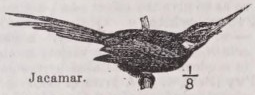
1. A kind of fowls arranged by Linne under the genus Alcedo; but their toes are differently placed, and their food consists of insects. They are about the size of a lark. Numerous species are described.
2. The Jacamars are arranged in a separate genus, Galbula, and along with the woodpeckers in the order of climbers.
Any one of numerous species of tropical American birds of the genus Galbula and allied genera. They are allied to the kingfishers, but climb on tree trunks like nuthatches, and feed upon insects. Their colors are often brilliant.
JACAMAR, a word formed by Brisson from Jacameri, the Brazilian name of a bird, as given by Marcgrave, and, since adopted in most European tongues for the species to which it was first applied and others allied to it, forming the Family Galbulidae j of ornithologists, the precise position of which is uncertain, since the best authorities differ greatly thereupon. All will agree that the Jacamars belong to the great heterogeneous group called by Nitzsch Picarix, but further into detail it is hardly safe to go. The Galbulidae have zygodactylous feet, like the Cuculidx, Βucconidx, and Picidx, they also resemble both the latter in laying glossy white eggs, but in this respect they bear the same resemblance to the Momotidx, Alcedinidx, Meropidx, and some other groups, to which affinity has been claimed for them. In the opinion of Mr Sclater the Jacamars form two groups—one consisting of the single genus and species Jacamerops aureus (J. grandis of most authors), and the other including all the rest, namely, Urogalba with two species, Galbula with nine, Brachygalba with five, and Jacamaralcyon and Galbalcyrhynchus with one each. They are all rather small birds, the largest known being little over 10 inches in length, with sharply pointed bills, and the plumage in every case more or less resplendent with golden or bronze reflexions, but at the same time comparatively soft. Jacamaralcyon tridactyla differs from all the rest in possessing but three toes (as its name indicates) on each foot, the hallex being deficient. With the exception of Galbula melanogenia, which is found also in Central America and southern Mexico, all the Jacamars inhabit the tropical portions of South America eastward of the Andes, Galbula ruficauda, however, extending its range to the islands of ...Trinidad and Tobago. Very little is known of the habits of any of the species. They are seen sitting motionless on trees, sometimes solitarily, at other times in companies, whence they suddenly dart off at any passing insect, catch it on the wing, and return to their perch. Of their nidification almost nothing has been recorded, but the species above-mentioned as occurring in Tobago is said by Mr Kirk—apparently the only European observer of the mode of propagation in these birds—to make its nest in marl-banks, digging a hole about an inch and a half in diameter and some 18 inches deep. From the accounts received by other travellers we may possibly infer that more of the Family possess the same habit. (a. n.)
9th ed. Encyclopædia Britannica, vol. 13, p. 531 [418 words — estimated reading time: 3 minutes]
No thesaurus entries found for "Jacamar".
No Bible verses found for "Jacamar".
This site uses cookies to remember your display preferences (search sources and editions, Bible version, auto-link, images, light/dark theme). No personal data whatsoever is collected. Privacy Policy