
Any of several wading birds belonging to the genus Jacana and several allied genera, all of which have spurs on the wings. They are able to run about over floating water weeds by means of their very long, spreading toes. Called also surgeon bird.
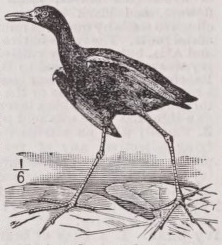
JACANA, the Brazilian name, according to Marcgrave, of certain birds, since found to have some allies in other parts of the world, which are also very generally called by the same appellation, They have been most frequently classed with the Water-hens or Rails (Rallidx), but are now recognized by many systematists as forming a separate Family, Parridae f whose leaning seems to be rather towards the Lirnicolx, as apparently first suggested by Blyth, a view which is supported by the osteological observations of Professor Parker (Proc. Zool. Society, 1863, p. 513), though denied by Professor A. Milne-Edwards (Ois. foss. de la Prance, ii. p. 110). The most obvious characteristic of this group of birds is the extraordinary length of their toes and claws (the latter being turned upwards), whereby they are enabled to walk with ease over water-lilies and other aquatic plants growing in rivers and lakes. It is also remarkable for the carpal spurs with which its members are armed. The Family has been divided into four genera,—of which Parra, as now restricted, inhabits South America; Metopidius, hardly differing from it, has representatives in Africa, Madagascar, and the Indian Region; Hydralector, also very nearly allied to Parra, belongs to the northern portion of the Australian Region; and Hydrophasianus, the most extravagant form of the whole, is found in India, Ceylon, and China—the draughtsmen of the country last named making it a favourite subject of their pictures, in which its flowing tail and the very peculiar filamentous appendages to the tip of its first and fourth primaries are generally faithfully represented. In habits the Jacanas have much in common with the Waterhens, but that fact is insufficient to warrant the affinity asserted to exist between the two ...groups; for in their osteological structure, as already implied, there is much difference, and the resemblance seems to be only that of analogy. The Parridx, or at least such of them as have been sufficiently observed, lay very peculiar eggs, of a rich olive-brown colour, in most cases closely marked with dark lines, thus presenting an appearance by which they may be readily known from those of any other birds, though an approach to it is occasionally to be noticed in those of certain Limicolx, and especially of certain Charadriidae. The genus Palamedea, consisting of the bird very commonly called the Horned Screamer, was at one time thought to be allied to this Family, but is now, by almost common consent, relegated to the neighbourhood of the Geese (Anatidse), though forming a separate Family. (a. n.)