
A small bird in America, so called from its voice or note; a species of plover.
Word of the Day: Catachrestical
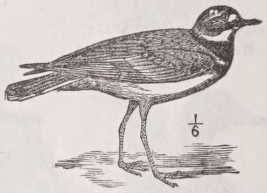
Killdeer
Encyclopedia Britannica
KILLDEER, a common and well-known American Plover, so called in imitation of its whistling cry, the Charadrius vociferιisoi Linnaeus, and the Aegialitis vocifera of modern ornithologists. About the size of a Snipe, it is mostly sooty-brown above, but showing a bright buff on the tail coverts, and in flight a white bar on the wings; beneath it is pure white except two pectoral bands of deep black. It is one of the finest as well as the largest of the group commonly known as Ringed Plovers or Ring Doterels, forming the genus Aegialitis of Boie. Mostly wintering in the south or only on the sea-shore of the more northern States, in spring it spreads widely over the interior, breeding on the newly-ploughed lands or on open grass-fields. The nest is made in a slight hollow of the ground, and is often surrounded with small pebbles and fragments of shells. Here the hen lays her pear-shaped, stone-coloured eggs, four in number, and always arranged with their pointed ends touching each other, as is indeed the custom of most Limicoline birds. The parents exhibit the greatest anxiety for their offspring on the approach of an intruder: the lien runs off with drooping wings and plaintive cries, while the cock sweeps around, gesticulating with loud and angry vociferations. It is the best-known bird of its Family in the United States, throughout which it is found in all suitable districts, but less abundantly in the north-east than further south or west. In Canada it does not range further to the northward than 56° N. lat., and it is not known to occur in Greenland, or hardly in Labrador, though it is a passenger in Newfoundland every spring and autumn. In winter it finds its way to Bermuda and to some of the Antilles, but it is not recorded from any of the islands to the windward of ...Porto Rico. However, in the other direction it goes very much further south, travelling down the Isthmus of Panama and the west coast of South America to Peru. The Killdeer has several other congeners in America, among which may be noticed Ae. semipalmata, so curiously resembling the ordinary Ringed Plover of the Old World, Ae. hiaticula, except that it has its toes connected by a web at the base; and Ae. nivosa, a bird inhabiting the western parts of both the American continents, which in the opinion of some authors is only a local form of the widely-spread Ae. alexandrνna or cantiana, best known by its English name of Kentish Plover, from its discovery near Sandwich towards the end of the last century, though it is far more abundant in many other parts of the Old World. The common Ringed Plover, Ae. hiaticula, has many of the habits of the Killdeer, but is much less often found away from the sea-shore, though a few colonies may be found in dry warrens in certain parts of England many miles from the coast, and in Lapland at a still greater distance. In such localities it has the curious habit of paving its nest with small stones (whence it is locally known by the name of “Stone-hatch”), a habit almost unaccountable unless regarded as an inherited instinct from shingle-haunting ancestors.
About thirty species all apparently referable with propriety to the genus Aegialitis have been described, but probably so many do not exist. Some, as the Kentish Plover above named, have a very extended distribution, for that, letting alone its supposed American habitat, certainly occurs in greater or less numbers on the coasts of China, India, and Africa generally. On the other hand there is one, the Ae. sanctae-helenae, which seems to be restricted to the island whence it takes its scientific name, and where it is called the “Wire-bird” (Ibis, 1873, p. 260). Nearly allied to Aegialitis are two genera peculiar to the New Zealand subregion— Thinornis, which does not call for any particular remark, ànd the extraordinary Anarhynchus, which deserves a few words. Of this there is but one species, Ae. frontalis, the Wrybill, so called from its bill being congenitally bent in the middle and diverted to the right side—a formation supposed to give the bird greater facility in seeking its food, chiefly arthropods that lurk under stones, round which it may be seen running from left to right. Mr Buller (Ji. Hew Zealand, p. 219) connects with this habit the curious fact that the black pectoral band worn by the bird is “narrower and of a less decided colour on the left side of the breast,” whence he infers that “the law of natural selection has operated to lessen the colouring on the side of the bird more exposed to Hawks and other enemies while the Anarhyηchus is hunting for its daily food.” Be that as it may, it does not detract from the wonderful nature of this asymmetry of the bill, which is comparable indeed with that found in so large a number of Cetaceans among mammals, but with nothing known among birds, for in the Crossbills (g ’.v.) the bones of the mandibles are not affected, and in certain Owls (Hyctala) the distortion of the ear-bones is not externally visible. (a. n. )
9th ed. Encyclopædia Britannica, vol. 14, p. 76
[887 words — estimated reading time: 6 minutes]
[887 words — estimated reading time: 6 minutes]
No thesaurus entries found for "Killdee".
No Bible verses found for "Killdee".