
A limb.
Word of the Day: Catachrestical
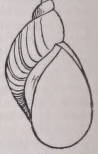
A genus of fresh-water air-breathing mollusks, abundant in ponds and streams; -- called also pond snail.
The capital city of Peru, in South America.
Lima
Encyclopedia Britannica
LIMA, capital of the republic of Peru, as also of the department and province of Lima, is situated on an extensive plain, 500 feet above the sea-level, and 7 miles east from its port Callao on the Pacific coast, in 12° 2' 34" S. lat., 77° 7' 36" W. long. The general configuration of the main portion of the city, previous to 1870 surrounded by walls, is that of an irregular triangle, whose base rests on the river Rimae, which separates the city from its offshoot or suburb of San Lazaro. Sheltered on the north and east by the spurs of the Andes, the city is exposed to the winds prevailing from the south-east, as also to those from the south and west. Although the atmosphere is moist, and the transitions of the seasons are rapid, the climate is not unhealthy, the rainfall being slight, and the variations of temperature not excessive. The summer commences in December, and the winter in June, and the mean temperature for the year is about 73° Fahr. The city is divided into five quarters or parishes, and is well laid out with broad and regular thoroughfares, the streets intersecting one another at right angles. The houses are spacious, but generally of only two stories, and are approached by portals leading into an open court or yard. In the principal square, which covers an area of 9 English acres in the centre of the city, stands a fine fountain of bronze. Here also are the cathedral, a stone structure with two lofty towers and a broad façade, the archiepiscopal palace, the Government house, and the Portal de los Escribanos, containing the municipal offices and archives. Besides the cathedral there are five chief parochial and sixty-two other churches and chapels, and numerous monasteries and convents. Of the churches, the largest is that of San Pedro (1598), which has ...seventeen altars; of the religious houses that of the Dominicans is the finest, and that of the Franciscans the most extensive. The university, built in 1576, is the oldest in America; it contains the hall and offices used by the chamber of deputies. Lima has more than seventy schools, a public library containing upwards of forty thousand volumes, and many charitable institutions, several of them connected with the religious orders. The principal place of amusement is the amphitheatre for bullfights in the Plaza del Acho, accommodating nine thousand spectators. In the Plaza de la Exposicion is a marble statue of Columbus unveiling a figure of America. Of the many other monuments in Lima the most famous is the bronze equestrian statue of Simon Bolivar in the Plaza de la Independencia (or de Bolivar), 11 tons in weight, commemorating the battle of Ayacucho, which secured the independence of Peru. Among the public promenades are reckoned the cemetery outside the Maravillas gate, and the Paseo de la Alameda de los Descalzos, in the centre of which is a gorgeous garden. As the capital of Peru, Lima is one of the most important trading centres in South America. It has, however, but few home industries, its manufactured goods being chiefly imported from Europe via Callao, the medium of nearly all its foreign commerce. Several attempts have from time to time been made to establish factories, but the high price of labour has hitherto prevented any efforts on a large scale being permanently successful. There are, however, manufactories for tallow, soap, sperm candles, glue, gold lace, gilt leather, and silver filigree work, and the capital supplies the towns of the republic with coarse woollen fabrics. The market is attended daily by about a thousand dealers. Fish is supplied from Callao, and vegetables partly from gardens in the city and environs, and partly from the native villages. Since 1857 the water for drinking purposes has been obtained filtered from the Rimae, and supplied by pipes to the houses. The imports are various; the exports include guano, cinchona, Indian wool, raw cotton, hides, sugar, saltpetre, gold, silver, and other minerals. Under ordinary conditions the imports and exports together exceed £5,000,000 annually. There are railways f.om Lima leading to Callao, Chancay, Chorrillos, and Oroya; the construction of several other lines has been stopped by the war with Chili. In 1780 the population of Lima was 50,000; in 1860 it had reached 100,341, and in 1868 121,362, of whom 38,761 were foreigners. A recent estimate (1877) gives the number at about 200,000, but, considering the vicissitudes the city has since then endured, these figures must be considered at the present time (1882) as far too high. The Spanish natives have the reputation of being courteous, affable, and generous, but at the same time fond of pleasure, improvident, and superstitious. By confession they are mostly Roman Catholics.
Lima was founded 18th January 1535, by Francisco Pizarro, who named it Ciιιdad de los Reyes in honour of the emperor Charles V. and Dona Juana his mother, or, according to some authors, from its site having been selected on the 6th January, the Feast of the Epiphany. The name afterwards gave place to that of Lima, a Spanish corruption of the Quichua word Rimae. In 1548 Lima received its first archbishop, and in 1582 the earliest provincial council for the state was held there. .Remaining under Spanish rule during the 17th, 18th, and early part of the 19th centuries, the city continued to increase in prosperity, though often visited by terrible earthquakes, of which the most disastrous was that of the 28th October 1746, when 5000 of the inhabitants perished and the port of Callao was destroyed (see Callao, vol. iv. p. 107). On the 12th July 1821, after a siege of some months, Lima was entered by a Chilian force under General San Martin, who on the 28th was proclaimed protector of Peru as a free state, but its independence was not finally secured until after the victory of Ayacucho (9th December 1824). In March 1828 the city again suffered from an earthquake, and in 1854-55 the yellow fever earned off a great number of the inhabitants. On the 11th of August 1857, Mr Sullivan, British minister to Peru, was assassinated. In November 1864 a congress of plenipotentiaries from Chili and other South American states was held here to concert measures of·mutual defence. Of the various revolts which have during the last few years taken place at Lima may be mentioned that of November 1865, when President Pezet was displaced for Canseco; the riots against religious toleration, 15th April 1867; and the military insurrection, 22d July 1872, when Gutierrez, minister of war, arbitrarily assumed power, had President Balta imprisoned and shot, but himself soon fell a victim to the popular fury; order being afterwards with difficulty restored by Vice-President Zavallos. In consequence of the ill-success of the war with Chili, Lima towards the close of 1879 was again in an unsettled condition; President Prado fled, and ou the 22d December, after a sanguinary coup d’état, Pierola was proclaimed dictator. In April 1880 Callao was blockaded by Chilian war ships, and Lima had to be placed in a state of defence. On the 20th of November the Chilian army effected a landing at Pisco, a fortified place about 100 miles south of Lima, and, having afterwards advanced upon the capital, forcibly occupied it upon the 17th of January 1881.
See Mariano F. Paz Soldan, Diccionario gengräfko estesdistico del Peril. Lima, 1877, pr>. 513-27; Mateo Paz Solιlan and Μ. F. Paz Soldan, Geografia del Peru, Paris, 1862, vol. i. pp. 290-320; Μ. A. Fuentes, Lima, cr Sketches of the Capital of Peru, Historical, Statistical, Administrative, <tc.. London, 1866; C. R. Markham, Cuzco . . . and Lima, London, 1856. For further information as to the early history of Lima, see Lopez de G<5mara, Hist. gen. de. las Ind.; A. de Herrera, Hist. gen. de las Ind. Occid.: W. II. Prescott. Hist, of the Conquest of Peru; F. de Xeres, Conquista del Peril; A. de Zarate, Hist, de la Conq. del Peru; and J. de Ferreras, Hist d'Espagne (French translation by Hermilly), Paris, 1751.
LIMA, capital of Allen county, Ohio, U.S., on the Ottawa river, and at the intersection of four railway lines, 130 miles north of Cincinnati. It is pleasantly situated in a fine farming country, and has two large railway repairs shops, extensive car-works, and other smaller manufactories. The population in 1850 was 757; in 1860, 1989: in 1870, 4464; and in 1880, 7567.
9th ed. Encyclopædia Britannica, vol. 14, p. 644 — signed E. D.B.
[1,362 words — estimated reading time: 8 minutes]
[1,362 words — estimated reading time: 8 minutes]
A curve of the fourth degree, invented by Pascal. Its polar equation is r = a cos / + b.
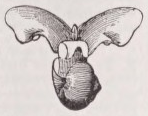
A genus of small spiral pteropods, common in the Arctic and Antarctic seas. It contributes to the food of the right whales.
1. The act of filing.
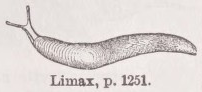
A genus of airbreathing mollusks, including the common garden slugs. They have a small rudimentary shell. The breathing pore is on the right side of the neck. Several species are troublesome in gardens. See Slug.
1. lim. [Latin limbus, edge or border, extremity; limes, limit. The sense of limb is from shooting or extending.]
2. Edge or border. This is the proper signification of the word; but in this sense it is limited chiefly to technical use, and applied to the sun, moon, or a star, to a leaf, to a quadrant, etc. We say, the sun or moon is eclipsed on its northern limb But we never say, the limb of a board, of a tract of land or water, etc.
3. In anatomy, and in common use, an extremity of the human body; a member; a projecting part; as the arm or leg; that is, a shoot.
4. The branch of a tree; applied only to a branch of some size, and not to a small twig.
5. In botany, the border or upper spreading part of a monopetalous corol.
1. A part of a tree which extends from the trunk and separates into branches and twigs; a large branch.
2. An arm or a leg of a human being; a leg, arm, or wing of an animal.
3. A thing or person regarded as a part or member of, or attachment to, something else.
4. An elementary piece of the mechanism of a lock.
5. A border or edge, in certain special uses.
7. The border or edge of the disk of a heavenly body, especially of the sun and moon.
8. The graduated margin of an arc or circle, in an instrument for measuring angles.
1. To supply with limbs.
2. To dismember; to tear off the limbs of.
A cooling periodical wind in the isle of Cyprus, blowing from the north west from eight o'clock, adjective M. to the middle of the day or later.
Bordered, as when one color is surrounded by an edging of another.
A still; a word not now used.
To strain or pass through a still. obsolete
To distill.
In composition, formed with regard to limbs; as well-limbed; large-limbed; short-limbed.
Having limbs; -- much used in composition; as, large-limbed; short-limbed.
Easily bent; flexible; pliant; yielding. In America, it is applied to material things; as a limber rod; a limber joint.
In a ship, a square hole cut through the floor timbers, as a passage for water to the pump-well.
1. The shafts or thills of a wagon or carriage.
2. The detachable fore part of a gun carriage, consisting of two wheels, an axle, and a shaft to which the horses are attached. On top is an ammunition box upon which the cannoneers sit.
3. Gutters or conduits on each side of the keelson to afford a passage for water to the pump well.
1. To attach to the limber; as, to limber a gun.
2. To cause to become limber; to make flexible or pliant.
The quality of being easily bent; flexibleness; pliancy.
The quality or state of being limber; flexibleness.
No thesaurus entries found for "LIM".
King James Bible KJV Bible
Berean Standard Bible BSB Bible
5 KJV and 37 BSB verses contain “LIM” — showing the first 20. Show all 41 verses (searchable)
Either a bullock or a lamb that hath any thing superfluous or lacking in his parts, that mayest thou offer for a freewill offering; but for a vow it shall not be accepted.
You may present as a freewill offering an ox or sheep that has a deformed or stunted limb, but it is not acceptable in fulfillment of a vow.
But the mountain shall be thine; for it is a wood, and thou shalt cut it down: and the outgoings of it shall be thine: for thou shalt drive out the Canaanites, though they have iron chariots, and though they be strong.
because the hill country will be yours as well. It is a forest; clear it, and its farthest limits will be yours. Although the Canaanites have iron chariots and although they are strong, you can drive them out.”
And when he was come into his house, he took a knife, and laid hold on his concubine, and divided her, together with her bones, into twelve pieces, and sent her into all the coasts of Israel.
Unto an hundred talents of silver, and to an hundred measures of wheat, and to an hundred baths of wine, and to an hundred baths of oil, and salt without prescribing how much.
up to a hundred talents of silver, a hundred cors of wheat, a hundred baths of wine, a hundred baths of olive oil, and salt without limit.
And the drinking was according to the law; none did compel: for so the king had appointed to all the officers of his house, that they should do according to every man’s pleasure.
By order of the king, no limit was placed on the drinking, and every official of his household was to serve each man whatever he desired.
Thou puttest my feet also in the stocks, and lookest narrowly unto all my paths; thou settest a print upon the heels of my feet.
You put my feet in the stocks and stand watch over all my paths; You set a limit for the soles of my feet.
Seeing his days are determined, the number of his months are with thee, thou hast appointed his bounds that he cannot pass;
Since his days are determined and the number of his months is with You, and since You have set limits that he cannot exceed,
when He set a limit for the rain and a path for the thunderbolt,
His bones are as strong pieces of brass; his bones are like bars of iron.
His bones are tubes of bronze; his limbs are rods of iron.
I will not conceal his parts, nor his power, nor his comely proportion.
I cannot keep silent about his limbs, his power and graceful form.
I have seen an end of all perfection: but thy commandment is exceeding broad.
I have seen a limit to all perfection, but Your commandment is without limit.
Great is our Lord, and of great power: his understanding is infinite.
Great is our Lord, and mighty in power; His understanding has no limit.
There is no end of all the people, even of all that have been before them: they also that come after shall not rejoice in him. Surely this also is vanity and vexation of spirit.
There is no limit to all the people who were before them. Yet the successor will not be celebrated by those who come even later. This too is futile and a pursuit of the wind.