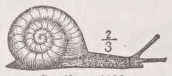
1. A slimy slow creeping animal, of the genus Helix, and order of Mollusca. The eyes of this insect are in the horns, one at the end of each, which it can retract at pleasure.
1. Any one of numerous species of terrestrial air-breathing gastropods belonging to the genus Helix and many allied genera of the family Helicidae. They are abundant in nearly all parts of the world except the arctic regions, and feed almost entirely on vegetation; a land snail.
2. Any gastropod having a general resemblance to the true snails, including fresh-water and marine species. See Pond snail, under Pond, and Sea snail.
4. A spiral cam, or a flat piece of metal of spirally curved outline, used for giving motion to, or changing the position of, another part, as the hammer tail of a striking clock.
5. A tortoise; in ancient warfare, a movable roof or shed to protect besiegers; a testudo.
SNAIL. In England the word “snail” in popular language is associated with Gasteropods which inhabit land or fresh water and which possess large conspicuous spiral shells; terrestrial Gasteropods in which the shell is rudimentary and concealed are distinguished as “slugs.” In Scotland the word “slug” is absent from the vernacularvocabulary, both shell-bearing and shell-less inland molluscs being known as snails. Marine Gasteropods are occasionally termed “sea-snails,” and the compounds “pond-snails,” “river-snails,” “water-snails” are in common use. The commonest land-snails are those species which constitute the family Helicidae, order Pulmonata, sub-order Stylommatophora. The other two families of the same sub-order, Limacidae and Onchidiidae, include all the slugs. In the first of these are comprised all the slugs known in Great Britain, and indeed in Europe. The Onchidiidae are entitled to the name “sea-slugs,” as they are shell-less Pulmonates living on the seashore, though not actually in the sea. The term “water-snails” includes the whole of the remaining sub-order of the Pulmonata, namely, the Basommatophora, in which the eyes are sessile. This division comprises two families, Limnaeidae and Auriculidae·, some of the members of the first are amphibious, some entirely aquatic; the snails of the second family are found near but not in the water. Thus the whole of the Pulmonata which breathe air, are destitute of gill-plumes and operculum, and have a complicated hermaphrodite reproductive system are either snails or slugs. But there are a considerable number of snails, both terrestrial and aquatic, which are not Pulmonates. The land-snails which have no gill-plume in the mantle-chamber and breathe air, but have the sexes ...separated, and possess an operculum belong to the order Azygobranchia, of which they form a distinct sub-order, the Pneumonochlamyda, containing three families, Cyclostomidae, Helicinidae, and Aciculidae. The fresh-water snails which are not Pulmonates are the Paludinidae, Valvatidae, and Ampullaridae, together with Neritina, a genus of the Neritidae. These all possess a fully developed gill-plume and are typical Azygobranchiates of the sub-order Holochlamyda, most of the members of which are marine.
The family Helicidae has a world-wide distribution. In Helix the spire forms a more or less obtuse-angled cone; there are above 1200 species, of which 24 are British. Helix nemoralis, L., of which H. hortensis is a variety, is one of the commonest forms. Helix pomatia, L., is the largest species, and is known as the “edible snail”; it is commonly eaten in France and Italy, together with other species. It was formerly believed to have been introduced into Britain by the Romans, but there is no doubt that it is a native. In Succinea the cone of the spire is acute-angled; three species are British. In Vitrina the spire is very flat and the surface glassy. In Bulimus the spire is elongated with a pointed apex. Pupa is named from its resemblance to a chrysalis, the apex being rounded. The shell of Clausilia is sinistral and its aperture is provided with a hinged plate. The commoner European slugs of small size all belong to the genus Limax, in which the opening of the mantle-chamber is posterior. L. flavus is the cellarslug. L. agrestis, L. arborum, L. maximus, occur in gardens and fields. The larger black slugs are species of Arion, of which two are British, A. ater and A. hortensis. Testacella haliotidea is common in Great Britain and throughout Europe.
The Limnaeidae occur in all parts of the world. Limnaeus contains the largest species. L. pereger, Miiller, is ubiquitous in Great Britain and common all over Europe. All the species are usually infested with C ercariae and Rediae, the larval forms of Trematode parasites of vertebrates. L. truncatulus harbours the Cercaria of Fasciolahepatica, the liver-fluke, which causes rot in sheep. Ancylus, which occurs in rivers, has a minute limpet-like shell. Planorbis has the spire of the shell in one plane. Physa is smaller than Limnaeus and has the upper part of the spire much shorter. In the Auriculidae the aperture is denticulated. Auricilla is confined to the East Indies and Peru. Carychium minimum is British.
Of the Cy clostomidae only one species, Cyclostoma elegans, Miiller, is British; it hides under stones and roots. The Helicinidae are exotic, ranging from the West Indies to the Philippines. Of the Aciculidae, which are all minute, Acicula lineata is British.
The Ampullaridae are confined to the tropics. Ampullaria has very long tentacles and a long siphon formed by the mantle. Valvata is common in fresh waters throughout Britain; the gill when the animal is expanded is protruded beyond the mantlechamber. The Paludinidae are common in the northern hemisphere. Paludina and Bithynia are both British genera. In Paludina the whorls of the spiral are very prominent; the genus is viviparous. Bithynia is smaller and the shell smoother.
Neritina has a very small spire, the terminal portion of the shell containing nearly the whole animal.
Adv. slowly, leisurely, piano, adagio, largo, larghetto, at half speed, under easy sail, at a foots pace, at a snail's pace, at a funeral pace, in slow time, with mincing steps, with clipped wings, haud passibus aequis, gradually, gradatim, by degrees, by slow degrees, by inches, by little and little, step by step, one step at a time, inch by inch, bit by bit, little by little, seriatim, consecutively
Phr. dum roma deliberat saguntum perit, at a glacial pace, 3, motion conjoined with force
As a snail which melteth, let every one of them pass away: like the untimely birth of a woman, that they may not see the sun.
Like a slug that dissolves in its slime, like a woman’s stillborn child, may they never see the sun.
This site uses cookies to remember your display preferences (search sources and editions, Bible version, auto-link, images, light/dark theme). No personal data whatsoever is collected. Privacy Policy