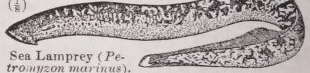
1. A genus of anguilliform fishes, resembling the eel, and moving in water by winding, like the serpent on land. This fish has seven spiracles on each side of the neck, and a fistula or aperture on the top of the head, but no pectoral or ventral fins. The marine or sea lamprey is sometimes found so large as to weigh four or five pounds.
An eel-like marsipobranch of the genus Petromyzon, and allied genera. The lampreys have a round, sucking mouth, without jaws, but set with numerous minute teeth, and one to three larger teeth on the palate (see Illust. of Cyclostomi). There are seven small branchial openings on each side.
LAMPREY, a fish belonging to the family Petromyzon- tidae (from τreτpoς and μυζω; literally, stone-suckers), which with the hag-fishes or Afyxinidae forms a distinct subclass of fishes, the Cyclοstomata, distinguished by the low organization of their skeleton, which is cartilaginous, without vertebralsegmentation, without ribs or real jaws, and without limbs. The lampreys are readily recognized by their long, eel-like, scaleless body, terminating anteriorly in the circular, suctorial mouth which is characteristic of the whole subclass. On each side, behind the head, there is a row of seven branchial openings, through which the water is conveyed to and from the gills. By means of their mouth they fasten themselves to stones, boats, <fcc∙., as well as to other fishes, their object being to obtain a resting place on the former, whilst they attach themselves to the latter for the purpose of derivingnourishment from them. The inner surface of their cup-shaped mouth is armed with pointed teeth, with which they perforate the integuments of the fish attacked, scraping off particles of the flesh and sucking the blood. Mackerel, cod, pollack, and flat-fishes are the kinds most frequently attacked by them in the sea; of river-fish the migratorySalmonidae and the shad are sometimes found with the marks of the teeth of the lamprey, or with the fish actually attached to them. About ten species are known from the coasts and rivers of the temperate regions of the northern and southern hemispheres. In Great Britain and Europe generally, three species occur, of which the two larger, if not all three, are met with also in North America, viz., the large spotted Sealamprey {Petromyzon marinus); the River-lamprey or Lampern (F. fluviatilis) ; and the Small Lampern or “Pride” ...or “Sand-Piper” (P. branchialis). The first two are migratory, entering rivers in the spring to spawn; of the river-lamprey, however, specimens are met with in fresh water all the year round. Lampreys, especially the sealamprey, are esteemed as food, and were formerly even more so than at present; but their flesh is not easy of digestion. Henry I. is said to have fallen a victim to this, his favourite dish. The species of greatest use is the river-lamprey, which as bait is preferred to all others in the cod and turbot fisheries of the North Sea. Yarrell states that formerly the Thames alone supplied from 1,000,000 to 1,200,000 lamperns annually, but their number has so much fallen off that, for instance, in 1876 only 40,000 were sold to the cod-fishers. That year, however, was an unusually bad year: the lamperns, from their scarcity, fetched £8, 10s. a thousand, whilst in ordinary years £5 is considered a fair price. The season for catching lamperns closes in the Thames about the middle of March. The origin of the name lamprey is obscure; its Latinized form Lampetra, which occurs in all ichthyological works of the Middle Ages, was unknown in classical times; and its derivation from lambere petras is a specimen of etymological ingenuity. The development of lampreys has received much attention on the part of naturalists, since Aug. Müller discovered that they undergo a metamorphosis, and that the minute worm-like lamperns previously known under the name of Ammοc<xtes, and abundant in the sand and mud of many streams, were nothing but the undeveloped young of the river-lampreys and small lamperns. See Ichthyology.
9th ed. Encyclopædia Britannica, vol. 14, p. 249 [577 words — estimated reading time: 4 minutes]
This site uses cookies to remember your display preferences (search sources and editions, Bible version, auto-link, images, light/dark theme). No personal data whatsoever is collected. Privacy Policy