
A genus of mosslike plants, the type of the order Lycopodiaceae; club moss.
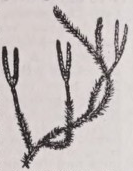
LYCOPODIUM. This and Selaginella are the two chief genera of the order Lycopodiaceae or club mosses. They are flowerless herbs, and mostly creeping; but during the period of the development of coal plants members of this order attained to the dimensions of lofty trees. A remarkable bed of Scotch coal called the “better bed” was found on microscopical examination to be almost entirely composed of the spores and sporanges of some “lycopod.” There are one hundred species, which occur in all climates, five being British. The leaves of lycopodium are for the most part small, and thickly cover the stem and branches. The “fertile” leaves are arranged in cones, «and bear sporanges in their axils, containing spores of one kind only (of two kinds in Selaginella). The prothallium developed from the spore is a subterranean mass of tissue of considerable size, and bears the male and female structures (antheridia and archegonia). Bee Micrographic Diet.; Le Maout and Decaisne’s Desc. and Anal. Boh, Eng. ed., p. 911; and Sach’s Text-book of Boh, Eng, ed., p. 400 sq. Gerard, in 1597, described two kinds of lycopodium (Herball, p. 1373) under the names Muscus denticulatus and Muscus clavatus (L. clavatum, L.) as “Club Mosse or Woolfes Clawe Mosse,” the names being in Low Dutch, “Wolfs Clauwen,” from the resemblance of the club-like or claw-shaped shoots to the toes of a wolf, “whereupon we first named it LycopodionT Gerard also speaks of its emetic and many other supposed virtues. L. Selago, L., and L. catharticum, Hook., of South America, have been said to be, at least when fresh, cathartic; but, with the exception of the spores (“lycopodium powder ”), lycopodium as a drug has fallen into disuse. The powder is used for rolling pills in, as a dusting powder ...for infants’ sores, &c. It is highly inflammable, and is used in pyrotechny and for artificial lightning on the stage. If the hand be covered with the powder it cannot be wetted on being plunged into water. Another use of lycopodium is for dyeing; woollen cloth boiled with species of lycopodium, as L. clavatum, becomes blue when dipped in a bath of Brazil wood.