
A species of monkey.
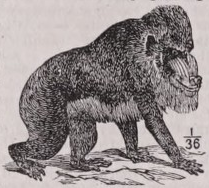
MANDRILL, the name of one of the most remarkable, at all events in outward appearance, of the Baboons, Cynocephalus maimon or mormon. The general characters of the genus to which it belongs are given in the article Ape, vol. ii. p. 152. The word appears to have been first introduced into our literature in a w ork published in 1744 called A New Voyage to Guinea, by William Smith, who in an account of the animals of Sierra Leone describes one “called by the white men in this country Mandrill,” but adds, “why it is so called I know not.” Smith gives sufficiently accurate details to show that his animal is not that now called Mandrill, but the Chimpanzee. Buffon, however, while quoting Smith’s description, transferred the name to the very different species now under consideration, and to that it has been attached ever since....
The Baboons generally are distinguished from other Monkeys by the comparative equality of the length of their limbs, which with the structure of the vertebral column adapts them rather for quadrupedal progression on the ground than for climbing among the branches of trees. They are also remarkable for the great size of their face and jaws as compared with the part of the skull which encloses the brain. The Mandrill, in addition to these characters, is distinguished by the heaviness of its body, stoutness and strength of its limbs, and exceeding shortness of its tail, which is a mere stump, not 2 inches long, and usually carried erect. It is, moreover, remarkable for the prominence of its brow ridges, beneath which the small and closely approximated eyes are deeply sunk; the immense size of the canine teeth; the great development of a pair of oval bony prominences on the maxillary bones in front of the orbits, rising on each side of the median line of the face, and covered by a longitudinally-ribbed naked skin; and more especially for the extraordinarily vivid colouring of some parts of the skin.
The body generally is covered with a full soft coating of hair of a light olive-brown above and silvery-grey beneath, and the chin is furnished underneath with a small pointed yellow beard. The hair of the forehead and temples is directed upwards so as to meet in a point on the crown, which gives the head a triangular appearance. The ears are naked and of a bluish-black colour. The hands and feet are naked and black. A large space around the greatly developed ischial callosities, as well as the upper part of the insides of the thighs, is naked and of a crimson colour, shading off on the sides to lilac or blue, which, depending not upon pigment but upon injection of the superficial blood-vessels, varies in intensity according to the condition of the animal—increasing under excitement, fading during sickness, and disappearing after death. But it is in the face that the most remarkable disposition of vivid hues occur, more resembling those of a brilliantly coloured flower than what might be expected in the cutaneous covering of a mammal. The cheek prominences are of an intense blue, the effect of which is heightened by deeply sunk longitudinal furrows of a darker tint, while the central line and termination of the nose are a bright scarlet. Notwithstanding the beauty of these colours in themselves, the whole combination, with the form and expression of features, quite justifies Cuvier’s assertion that “il serait difficile de se figurer un être plus hideux que le Mandrill.”
It is only to fully adult males that this description applies. The female is of much smaller size, and of more slender make; and, though the general tone of the hairy parts of the body is the same, the prominences, furrows, and colouring of the face are very much less marked. The young males have black faces. At the age of three the blue of the cheeks begins to appear, and it is not until they are about five, when they cut their great canine teeth, that they acquire the characteristic red of the end of the nose.
The Mandrills, especially the old males, are remarkable for the ferocity of their disposition, as well as for other disagreeable qualities, which are fully described in Cuvier’s account of the animal in La Ménagerie du Museum d ’ IIistoire Naturelle (1801), but when young they can easily be tamed. Like the rest of the Baboons, they appear to be rather indiscriminate eaters, feeding upon fruit, roots, reptiles, insects, scorpions, &c., and inhabit open rocky ground rather than forests. Not much is known of the Mandrill’s habits in the wild state, nor of the exact limits of its geographical distribution. The specimens brought to Europe all come from the west coast of tropical Africa, from Guinea to the Gaboon.
An allied species, the Drill (Cynocephalus leucophseus') t which resembles the Mandrill in size, general proportions, and shortness of tail, but wants the bright colouring of the face which makes that animal so remarkable, inhabits the same district. (w. h. f.)