
A plant (Reseda odorata) having greenish flowers with orange-colored stamens, and exhaling a delicious fragrance. In Africa it is a low shrub, but further north it is usually an annual herb.
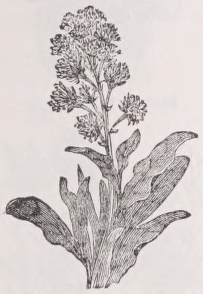
MIGNONETTE, or Mignonnette(i.e., “little darling”), the name given to a popular garden flower, the Reseda odorata of botanists, a “fragrant weed,” as Cowper calls it, highly esteemed for its delicate but delicious perfume. The mignonette is generally regarded as being of annual duration, and is a plant of diffuse decumbent twiggy habit, scarcely reaching a foot in height, clothed with bluntish lanceolate entire or three-lobed leaves, and bearing longish spikes—technically racemes—of rather insignificant flowers at the ends of the numerous branches and branchlets. The plant thus naturally assumes the form of a low dense mass of soft green foliage studded over freely with the racemes of flowers, the latter unobtrusive and likely to be overlooked until their diffused fragrance compels attention. The native country of the original or typical mignonette has sometimes been considered doubtful, but according to the best and latest authorities it has been gathered wild on the North African coast near Algiers, in Egypt, and in Syria. As to its introduction, a MS. note in the library of Sir Joseph Banks records that it was sent to England from Paris in 1742; and ten years later it appears to have been sent from Leyden to Philip Miller at Chelsea. Though originally a slender and rather straggling plant, there are now some improved garden varieties in which the growth is more compact and vigorous, and the inflorescence bolder, though the odour is perhaps less penetrating. The small six-petalled flowers are somewhat curious in structure: the two upper petals are larger, concave, and furnished at the back with a tuft of club-shaped filaments, which gives them the appearance of being deeply incised, while the two lowest petals are much smaller and undivided; the most ...conspicuous part consists of the anthers, which are numerous and of a brownish red, giving the tone of colour to the inflorescence. In a new variety named Golden Queen the anthers have a decided tint of orange-yellow, which imparts a brighter golden hue to the plants when in blossom. A handsome proliferous or double-flowered variety has also been obtained, which is likely to be a very useful decorative plant, though only to be propagated by cuttings; the double white flowers grow in large massive panicles (proliferous racemes), and are equally fragrant with those of the ordinary forms.
What is called tree mignonette in gardens is due to the skill of the cultivator. Though practically a British annual, as already noted, since it flowers abundantly the first season, and is utterly destroyed by the autumnal frosts, and though recorded as being annual in its native habitat by Desfontaines in the Flora Atlantica, the mignonette, like many other plants treated in England as annuals, will continue to grow on if kept in a suitable temperature. Moreover, the life of certain plants of this semiannual character may be prolonged into a second season if their flowering and seeding are persistently prevented. In applying these facts to the production of tree mignonette, the gardener grows on the young plants under glass, and prevents their flowering by nipping off the blooming tips of the shoots, so that they continue their vegetative growth into the second season. The young plants are at first supported in an erect position, the laterals being removed so as to secure clean upright stems, and then at the height of one or two feet or more, as may be desired, a head of branches is encouraged to develop itself. In this way very large plants can be produced.
For ordinary purposes, however, other plans are adopted. In the open borders of the flower garden mignonette is usually sown in spring, and in great part takes care of itself; but, being a favourite either for window or balcony culture, and on account of its fragrance a welcome inmate of town conservatories, it is also very extensively grown as a pot plant, and for market purposes with this object it is sown in pots in the autumn, and thinned out to give the plants requisite space, since it does not transplant well, and it is thereafter specially grown in pits protected from frosts, and marketed when just arriving at the blooming stage. In this way hundreds of thousands, probably, of pots of blooming mignonette are raised and disposed of year by year.
1 n classifying the odours given off by plants Rimmel ranks the mignonette in the class of which he makes the violet the type; and Fée adopts the same view, referring it to his class of “iosmoids” along with the violet and wallflower.
The name is sometimes, but it would appear less correctly, written mignionette. The genus Reseda contains some other interesting and useful species,—among them the Reseda Luteola, which is commonly called dyer’s-weed and weld, and yields a valuable yellow dye.