
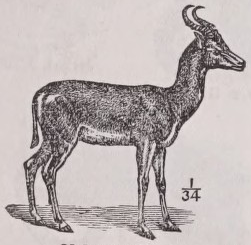
A West African gazelle (Gazella mohr), having horns on which are eleven or twelve very prominent rings. It is one of the species which produce bezoar.
MOHR, Karl Friedrich (1806-1879), a philosopher whose greatest claims to scientific distinction are as yet, though indubitable^ only partially admitted, was the son of a well-to-do druggist in Coblentz, and was born 4th November 1806. Being a delicate child, he received much of his early education at home, in great part in his father’s laboratory. To this may be traced much of the skill he showed in devising instruments and methods of analysis which are still in common use in chemical and pharmaceutical laboratories. At the age of 21 he studied chemistry under Gmelin, and, after five years spent in Heidelberg, Berlin, and Bonn, returned with the degree of Ph.D. to join his father’s establishment. On the death of his father in 1840 he succeeded to the business, retiring from it for scientific leisure in 1857. Serious pecuniary losses led him at the age of 57 to become a privat-docent in Bonn, where he was soon after appointed, by the direct influence of the emperor, extraordinary professor of pharmacy. In private and domestic life he was a man of singularly winning manners, intensely fond of music and poetry, for the latter of which he showed wonderful memory. But his uncompromising spirit—perhaps we might even in some cases say his wrongheadedness—in matters of scientific and theological authority had raised such a host of enemies that even royal influence could not secure his further advancement. Although he stood at the very head of the scientific pharmacists of Germany, his name was deliberately omitted from the list of the commission entrusted with the preparation of the Pharmacopoeia Germanica. Yet in that work many of his ideas and processes were incorporated by the very men who had previously denounced them. He died in October 1879....
Mohr’s best-known work is his Lehrbuch der chemisch-analytischen Titrirmethode (1855), which has already run through many editions, and which was specially commended by Liebig. His improvements in methods of chemical analysis occupy a long series of papers extending over some fifty years. He also published a number of physical papers on subjects such as Hail, St. Elmo’s Fire, Ground-ice, &c., and a curious notice of the earliest mention of Ozone. He shows that Homer, on four different occasions, mentions the sulphurous smell produced by lightning, and employs the very word from which the name of Ozone was long afterwards coined. In 1866 appeared his Geschichte der Erde, cine Geologie auf neuer Grundlage, which has obtained a wide circulation.
But he will be remembered in future times mainly on account of a paper, Uebcr die Natur der Wärme, published in 1837, which unfortunately has not yet appeared in full in an English translation. The history of this paper is remarkable. It was refused admission into Poggendorff’s Annalen, and was then sent to Baumgartner of Vienna, in whose Zeitschrift für Physik, &c., it was at once published. As no proof-sheets reached Mohr, he concluded that his paper had been lost or rejected, and contented himself with publishing a short analysis in the Annalen der Pharmacie, of which he was an editor. This analysis, it is only fair to say, though probably prepared by the author himself, gives a very inadequate idea of the scope and merit of the paper. In 1864 Dr. Akin unearthed the paper from the forgotten pages of the Zeitschrift, and the author was enabled to reprint it, with notes, while the recent discussions as to the history of Conservation of Energy were still being carried on. · Along with it he issued a number of other papers of greatly inferior merit.
Unless some still earlier author should be discovered, there can be no doubt that Mohr is to be recognized as the first to enunciate in its generality what we now call “conservation of energy.” The thesis of his paper must be stated in his own words,—“Besides the 54 known chemical elements, there is in the physical world one agent only, and this is called Kraft (energy). It may appear, according to circumstances, as motion, chemical affinity, cohesion, electricity, light, and magnetism; and from any one of these forms it can be transformed into any of the others.” Even now, after nearly half a century of rapid advance in science, it would be difficult to improve this statement except by inserting, as regards transformation of energy, some such guarding expression as “in whole or in part.” But if Mohr had inserted this, he might have had claims to the “dissipation of energy” also. Mohr’s starting-point appears to have been the discovery (by Forbes) of the polarization of radiant heat. He goes through the whole of the then range of physics, pointing out the explanation of each experimental result as a transformation of energy, mentioning even the electric currents produced by electro-magnetic induction as a transformation of the energy required to draw the coil from the magnet—one of the earlier methods used by Joule for quantitative determinations. His numerical results, based on data quoted from various books, are, it is true, very inaccurate; the correct experimental determinations we owe to Joule. But it must be remembered that these speculations, daring as they were and accurate (on the whole) as they have been found to be, required the confirmation which they received from the experimental work of Colding and Joule, or from the Essay of Von Helmholtz, whose basis also is wholly experimental, being the fact that “perpetual motion” is recognized as unattainable.