
1. Garden nightshade, a plant of the genus Solanum.
2. A kind of cherry.
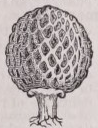
MOREL or Morchella. See Mushroom.
MORELIA, formerly Valladolid, a city of Mexico, capital of the state of Michoacan de Ocampo, is situated 125 miles west by north of Mexico, at a height of 6400 feet above the sea, in 19° 42' N. lat. and 101° W. long. The site is a rocky hill on the Guayangareo valley, and the western horizon is bounded by the great Quinceo mountain (11,000 feet). Since the middle of the century a considerable extension of the city has taken place, especially towards the north: its streets, which run for the most part at right angles to each other, had increased from thirty in 1856 to ninety-nine in 1873. The principal square is the Plaza de los Martires (formerly de Armas), where Matamoros was shot by the Spaniards in 1814; its one side is occupied by the cathedral (1745), a large building with two towers about 200 feet high. The churches of the Carmelites (del Carmen) and San José are of some note, and of the nine convents, now for the most part in ruins, several were wealthy and extensive. That of the Capuchins is now used as a hospital, the old seminary has been turned into a state-house, and the tobacco factory, one of the most ancient buildings in the city, serves as municipal offices. An important institution, supported by the state, is the college of San Nicolas de Hidalgo, originally founded by Juan de San Miguel in the 16th century and rebuilt in 1868. The Ocampo theatre dates from 1869-1870. Water is brought from a distance of about 3 miles by a fine aqueduct, constructed in 1788 by D. Antonio de San Miguel, but the quality is often deteriorated by the presence of vegetable matter. Morelia lies too far from any great natural route to have much commerce in the present state of the country, and its manufactures are limited to the production, on a small scale, of cotton, ...woollen, and silk goods. A certain delicate sweetmeat called guayabate is a regular article of commerce to Mexico. In 1750 the city had about 18,000 inhabitants, in 1873 the municipality had 36,940 and the city proper about 30,000, and in 1880 the number is stated at 20,400.
In 1541 Mendoza chose the Guayangareo valley as the new site for the city of Michoacan, and in 1545 the place received the name of Valladolid. Iturbide and Morelos were both born within its precincts; and in 1828 the Government did this latter patriot the honour of renaming the city Morelia. In 1863 it was made the seat of an archbishop. See Bol. Soc. de geogr. de la Rep. Max., Mex., 1873.
MORELLET, André (1727-1819), economist and miscellaneous writer, was born at Lyons on the 7th of March 1727. He was long regarded as almost the last survivor of the Philosophe school; and in this character he figures in many memoirs,—for instance in Madame de Remusat’s. He was educated by the Jesuits in his native town, then at a seminary in Paris, and finally at the Sorbonne; and he took holy orders, but his designation of abbé was the chief thing clerical about him. He early joined the Philosophe party, and was a frequenter of most of their salons, being something of a butt (especially to his fellow-abbé and rival in political economy, Galiani), but having the credit of a ready and biting pen. Voltaire called him “I.’Abbé Mord-les.” His work was chiefly occasional, and the most notable parts of it were a smart pamphlet in answer to Palissot’s scurrilous play Les Philosophes (which procured him a short sojourn in the Bastille for an alleged libel on Palissot’s patroness, the princesse de Robeck), and a reply to Galiani’s Commerce des Blés (1770). Later, he made himself useful in quasi-diplomatic communications with English statesmen, and was pensioned, being, moreover, elected a member of the Academy in 1785. The outbreak of the Revolution (soon after which he was engaged in a controversy with Chamfort on the question of the advantages and deserts of the Academy) did not, as it did with many of his friends, drive him from the country or put his life in danger, but it put him in considerable straits of fortune. He maintained a kind of moderate liberal tone, and the return of something like order under the Consulate and the Empire restored him to prosperity and pensions. A year before his death, at the great age of ninety-two, on the 12th of January ...1819 at Paris, he brought out a series of Melanges, composed chiefly of selections from his former publications; and after his death appeared his memoirs, which are of value for the Philosophe period. Morellet, though not a man of extraordinary ability or of specially amiable or estimable character, was in both respects a fair specimen of the man of letters of all work of the time. He was, in fact, a journalist with a special turn for economical subjects.