
Word of the Day: Catachrestical
2. A dark pure color, like the hue of a black mulberry.
Mulberry
Encyclopedia Britannica
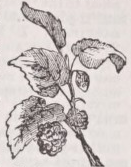
MULBERRY. The mulberry family (Moraceae) is usually included, along with the closely-allied figs, breadfruits, nettles, hops, planes, and elms, in one vast alliance of monochlamydeous Exogens, the order Urticaceae (or Ul- maceae, as Bâillon prefers to call it). The Moraceae include three sub-families, of which the typical genera are: Dorstenia, which is almost a Fig; Broussonetia, the Paper Mulberry of Japan, the East Indies, and the South Sea Islands; and Morus, the Mulberry proper, of which the ten or twelve species are all native to temperate regions in Asia and America, or to hill regions in their tropics, but are readily cultivated in similar climates in Europe, Africa, and Australia.
The Black Mulberry (Morus nigra, I..) is mainly cultivated for its purplish black compound fruit (a sorosis formed by the aggregated drupes of the whole female inflorescence), which is wholesome and palatable if eaten fresh from the tree before acetous fermentation has had time to set in. Save in syrup, and on account of its rich dark-red colouring matter, it has no longer any pharmaceutical uses. (See Horticulture, vol. xii. p. 272.)
The White Mulberry (Jf. alba, I..), so called from its nearly white fruit, is the one mainly employed in sericulture. There are many varieties, among which the Philippine Mulberry (var. multicaulis) is perhaps most highly esteemed. The American and Indian species (J∕. americana and 3f. indica, the latter not to be confounded with Morinda citrifolia, a cinchonaceous tree, sometimes also called Indian Mulberry) are also cultivated for the same purpose....
9th ed. Encyclopædia Britannica, vol. 17, p. 13
[305 words — estimated reading time: 2 minutes]
[305 words — estimated reading time: 2 minutes]
Mulberry
Watson's Biblical & Theological Dictionary
TREE, בכא, 2 Sam. v, 23, 24; 1 Chronicles xiv, 14, 15; Psalm lxxxiv, 7. The LXX, in Chronicles, render the word by ἀπίων, pear trees;” so Aquila and the Vulgate, both in Samuel and Chronicles, _pyrorum_.” Others translate it the mulberry tree.” More probably it is the large shrub which the Arabs still call baca;” and which gave name to the valley where it abounded. Of this valley Celsius remarks, that it was rugged and embarrassed with bushes and stones, which could not be passed through without labour and tears;” referring to Psalm lxxxiv, 7; and the rough valley,” Deut. xxi, 4; and he quotes from a manuscript of Abu'l Fideli a description of the tree which grew there, and mentions it as bearing a fruit of an acrid taste.
Watson's Biblical & Theological Dictionary
[131 words — estimated reading time: 1 minute]
[131 words — estimated reading time: 1 minute]
The tree which produces the mulberry.
No thesaurus entries found for "Mulberry".
King James Bible KJV Bible
Berean Standard Bible BSB Bible
4 KJV and 1 BSB verses contain “Mulberry”
And let it be, when thou hearest the sound of a going in the tops of the mulberry trees, that then thou shalt bestir thyself: for then shall the LORD go out before thee, to smite the host of the Philistines.
As soon as you hear the sound of marching in the tops of the balsam trees, move quickly, because this will mean that the LORD has marched out before you to strike the camp of the Philistines.”
Therefore David enquired again of God; and God said unto him, Go not up after them; turn away from them, and come upon them over against the mulberry trees.
So David again inquired of God, who answered him, “Do not march up after them, but circle around them and attack them in front of the balsam trees.
And it shall be, when thou shalt hear a sound of going in the tops of the mulberry trees, that then thou shalt go out to battle: for God is gone forth before thee to smite the host of the Philistines.
As soon as you hear the sound of marching in the tops of the balsam trees, move out to battle, because this will mean that God has marched out before you to strike the camp of the Philistines.”
And the Lord said, If ye had faith as a grain of mustard seed, ye might say unto this sycamine tree, Be thou plucked up by the root, and be thou planted in the sea; and it should obey you.
And the Lord answered, “If you have faith the size of a mustard seed, you can say to this mulberry tree, ‘Be uprooted and planted in the sea,’ and it will obey you.