
A wall. [Not used.]
Word of the Day: Catachrestical
1. To inclose in walls; to wall.
2. [But immure is chiefly used.]
1. A wall.
2. To inclose in walls; to wall; to immure; to shut up.
Mure
Encyclopedia Britannica
MURE, William (1799-1860), historian of Greek literature, was born at the family seat near Caldwell, Ayrshire, Scotland, 9th July 1799. He was educated at Westminster school and Edinburgh, and he spent several years at the university of Bonn, where he laid the foundations of his classical knowledge. From 1846 to 1855 he represented the county of Renfrew in parliament in the Conservative interest, and he was lord rector of Glasgow university in 1847-48. For many years he devoted his leisure to Greek studies, and in 1850-57 he published five volumes of a Critical History of the Language and Literature of Ancient Greece, which, however, he did not live to complete. While C. O. Miiller’s work, as translated and continued by Donaldson, is the best general history of Greek literature in English, Mure’s treatment of the Homeric poems, of the lyric poets, and of the historians of the Attic period is the fullest in our language, and is everywhere marked by thorough knowledge, at first hand, of the Greek authors. Of the unity of the authorship of the Iliad and Odyssey he is a strenuous defender, attributing both to the one person, Homer. Colonel Mure was for many years commandant of the Renfrewshire militia. He died at London on 1st April 1860.
His other works are— Remarks on the Chronology of the Egyptian Dynasties, 1829; Dissertation on the Calendar of the Zodiac of Ancient Egypt, Edinburgh, 1832; Journal of a Tour in Greece and the Ionian Islands in 1838, Edinburgh, 1842. He also edited the Caldwell Papers, 3 vols., for the Maitland Club.
9th ed. Encyclopædia Britannica, vol. 17, p. 53
[267 words — estimated reading time: 2 minutes]
[267 words — estimated reading time: 2 minutes]
One who had charge of the wall of a town, or its repairs.
Like or pertaining to the genus Muraena, or family Muraenidae.
Muret
Encyclopedia Britannica
MURET, or Muretus, Marc Antoine (1526-1585), French humanist, was born of respectable parentage at Muret near Limoges on 12th April 1526. Nothing is recorded of his early education, but at the age of eighteen he was already sufficiently accomplished to attract the notice of the elder Scaliger, and to be invited to prelect upon Cicero and Terence in the archiépiscopal college at Auch. He afterwards taught Latin at Villeneuve, and then at Bordeaux, where the youthful Montaigne was one of his pupils and played some of the principal parts in his Latin tragedies. Some time before 1552 he received a regency in the college of Cardinal Lemoine at Paris, and his brilliant lectures were largely attended, Henry II. and his queen being occasionally, it is recorded, among his hearers. His success seems to have excited more than the usual amount of envy; and in consequence of a disgraceful charge—which, however, was never established— he was thrown into prison. Here he had begun to carry out a resolution to starve himself to death, when the exertions of powerful friends procured his release. Hardly had he resumed lecturing at Toulouse when his career was again cut short by a new charge similar to that which had proved so disastrous at Paris; he saved his life by timely flight, but the records of the town bear that he was burned in effigy as a Huguenot and as shamefully immoral (1554). After a wandering and insecure life of some years in Italy, he received and accepted the invitation of the Cardinal d’Este to settle in Rome in 1559. Henceforward his life was one of unclouded prosperity. He was even able to revisit France in 1561 as a member of the cardinal’s suite at the colloquy of Poissy. The interest shown in his lectures on the Ethics of Aristotle, and on the Pandects, ...almost recalled his early successes in Paris, and in 1578 his services as a teacher of jurisprudence were sought by the “natio Germanorum” studying law at Padua, and also by the king of Poland for his new college at Cracow. Muretus, however, who about 1576 had taken holy orders, was induced by the liberality of the pope to remain in Rome, where he died on 4th June 1585.
The first collected edition of the works of Muretus appeared at Verona in 1727-1730 (5 vols. 8vo); a more complete edition was published by Ruhnken at Leyden in 1789 (4 vols. 8vo); there is also an edition by Frotscher and Koch (3 vols., Leipsic, 1834-41), and two volumes of Scripta selecta have been edited by Frey (Leipsic, 1871 - 73). He annotated wholly or partially, in a learned and scholarly way that has proved more or less serviceable to subsequent editors, Terence, Horace, Catullus, Tibullus, Propertius, Tacitus, Sallust, Cicero, Aristotle, Xenophon. His other works include Juvenilia et poemata varia, Orationes, and Epistolae. His merits as a stylist at one time secured for his Orationes a place among Latin school-books, but, although, according to his pupil Montaigne, he was recognized alike by France and Italy to be “the best orator of his time,” the modern judgment must rather be in substance that of a later critic, that, if he “appears to have had a more delicate ear than almost any of the moderns and his Latinity surpasses in elegance that of any of the Romans themselves, excepting Cicero and Caesar,” he at the same time was “conceited, fantastical, and weakly-minded” (Landor, Im. Conv., “Chesterfield and Chatham”).
9th ed. Encyclopædia Britannica, vol. 17, p. 54
[589 words — estimated reading time: 4 minutes]
[589 words — estimated reading time: 4 minutes]
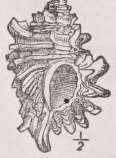
A genus of marine gastropods, having rough, and frequently spinose, shells, which are often highly colored inside; the rock shells. They abound in tropical seas.
A complex nitrogenous substance obtained from murexide, alloxantin, and other ureids, as a white, or yellowish, crystalline which turns red on exposure to the air; -- called also uramil, dialuramide, and formerly purpuric acid.
A complex nitrogenous compound obtained as a scarlet crystalline substance, and regarded as related to murexide.
No thesaurus entries found for "Mure".
No Bible verses found for "Mure".