
Word of the Day: Catachrestical
Perseus
Encyclopedia Britannica
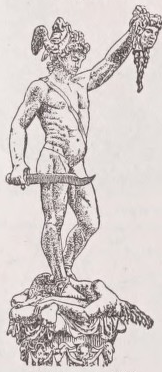
PERSEUS, a hero of Grecian fable, son of Danae {q.v.] and Zeus. When Perseus was grown to manhood Polydectes, the wicked king of Seriphus, cast his eye on Danae; and, that he might rid himself of the son, he exacted of him a promise that he would bring him the head of the Gorgon Medusa. Now the dreadful Gorgons {q.vf dwelt with their sisters the Graeae (the Gray Women) by the great ocean, far aAvay in the Avest. Guided by Hermes and Athene, Perseus came to the Graeae. They Avere three hags, with but one eye and one tooth between them, which they handed one to the other. Perseus stole the eye and tooth, and would not restore them till the Graeae had guided him to the Nymphs, from whom he received the winged sandals, the Avallet (κ∕∕3ισιs), and the cap of invisibility. These he put on, and, being armed by Hermes with a scimitar (αpτn∕), came upon the Gorgons as they slept and cut off Medusa’s head, while with averted eyes he looked at her image on his brazen shield lest he should be turned to stone. Perseus put the Gorgon’s head in his wallet and fled. Coming to Aethiopia he delivered and married Andromeda {q.vf). With her he returned to Seriphus in time to rescue his mother and Dictys from Polydectes, whom he turned to stone along with all his court by showing them the Gorgon’s head. The island itself Avas turned to stone, and was still and lonely ever after; the very frogs of Seriphus (so ran the proverb) were dumb. Perseus then gave the head of Medusa to Athene, Avho put it on her shield, and, with Danae and Andromeda, he hastened to Argos to see his grandfather, Acrisius,once more. But he, fearing the oracle, had gone to Larissa in Thessaly. Thither his grandson followed him, but at some games given by Teutamias, king of Larissa, he threw a quoit ...Avhich lighted on his grandfather’s foot and caused his death. Ashamed to return to Argos, Perseus gave his kingdom to Megapenthes, and received from him Tiryns in return. There he reigned and founded Midea and the famed Mycenae, and became the ancestor of the Persides, amongst whom Avere Eurystheus and Heracles.
The legend of Perseus was a favourite theme of Greek poetry and art. Sophocles and Euripides had each several dramas on the subject, and sculptor and painter vied with each other in depicting the rescue of Andromeda from the sea-monster. The story was localized in various places. Italy claimed that the ark with Danae and Perseus had drifted to the Latin coast (Servius on Virg., Aen., vii. 372, and viii. 345). The Persian kings were said to have sprung from a son of Perseus (Apollod., ii. 4, 5; Herod., vii. 61); and, according to Pausanias Damascenus, Perseus taught the Persians to Avorshιp fire, and founded the Magian priesthood. The tale of the rescue of Andromeda by Perseus from the sea-beast is akin to that of Heracles and Hesione. Both have been interpreted of the sun slaying the darkness, Andromeda or Hesione being the moon, Avhom the darkness is about to devour. According to one version Heracles rescued Hesione from the sea-beast by leaping into its mouth, from which he came forth after three days spent in the belly of the beast. This points to a connexion with the Semitic story of Jonah and the fish. Greek sculptures of Andromeda’s monster Avere the models for Jonah’s fish in early Christian art, and on a rock at Joppa they shθAved the chains which had bound Andromeda, and the bones of the sea-beast (Pliny, II. N., v. 13; Mela, i. 11). Tarsus in Cilicia was said to have been founded by Perseus, av!io appears on coins of the city, as well as on coins of Pontus and Cappadocia.
9th ed. Encyclopædia Britannica, vol. 18, p. 560
[659 words — estimated reading time: 4 minutes]
[659 words — estimated reading time: 4 minutes]
No thesaurus entries found for "Perseus".
King James Bible KJV Bible
Berean Standard Bible BSB Bible
1 KJV and 0 BSB verses contain “Perseus”
Beside this, how they had discomfited in battle Philip, and Perseus, king of the Citims, with others that lifted up themselves against them, and had overcome them: