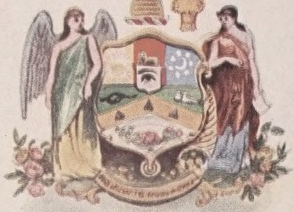
One of the descendants of Jonadab, the son of Rechab, all of whom by his injunction abstained from the use of intoxicating drinks and even from planting the vine. Jer. xxxv. 2-19. Also, in modern times, a member of a certain society of abstainers from alcoholic liquors.
RECHABITES or Sons of Rechab, in ancient Israel formed a sort of religious order in some respects analogous to the Nazarites, with whom they shared the rule of abstinence from wine. They went farther than the latter, however, in eschewing the luxuries and pursuits of settled life, living in tents and refusing to sow grain as well as to plant vineyards. Their origin must have been in northern Israel, for their “father” or founder, to whom they referred their rule of life, was that Jehonadab or Jonadab, son of Rechab, who lent his countenance to Jehu in the abolition of TyrianBaal-worship (2 Kings x.). The order founded by Jehonadab must from its constitution have soon become a sort of hereditary clan, and as such the “house of Rechab” appears in Jer. xxxv., from which we learn that they had survived in Judah after the fall of the northern kingdom and continued to observe the ordinance of Jehonadab till the approach of Nebuchadnezzar drove them for protection into Jerusalem. Jeremiah promised them as a reward of their obedience that they should never lack a man to represent them (as a priest) before Jehovah. This perhaps is the origin of the later Jewish tradition that the Rechabites intermarried with the Levites and so entered the temple service. Hegesippus in his account of the death of James the Just even speaks of Rechabite priests and makes one of them protest against the crime (Eus., II.fi., ii. 23).
9th ed. Encyclopædia Britannica, vol. 20, p. 309 [247 words — estimated reading time: 2 minutes]
The Rechabites, though they dwelt among the Israelites, did not belong to any of their tribes; for they were Kenites, as appears from 1 Chron. ii, 55, where the Kenites are said to have come of “Hemath, the father of the house of Rechab.” These Kenites, afterward styled Rechabites, were of the family of Jethro, otherwise called Hobab, whose daughter Moses married; for “the children of the Kenite, Moses’s father-in-law,” it is said, “went up out of the city of palm trees with the children of Judah, and dwelt among the people,” Judges i, 16; and we read of “Heber the Kenite, who was of the children of Hobab, the father-in-law of Moses, who had severed himself from the Kenites,” or from the bulk of them who settled in the tribe of Judah, “and pitched his tent in the plain of Zaanaim,” Judges iv, 11. They appear to have sprung from Midian, the son of Abraham by Keturah, Gen. xxv, 2; for Jethro, from whom they are descended, is called a Midianite, Num. x, 23. Of this family was Jehonadab, the son of Rechab, a man of eminent zeal for the pure worship of God against idolatry, who assisted King Jehu in destroying the house of Ahab, and the worshippers of Baal, 2 Kings x, 15, 16, 23, &c. It was he who gave that rule of life to his children and posterity which we read of in Jer. xxxv, 6, 7. It consisted of these three articles: that they should drink no wine; that they should neither possess nor occupy any houses, fields, or vineyards; that they should dwell in tents. This was the institution of the children of Rechab; and this they continued to observe for upward of three hundred years, from the time of Jehu to that of Jehoiakim, king of Judah, when Nebuchadnezzar coming to besiege Jerusalem, the Rechabites were obliged to leave the country and take refuge ...in the city. In Jer. xxxv, there is a promise made to this people, that Jonadab, the son of Rechab, should not want a man to stand before the Lord; that is, that his posterity should not fail: and to this day this tribe is found among the Arabians of the desert, distinct, free, and practising exactly the institutions of Jonadab, whose name they bear, and of whose institutions they boast. This is a remarkable instance of the exact fulfilment of a minute and isolated prophecy. See BENI KHAIBIR.
Go unto the house of the Rechabites, and speak unto them, and bring them into the house of the LORD, into one of the chambers, and give them wine to drink.
“Go to the house of the Rechabites, speak to them, and bring them to one of the chambers of the house of the LORD to offer them a drink of wine.”
And Jeremiah said unto the house of the Rechabites, Thus saith the LORD of hosts, the God of Israel; Because ye have obeyed the commandment of Jonadab your father, and kept all his precepts, and done according unto all that he hath commanded you:
Then Jeremiah said to the house of the Rechabites: “This is what the LORD of Hosts, the God of Israel, says: ‘Because you have obeyed the command of your forefather Jonadab and have kept all his commandments and have done all that he charged you to do,
This site uses cookies to remember your display preferences (search sources and editions, Bible version, auto-link, images, light/dark theme). No personal data whatsoever is collected. Privacy Policy