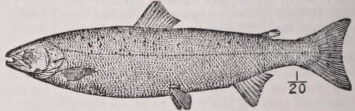
SALMONIDAE. The distinguishing features of this family of fishes are described in technical language in the article Ichthyology (vol. xii. p. 693), and it is unnecessary to repeat the definition. The most conspicuous of the external characteristics is the presence of two dorsal fins, of which the anterior is well developed and supported by the usual jointed bones known as fin-rays, while the posterior is thick and fleshy, rounded in outline, and destitute of rays. The posterior fin is thus a rudimentary organ, and it is commonly called the adipose fin. There are two other families of fishes which resemble the Salmonidae in the arrangement of the dorsal fins—the Percopsidae and Haplochitonidae; but the former consists of only one species, found in the United States, and the latter is confined to the southern hemisphere. Amongst British fishes a Salmonoid can be always recognized by its dorsal fins.
The Salmonidae retain the open communication of the air-bladder with the intestine, and the original posterior position of the pelvic fins,—features which characterize the division of Teleostei known as Physostomi. In the great assemblage of bony fishes known as Physoclisti, these features are lost in the adult condition. It is known that in all cases the air-bladder develops in the young fish as an outgrowth or diverticulum from the intestine; and it is obvious from a survey of Vertebrates in general that the posterior limbs belong originally to the neighbourhood of the anus. It follows therefore that in these features the Salmonidae, and all the Physostomi, are more similar to the early ancestors of the bony fishes than are those species in which the air-bladder is closed and the pelvic fins have an anterior position....
In the Salmonidae the characteristic Teleostean pseudobranchia is present. This organ is the diminished remnant of the series of gill-lamellae belonging to the posterior face of the hyoid arch, as the pseudobranchia in Elasmobranchs is the rudiment of the series of gill-lamellae belonging to the posterior face of the mandibular arch. The bones known as maxillae form portion of the boundary of the upper jaw in Salmonidae; in many fishes they are excluded from the jaw margin by the backward prolongation of the premaxillae. There are no scales on the head in this family, and there are no fleshy filaments or “barbels” in the neighbourhood of the mouth as there are in many bony fishes—for example, the Cod, in which a single short barbel is attached beneath the lower jaw. The pyloric appendages, caecal diverticula of the intestinal tube immediately behind the stomach, are nearly always present in considerable numbers. In the female Salmon the oviduct, the tube connecting the ovary with the exterior, is wanting; the eggs when ripe escape from the surface of the ovary into the abdominal cavity and pass thence to the exterior through a pair of apertures in the body wall situated one on each side of the anus; these apertures are the abdominal pores. In the male salmon there is a duct to the testis, and the semen is extruded through it in the usual way. Fertilization takes place outside the body, the spermatozoa and eggs uniting in the water.
Distribution.—Salmonidse are found both in the sea and in fresh water. Most of the marine species inhabit the deeper parts of the ocean. Many of the freshwater forms pass a portion of their lives in the littoral parts of the sea, ascending rivers when adult every year in order to deposit their spawn; that is to say, many species are anadromous. Some are confined entirely to fresh water. The Salmonidae are, with the exception of one species indigenous to New Zealand, peculiar to the temperate and arctic regions of the northern hemisphere. Fossils belonging to the family are found in strata of Mesozoic age. Osmerus occurs in the greensand of Ibbenbüren, and the schists of Glarus and Licata. Mallotus villosus, indistinguishable from the living Capelin, occurs abundantly in clay in Greenland, the geological age of the bed being unknown. Osmeroides acrognathus and Aulolepis are fossil genera occurring in the chalk near Lewes in Sussex, and were probably deep-sea Salmonoids. The introduction of certain species into new areas by human agency, which has been effected recently, and is still going on, will be described in another section.
Synopsis of Genera.
The following five genera include British species :—
1. Salmo, Artedi (Salmon and Trout). Scales small. Cleft of mouth wide; maxilla extending backward to below or behind the eye. Dentition well developed; conical teeth on the jaw bones, on the vomer and palatines, and on the tongue; none on the pterygoid bones. Anal fin short, with fourteen or fewer rays. Pyloric appendages numerous. Ova large. Dark transverse bands, known as “parr marks,” present on the sides of the body in the young stages of life.
2. Osmerus, Cuv. (Smelts). Scales of moderate size. Cleft of the mouth wide; maxilla long, extending to or nearly to the hind margin of the orbit. Dentition well developed; teeth on the maxilla and premaxilla smaller than those on the mandible; transverse series of teeth on the vomer, several of which are large and fang-like; a series of conical teeth along the palatine and pterygoid bones; strong fang-like teeth on the front of the tongue, several longitudinal series of smaller ones on its posterior part. Pyloric appendages short and few in number, Ova small.
3. Coregonus. Scales of moderate size. Cleft of mouth small; maxilla rather short, not extending back beyond the orbit. Teeth minute, or absent altogether. Anterior dorsal fin with few rays. Pyloric appendages numerous, Ova small.
4. Thymallus, Cuv. (Graylings). Similar to Coregonus, but having a long anterior dorsal with many rays. Small teeth on jaws, vomer, and palatine bones.
5. Argentina, Cuv. Scales rather large. Cleft of mouth small; maxilla not extending to below the orbit. Teeth wanting on jaws; minute teeth on the head of the vomer and fore part of the palatines; series of small curved teeth on each side of the tongue. Dorsal fin short, in advance of the pelvic. Pyloric appendages few or in moderate numbers, Ova small. The most conspicuous peculiarity of this genus is the flattening of the sides to plane surfaces bordered by keeled ridges, so that the transverse section of the fish is hexagonal.
The following eleven genera include no British species :—
6. Oncorhynchus, Suckley (Ann. Lyc. Nat. Hist., 1861). Similar to Salmo, except that the anal fin has more than fourteen rays.
7. Brachymystax, Gunther. Intermediate between Salmo and Coregonus.
8. Luciotrutta, Günther. Migratory trout from North America.
9. Plecoglossus, Schlegel. Body covered with very small scales. Cleft of mouth wide; maxilla long. Dentition feeble; premaxilla with few small conical teeth. Ends of mandibles separate at the chin, the mucous membrane between them forming folds and pouches. Tongue very small, with minute teeth.
10. Retropinna, Gill. Similar to Osmerus.
11 and 12. Hypomesus, Gill, and Thaleichthys, Girard, are allied genera.
13. Mallotus, Cuv. (Capelin). Scales minute, somewhat larger along the lateral line and along each side of the belly. In mature males those scales become elongate, lanceolate with projecting points. Cleft of mouth wide; maxilla very thin, lamelliform, extending to below middle of eye. Dentition very feeble; teeth in single series. Pyloric appendages very short, few. Ova small.
14. Salanx, Cuv. Body elongate, compressed, naked, or with small, exceedingly fine deciduous scales. Head elongate and much depressed, terminating in a long, flat, pointed snout. Cleft of mouth wide. Jaws and palatine bones with conical teeth, some of those on premaxilla and mandibles being enlarged; no teeth on vomer; tongue with single series of curved teeth. Anterior dorsal fin far behind ventral, in front of anal; adipose small. Pseudobranchiae well developed; air-bladder none. Alimentary canal quite straight; pyloric appendages none. Ova small. 15. Microstoma, Cuv. Body elongate, cylindrical, covered with large thin silvery scales. Cleft of mouth very small; premaxilla very small; maxillae very short and broad. Eye very large. Narrow series of very small teeth in the lower jaw and across the head of the vomer; no other teeth. Dorsal fin short, inserted behind the ventrals, but before the anal; adipose fin present in most young specimens, frequently absent in old ones. Pseudobranchiae well developed; air-bladder large. Pyloric appendages absent; mucous membrane of stomach with numerous large papillae. The genus is allied to Argentina.
16. Bathylagus, a genus of deep sea Salmonoids discovered by the “Challenger” in the Atlantic and Antarctic Oceans at depths of 1950 and 2040 fathoms.
Species.
1. Genus Salmo. The difficulty of defining and distinguishing the species of this genus is considerable, and much diversity of opinion on the subject exists among ichthyologists. Many of the species are extremely variable, so that some individuals of one resemble the more aberrant individuals of another; the species are seldom separated by conspicuous differences. The individuals of a given species vary considerably with age and sex, and also with habitat and external conditions. Many of the species are capable of breeding together and producing fertile offspring. The characters which are most constant, and on whose differences the distinction of species chiefly rests, are as follows :—(1) the form of the praeoperculum (the horizontal breadth of this bone at its lower portion is always small in the young, but in the adult it is greater in some species than in others; (2) width and strength of maxillary in adult); (3) size of teeth; (4) arrangement and permanence of vomerine teeth; (5) form of caudal fin; (6) pectoral fins; (7) size of scales; (8) number of vertebra; (9) number of pyloric appendages.
In all the species of Salmo there are teeth in the vomer. In the Salmons proper and in the Trouts there are, in the young, teeth both on the head and body of that bone, but in some species on the body only; some of the teeth on the body are deciduous, and are in most of the species shed at an early age. In the Charrs there are teeth on the head of the vomer but none on the body of the bone at any period of life, and none of the vomerine teeth are deciduous. The species of true Trout are confined to fresh water, and are not migratory. In accordance with these peculiarities some zoologists have divided the genus Salmo into three subgenera,— Salmo sensu restricto, Fario, and Salvelinus. But modern authorities retain only two subdivisions,—the subgenera Salmo, including migratory Salmon and non-migratory Trout, and Salvelinus, the Charrs.
A. Subgenus Salmo. —A vast number of species of Salmo have been described; in the Brit. Mus. Cat. Dr Gunther distinguishes fifty-two, of which seven are confined to the British Islands and four are found both in the British Islands and other parts of the world. Mr Day on the other hand considers that all the indigenous Salmon and Trout of the British Islands belong to two species, Salmo salar and Salmo trutta,—Salmo levenensis and Salmo fario being varieties of the latter; the rest of the described British species he considers as local varieties or subvarieties of these.
(1) Salmo salar, L. (the Salmon). B. 11-12; D. 14; A. 11; P. 14; V. 9; L. lat. 120; L. transverse 22-26 / 19-22 ; Vert. 59-60; Caec. pyl. 53-77. Attains to a length of 4 to 5 feet; female mature at a length of about 15 inches. Praoperculum with a distinct lower limb and with the angle rounded. Head of vomer subpentagonal, as long as broad, toothless; the body of the bone with single series of small teeth which are gradually lost from behind forwards so that older examples only have from one to four left Hind part of body elongate and covered with relatively large scales. Young with about eleven dusky transverse bars on the sides; half-grown and old specimens silvery, with small black spots in small number; spawning males with numerous large black and red spots, some of the red spots confluent into more or less extensive patches, especially on the belly. An anadromous species, inhabiting temperate Europe southwards to 43° N. lat.; not found in Mediterranean; in Asia and America southwards to 41° N. lat.
No varieties of Salmo salar are recognized in Europe, but in North America there occurs one Salmonoid which is considered by different authorities either as a variety or a sub-species, viz., Salmo salar, var. sebago, L. lat. 115. Body and dorsal and caudal fins with subquadrangular or subcircular black spots. Is non-migratory and occurs in some of the lakes of Maine and New York in the United States; these lakes have no communication with the sea. This form is called variously the Landlocked Salmon or the Schoodic Salmon.
The true Salmo salar on the American shore of the Atlantic is sometimes called the Penobscot Salmon.
(2) Salmo trutta, Fleming; Salmo eriox, Parnell (Fishes of Firth of Forth) (Sea-Trout, Salmon-Trout, Bull-Trout). B. 11; D. 13; A. 11; P. 15; V. 9; L. lat. 120; L. transverse; Vert. 59- 60; Caec. pyl. 49-61. Attains to a length of about 3 feet; female mature at a length of 10 to 12 inches. Head of vomer triangular, as broad as long, toothless, body of the bone with a longitudinal ridge armed with a single series of teeth, which are deciduous; generally only the two or three anterior ones found in examples of more than 20 inches in length. Silvery, sometimes immaculate, usually with more or less numerous X-shaped spots; spots on the head and dorsal fin round and readily disappearing. Young (parr) with nine or ten dusky cross bars; grilse with top of dorsal and pectoral and with hind margin of caudal black. A migratory species, occurring in the rivers falling into the Baltic and German Ocean; numerous in Scotland, less frequent in English and Irish rivers.
(3) Salmo cambricus, Donov. (Brit. Fishes) (the Sewen of Couch, Salmon Peal). B. 10-11; D. 14; A. 11-12; P. 16; V. 9; L. lat. 120-125; L. transverse 27 / 28-40 ; Vert. 59; Caec. pyl. 39-47. Attaining to a length of 3 feet; female mature at a length of from 12 to 13 inches. Praoperculum with a distinct lower limb, with the angle rounded and with the hind margin convex or undulated, subvertical. Head of vomer triangular, broader than long, toothless in adult examples, armed with a few teeth across its hinder margin in young ones; body of the bone with a sharp longitudinal ridge, in the sides of which the teeth are inserted, forming a single series, and alternately pointing to right and left. In pure-bred specimens these teeth are lost in the grilse state, so that only the two or three anterior remain in specimens more than 12 or 13 inches long. Fins of moderate length; caudal fin forked in parr stage, slightly emarginate in grilse, truncate in mature specimens. This species loses the parr marks very early, when only 5 to 6 inches long; it is then bright silvery. Greenish on the back, with few small round black spots on the head and sides. This coloration remains nearly unaltered during the further growth of the fish, but the spots become more irregular, indistinctly X-shaped. An anadromous species, occurring in rivers of Norway, Denmark, Wales, and Ireland. Mr Day {Fishes of Great Britain) considers this form as merely a variety of Salmo trutta.
(4) Salmo fario, L. (Trout). Dr Günther distinguishes two varieties :—
(a) Salmo fario gaimardi; Salmo gaimardi, Cuv. and Val.; Salmo trutta, Gaimard (Voy. Isl. and Groenl., Atl. Poiss., pl. 15, fig. A). D. 13-14; A. 11-12; P. 14; V. 9; L. lat. 120; L. transverse; Caec. pyl. 33-46; Vert. 59-60. Largest specimen observed, 15 inches; female mature at a length of 7 or 8 inches. Head of vomer triangular, small, broader than long; vomerine teeth in a double series sometimes disposed in a zigzag line, persistent throughout life. Sides with numerous round or X-shaped black spots; upper surface and sides of the head and the dorsal, adipose, and caudal fins usually with crowded round black spots; dorsal, anal, and ventral with a black and white outer edge. Found in Iceland, North Britain, Ireland, Scandinavia.
(b) Salmo fario ausonii; Salmo ausonii, Cuv. and Val. (the common River-Trout). Formula as in a, but Vert. 57-58. Attains to a length of 30 inches; female mature at a length of 8 inches. A non-migratory species, inhabiting numerous fresh waters of Central Europe, Sweden, and England, and rivers of the Maritime Alps.
The following forms are peculiar to the British Islands :—
(5) Salmo levenensis, Walker (Werm. Mem., i. p. 541) (Loch Leven Trout). D. 13; A. 11; P. 14; V. 9; L. lat. 118; L. transverse; Caec. pyl. 68-80; Vert. 59. Maximum length 21 inches. Teeth moderately strong; the head of the vomer triangular with a transverse series of two or three teeth across its base; the teeth of the body of the vomer form a single series and are persistent throughout life. Upper parts brownish or greenish olive; sides of the head with round black spots; sides of the body with X-shaped, sometimes rounded, brown spots. Dorsal and adipose fins with numerous small brown spots. A non-migratory species, inhabiting Loch Leven and other lakes of southern Scotland and northern England. This species is considered by Mr Day as a variety of S. trutta.
(6) S. brachypoma, Günther; S. eriox, Parnell {Fish. Firth of Forth). D. 13; A. 10-11; P. 14; V. 9; L. lat. 118-128; L. transverse 27 / 30 ; Caec. pyl. 45-47; Vert. 59. Praoperculum with scarcely a trace of lower limb. Teeth rather strong; those of the vomer in double series, but in zigzag line. Most of them are lost in specimens 17 inches long, only a few of the anterior remaining. Sides of the body with X-shaped or ocellated black spots, some red spots along and below’ the lateral line; dorsal fin with round black spots. Dorsal, anal, and ventral fins with a white and black outer margin in young examples. A migratory species, from the rivers Forth, Tweed, and Ouse. According to Mr Day, it is identical with the White Salmon of Pennant and Salmo albus of Cuv. and Val., all of them being considered by Day as a variety, S. albus, of Salmo trutta.
(7) S. gallivensis, Günther. An anadromous species from Galway, distinguished by the acutely pointed but not elongate snout, broad convex head, small eye, feeble teeth, feeble maxillary and mandible, and by extremely thin and short pyloric appendages, which are not longer than one inch nor thicker than a pigeon’s quill. According to Day a variety of S . fario.
(8) S. ferox, Jard. and Selby (Edinb. New Philos. Journal, 1835, xviii.). A non-migratory species inhabiting the large lochs of the north of Scotland and several lakes of the north of England, Wales, and Ireland. Praeoperculum crescent-shaped, the hinder and lower margins passing into each other without forming an angle. According to Day a variety of S. fario.
(9) S. orcadensis, Günther, from Loch Stennis in Orkney.
(10) S. stomachicus, Günther (the Gillaroo). From lakes of Ireland. Thick stomach. Feeds on shells (Limnaeus, Ancylus).
(11) S. nigripinnis, Günther. Non-migratory species inhabiting mountain pools of Wales, also Lough Melvin, Ireland.
Day mentions also the following varieties of S. fario:— S. cornubiensis, Walb., Artedi;
Swaledale trout, from Swaledale, Yorkshire; and
Crassapuill trout, from Loch Crassapuill, Sutherlandshire.
Many species of Salmo exist which are confined to limited areas in the continent of Europe. An account of these is given in the Brit. Mus. Catalogue, which also contains references to the literature. One of these, S. macrostigma, Duméril, is a non-migratory form occurring in Algeria, and is the southernmost species of the Old World. Three non-migratory species exist in the rivers belonging to the basin of the Adriatic. In the Alpine lakes of central Europe five species are known, which resemble in habits the forms found in British lakes, ascending the streams which feed the lakes, in order to spawn. Two of these species inhabit the Lake of Constance, one the Lake of Geneva. Fario argenteus, Cuv. and Val., found in the Atlantic rivers of France, is considered by Dr Günther a distinct species, by Mr Day as a synonym of S. trutta. One migratory species is known from the Eidfjord river in Norway; two land-locked species from Lake Wener in Sweden.
The species of Salmo belonging to the Pacific Coast of North America have been described by Richards in Faun. Bor. Amer., by Suckley in Nat. Hist. Washington Territory, and by Girard in Proc. Acad. Nat. Sc. Philad. Only one species need be mentioned here, and that on account of the importance it has acquired in connexion with the work of the United States Fish Commission :—
Salmo irideus, Gibbons (Proc. Cal. Ac. Nat. Sc., 1855, p. 36); Salar iridea, Girard (Proc. Acad. Nat. Sc. Philad., 1856, p. 220 and U. S. Pac. R. R. Explor.—Fish, p. 321, pl. 73, f. 5, and pl. 74) (the Californian, Mountain, or Rainbow Trout). B. 10;...