
A dangerous rock on the Italian coast opposite the whirpool Charybdis on the coast of Sicily, -- both personified in classical literature as ravenous monsters. The passage between them was formerly considered perilous; hence, the saying "Between Scylla and Charybdis," signifying a great peril on either hand.
Word of the Day: Catachrestical
Scylla
Encyclopedia Britannica
SCYLLA and CHARYBDIS. In Homer (Od., xii. 73 sq.) Scylla is a dreadful sea-monster, daughter of Crataeis, with six heads, twelve feet, and a voice like the yelp of a puppy. She dwelt in a sea-cave looking to the west, far up the face of a huge cliff. Out of her cave she stuck her heads, fishing for marine creatures and snatching the seamen out of passing ships. Within a bowshot of this cliff was another lower cliff with a great fig-tree growing on it. Under this second rock dwelt Charybdis, who thrice a day sucked in and thrice spouted out the sea water. Between these rocks Ulysses sailed, and Scylla snatched six men out of his ship. In later classical times Scylla and Charybdis were localized in the Strait of Messina,—Scylla on the Italian, Charybdis on the Sicilian side. In Ovid (Metam., xiv. 1-74) Scylla appears as a beautiful maiden beloved by the sea-god Glaucus and changed by the jealous Circe into a sea-monster; afterwards she was transformed into a rock shunned by seamen. There are various other versions of her story. According to a late legend (Servius on Virgil, Aen., iii. 420), Charybdis was a voracious woman who robbed Hercules of his cattle and was therefore cast into the sea by Jupiter, where she retained her old voracious nature. The well-known line
“Incidis in Scyllam cupiens vitare Charybdim” occurs in the Alexandreis of Philip Gualtier (a poet of the 13th century), which was printed at Lyons in 1558.
Another Scylla, confounded by Virgil (Ec., vi. 74 sq.) with the sea-monster, was a daughter of Nisus, king of Megara. When Megara was besieged by Minos, Scylla, who was in love with him, cut off her father’s purple lock, on which his life depended. But Minos drowned the undutiful daughter (Aeschylus, Choeph., 613 sq.; Apollodorus, iii. 15, 8).
9th ed. Encyclopædia Britannica, vol. 21, p. 574
[318 words — estimated reading time: 2 minutes]
[318 words — estimated reading time: 2 minutes]
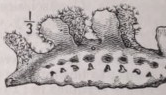
A genus of oceanic nudibranchiate mollusks having the small branched gills situated on the upper side of four fleshy lateral lobes, and on the median caudal crest.
No thesaurus entries found for "Scylla".
No Bible verses found for "Scylla".