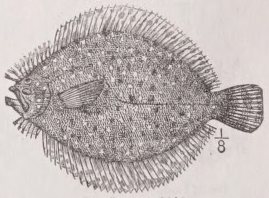
TURBOT, the largest and best known of a genus of flat fishes, Rhombus, which bears the appropriate systematic name of Rh. maximus. The turbot has great width of body, and is scaleless, but is covered with conical bony tubercles. The eyes are on the left side of the body, the lower being slightly in advance of the upper; the mouth is large and armed with teeth of uniformly minute size. The turbot is found all round the coasts of Europe (except in the extreme north), preferring a flat sandy bottom with from 10 to 50 fathoms of water. The broad banks off the Dutch coast are a favourite resort. It is a voracious fish, and feeds on other fish, crustaceans, and mollusks. It seems to constantly change its abode, wandering northward during the summer, and going into deeper water in the cold season. Some thirty years ago it was estimated that the Dutch supplied turbot to the London market to the value of <£80,000 a year. At present (1887) the value of turbot annually sold in London cannot be ascertained; but it must be several times that amount, and is principally earned by English line-fishermen and trawlers. Although the turbot abounds off the west coast of Ireland, the fishing is not carried on with the same energy and success as in the English Channel and German Ocean. The turbot is also common, though not abundant, in the Mediterranean, and is replaced in the Black Sea by an allied species with much larger bony tubercles (Rh. maeoticus). Both species grow to a large size, being usually sold at from 5 to 10 lb; but the common turbot is stated to attain to a weight of 30 lb. Both from its size and the excellent flavour of its flesh it ranks next after the codfish among British sea-fishes.
[309 words — estimated reading time: 2 minutes]