
A small bird, a species of Motacilla.
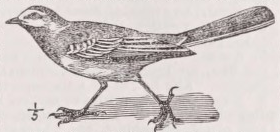
WAGTAIL(Wagsterd and Wagstyrt, 15th century, fide Th. Wright, Vol. Vocabularies, ii. pp. 221, 253; Uuagtale, Turner, 1544, p. 53), the little bird that delights us equally by its neat coloration, its slender form, its nimble actions, and its sprightly notes. Since it is so generally dispersed, especially in summer, throughout the British Islands, it seems to need no further description....
The Pied Wagtail of authors, it is the Motacilla lugubris of modern ornithology, or Μ. yarrelli of some writers, and has for its very near ally—if indeed it be not considered merely a local race or subspecies of—the Μ. alba of Linnaeus, which has a wide range in Europe, Asia, and Africa, visiting England almost yearly, and chiefly differing from the ordinary British form in its lightercoloured tints,—the cock especially having a clear grey instead of a black back. Eleven other more or less nearly-allied species are recognized by Mr Sharpe (Cat. B. Brit. Museum, x. pp. 456-496), who has laboriously treated the complicated synonymy of this group of birds. Eight of these are natives of Asia, several of them wintering in India, and one, Μ. ocularis, even occasionally reaching the west coast of North America, while the rest are confined to Africa. No colours but black, grey, or white enter into the plumage of any of the foregoing; but in the species peculiar to Madagascar, Μ. flaviventris, as well as in that which it much resembles, the so-called Grey Wagtail of Britain, Μ. melanope (Μ. boarula or sulphurea of some authors), a great part of the lower surface is yellow. The species last mentioned is one of the most graceful of birds, and though having a very wide range in the world at large is curiously local in its distribution in Britain, being almost wholly confined in the breeding-season to the neighbourhood of rocky streams in the west and north, and a line drawn from the Start Point, slightly curving to round the Derbyshire hills, and ending at the mouth of the Tees, will, it is believed, mark off its breeding-range in England. Then there is a section which by some systematists has been raised to the rank of a genus, Budytes, containing the Wagtails in which yellow takes a still more prominent part in their coloration. Of these, 8 species, besides several subspecies, are recognized by Mr Sharpe (ut supra, pp. 503-532). One of these is the common Yellow Wagtail of England, Μ. raii (by some mistakenly called Μ. campestris), which, though very generally distributed throughout the country, is much less numerous than the Pied Wagtail, and more addicted to wet meadows; but, just as Μ. lugubris is regarded by some as a local form of the more widely-ranging Μ. alba, so does Μ. raii hold the same relation to Μ. flaνa, the Blue-headed Wagtail, which has a very extensive distribution in the Old World, and even crosses the Pacific to Alaska, presenting also a great number of varieties or races (most of which are treated by Mr Sharpe as real species) differing from each other chiefly, if not solely, in the colour of the head, a character which in this section can hardly be deemed specific, while their geographical range intersects and inosculates in a most puzzling manner. Much credit is due to the author just named for the enormous trouble he has taken, after study of a vast series of specimens, to clear up the questions herein involved; but it will probably be long before ornithologists can agree on many of the disputed points, and it is certain that the last word has by no means been spoken concerning them.
The genus Motacilla (an exact rendering of the English “Wagtail,” the Dutch Kwikstaart, the Italian Codatremola and other similar words), which, as originally founded by Linnaeus, contained nearly all the “soft-billed” birds of early English ornithologists, was restricted by various authors in succession, following the example set by Scopoli in 1769, until none but the Wagtails remained in it. Most of the rest are now commonly classed as Sylviidae (cf. Warbler), while the Wagtails with the Pipits (q.v.) constitute the Family Motacillidae. (a. n.)