
A firm elastic substance taken from the upper jaw of the whale, used as a stiffening in stays, fans, screens, etc.
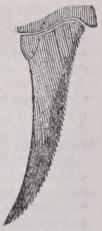
WHALEBONE is the inaccurate name under which the baleen plates of the right whale are popularly known; and the trade-name of whale-fin, which the substance receives in commerce, is equally misleading. Three kinds of whalebone are recognized by traders—the Greenland, yielded by the Greenland whale, Balaena mysticetus ; the South Sea, the produce of the Antarctic black whale, B. australis’, and the Pacific or American, which is obtained from B. japonica. Of these the Greenland whalebone is the most valuable. It formed the only staple known in earlier times, when the northern whale fishery was a great and productive industry. This whalebone usually comes into the market trimmed and clean, with the hairy fringe which edges the plates removed. To prepare whalebone for its economic applications, the blades or plates are boiled for about twelve hours, till the substance is quite soft, in which state it is cut either into narrow strips or into small bristle-like filaments, according to the use to which it is to be devoted....
Whalebone possesses a unique combination of properties which render it peculiarly and almost exclusively suitable for several purposes. It is light, flexible, tough, and fibrous, and its fibres run parallel to each other without intertwisting. It has been found practicable to employ flexible steel for several purposes to which whalebone was formerly applied, especially in the umbrella and corset industries, in which steel is now almost exclusively used. Whalebone is, however, still in large demand among dressmakers and milliners; but it is principally used in the brush trade. In cases where bristles are too soft and weak, and where the available vegetable fibres possess insufficient elasticity and durability, whalebone offers the great advantage of being procurable in strips or filaments, long or short, thick or thin, according to requirement. Hence it is principally used for making brushes for mechanical purposes, such as machines for road-sweeping, chimney-sweeping, boiler-flue cleaning, the cleaning of ships’ bottoms, and for stable use, &c. The use of whalebone in brush-making was originally patented by Samuel Crackles in 1808, and various special machines have been adapted for cutting the material into filaments. When whalebone came into the English market in the 17th century it cost at first about £700 per ton. In the 18th century its price ranged from £350 to £500 per ton, but early in the 19th century it fell as low as £25. Later it varied from £200 to £250; but with the decrease in whaling the article has become very scarce, and upwards of £1500 per ton is now paid for Greenland whalebone.